تاريخ الرياضيات

الاعداد و نظريتها
تاريخ التحليل
تار يخ الجبر
الهندسة و التبلوجي
الرياضيات في الحضارات المختلفة
العربية
اليونانية
البابلية
الصينية
المايا
المصرية
الهندية
الرياضيات المتقطعة
المنطق
اسس الرياضيات
فلسفة الرياضيات
مواضيع عامة في المنطق
الجبر
الجبر الخطي
الجبر المجرد
الجبر البولياني
مواضيع عامة في الجبر
الضبابية
نظرية المجموعات
نظرية الزمر
نظرية الحلقات والحقول
نظرية الاعداد
نظرية الفئات
حساب المتجهات
المتتاليات-المتسلسلات
المصفوفات و نظريتها
المثلثات
الهندسة
الهندسة المستوية
الهندسة غير المستوية
مواضيع عامة في الهندسة
التفاضل و التكامل
المعادلات التفاضلية و التكاملية
معادلات تفاضلية
معادلات تكاملية
مواضيع عامة في المعادلات
التحليل
التحليل العددي
التحليل العقدي
التحليل الدالي
مواضيع عامة في التحليل
التحليل الحقيقي
التبلوجيا
نظرية الالعاب
الاحتمالات و الاحصاء
نظرية التحكم
بحوث العمليات
نظرية الكم
الشفرات
الرياضيات التطبيقية
نظريات ومبرهنات
علماء الرياضيات
500AD
500-1499
1000to1499
1500to1599
1600to1649
1650to1699
1700to1749
1750to1779
1780to1799
1800to1819
1820to1829
1830to1839
1840to1849
1850to1859
1860to1864
1865to1869
1870to1874
1875to1879
1880to1884
1885to1889
1890to1894
1895to1899
1900to1904
1905to1909
1910to1914
1915to1919
1920to1924
1925to1929
1930to1939
1940to the present
علماء الرياضيات
الرياضيات في العلوم الاخرى
بحوث و اطاريح جامعية
هل تعلم
طرائق التدريس
الرياضيات العامة
نظرية البيان

Legendre Polynomial
 المؤلف:
Abramowitz, M. and Stegun, I. A.
المؤلف:
Abramowitz, M. and Stegun, I. A.
 المصدر:
"Legendre Functions" and "Orthogonal Polynomials." Ch. 22 in Chs. 8 and 22 in Handbook of Mathematical Functions with Formulas, Graphs, and Mathematical Tables, 9th printing. New York: Dover
المصدر:
"Legendre Functions" and "Orthogonal Polynomials." Ch. 22 in Chs. 8 and 22 in Handbook of Mathematical Functions with Formulas, Graphs, and Mathematical Tables, 9th printing. New York: Dover
 الجزء والصفحة:
...
الجزء والصفحة:
...
 6-8-2019
 6228
6228




+
-
20
Legendre Polynomial
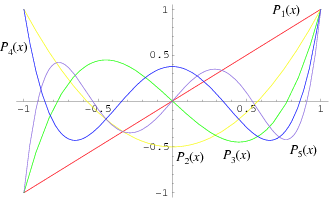
The Legendre polynomials, sometimes called Legendre functions of the first kind, Legendre coefficients, or zonal harmonics (Whittaker and Watson 1990, p. 302), are solutions to the Legendre differential equation. If  is an integer, they are polynomials. The Legendre polynomials
  are illustrated above for
 ![x in [-1,1]](http://mathworld.wolfram.com/images/equations/LegendrePolynomial/Inline3.gif) and
and  , 2, ..., 5. They are implemented in the Wolfram Language as LegendreP[n, x].
The associated Legendre polynomials  and
and  are solutions to the associated Legendre differential equation, where
  is a positive integer and
  , ...,
  .
.
The Legendre polynomial  can be defined by the contour integral
 |
(1) |
where the contour encloses the origin and is traversed in a counterclockwise direction (Arfken 1985, p. 416).
The first few Legendre polynomials are
 |
 |
 |
(2) |
 |
 |
 |
(3) |
 |
 |
 |
(4) |
 |
 |
 |
(5) |
 |
 |
 |
(6) |
 |
 |
 |
(7) |
 |
 |
 |
(8) |
When ordered from smallest to largest powers and with the denominators factored out, the triangle of nonzero coefficients is 1, 1,  , 3,
, 3,  , 5, 3,
  , ... (OEIS A008316). The leading denominators are 1, 1, 2, 2, 8, 8, 16, 16, 128, 128, 256, 256, ... (OEIS A060818).
The first few powers in terms of Legendre polynomials are
 |
 |
 |
(9) |
 |
 |
![1/3[P_0(x)+2P_2(x)]](http://mathworld.wolfram.com/images/equations/LegendrePolynomial/Inline40.gif) |
(10) |
 |
 |
![1/5[3P_1(x)+2P_3(x)]](http://mathworld.wolfram.com/images/equations/LegendrePolynomial/Inline43.gif) |
(11) |
 |
 |
![1/(35)[7P_0(x)+20P_2(x)+8P_4(x)]](http://mathworld.wolfram.com/images/equations/LegendrePolynomial/Inline46.gif) |
(12) |
 |
 |
![1/(63)[27P_1(x)+28P_3(x)+8P_5(x)]](http://mathworld.wolfram.com/images/equations/LegendrePolynomial/Inline49.gif) |
(13) |
 |
 |
![1/(231)[33P_0(x)+110P_2(x)+72P_4(x)+16P_6(x)]](http://mathworld.wolfram.com/images/equations/LegendrePolynomial/Inline52.gif) |
(14) |
(OEIS A008317 and A001790). A closed form for these is given by
 |
(15) |
(R. Schmied, pers. comm., Feb. 27, 2005). For Legendre polynomials and powers up to exponent 12, see Abramowitz and Stegun (1972, p. 798).
The Legendre polynomials can also be generated using Gram-Schmidt orthonormalization in the open interval  with the weighting function 1.
 |
 |
 |
(16) |
 |
 |
![[x-(int_(-1)^1xdx)/(int_(-1)^1dx)]·1](http://mathworld.wolfram.com/images/equations/LegendrePolynomial/Inline59.gif) |
(17) |
 |
 |
 |
(18) |
 |
 |
![x[x-(int_(-1)^1x^3dx)/(int_(-1)^1x^2dx)]-[(int_(-1)^1x^2dx)/(int_(-1)^1dx)]·1](http://mathworld.wolfram.com/images/equations/LegendrePolynomial/Inline65.gif) |
(19) |
 |
 |
 |
(20) |
 |
 |
-[(int_(-1)^1(x^2-1/3)^2dx)/(int_(-1)^1x^2dx)]x](http://mathworld.wolfram.com/images/equations/LegendrePolynomial/Inline71.gif) |
(21) |
 |
 |
 |
(22) |
Normalizing so that  gives the expected Legendre polynomials.
The "shifted" Legendre polynomials are a set of functions analogous to the Legendre polynomials, but defined on the interval (0, 1). They obey the orthogonality relationship
 |
(23) |
The first few are
 |
 |
 |
(24) |
 |
 |
 |
(25) |
 |
 |
 |
(26) |
 |
 |
 |
(27) |
The Legendre polynomials are orthogonal over  with weighting function 1 and satisfy
 |
(28) |
where  is the Kronecker delta.
The Legendre polynomials are a special case of the Gegenbauer polynomials with  , a special case of the Jacobi polynomials
  with
with  , and can be written as a hypergeometric function using Murphy's formula
 |
(29) |
(Bailey 1933; 1935, p. 101; Koekoek and Swarttouw 1998).
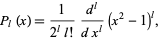
The Rodrigues representation provides the formula
 |
(30) |
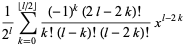
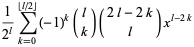
which yields upon expansion
 |
 |
 |
(31) |
 |
 |
 |
(32) |
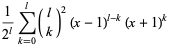
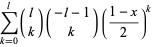
where  is the floor function. Additional sum formulas include
 |
 |
 |
(33) |
 |
 |
 |
(34) |
(Koepf 1998, p. 1). In terms of hypergeometric functions, these can be written
 |
 |
 |
(35) |
 |
 |
 |
(36) |
 |
 |
 |
(37) |
(Koepf 1998, p. 3).
A generating function for  is given by
 |
(38) |
Take  ,
,
 |
(39) |
Multiply (39) by  ,
,
 |
(40) |
and add (38) and (40),
![(1-2xt+t^2)^(-3/2)[(2xt-2t^2)+(1-2xt+t^2)]=sum_(n=0)^infty(2n+1)P_n(x)t^n](http://mathworld.wolfram.com/images/equations/LegendrePolynomial/NumberedEquation10.gif) |
(41) |
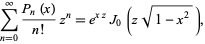
This expansion is useful in some physical problems, including expanding the Heyney-Greenstein phase function and computing the charge distribution on a sphere. Another generating function is given by
 |
(42) |
where  is a zeroth order Bessel function of the first kind (Koepf 1998, p. 2).
The Legendre polynomials satisfy the recurrence relation
 |
(43) |
(Koepf 1998, p. 2). In addition,
 |
(44) |
(correcting Hildebrand 1956, p. 324).
A complex generating function is
 |
(45) |
and the Schläfli integral is
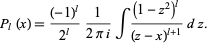 |
(46) |
Integrals over the interval ![[x,1]](http://mathworld.wolfram.com/images/equations/LegendrePolynomial/Inline119.gif) include the general formula
include the general formula
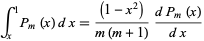 |
(47) |
for  (Byerly 1959, p. 172), from which the special case
 |
 |
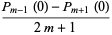 |
(48) |
 |
 |
(49) |
follows (OEIS A002596 and A046161; Byerly 1959, p. 172). For the integral over a product of Legendre functions,
 |
(50) |
for  (Byerly 1959, p. 172), which gives the special case
|
(51) |
where
 |
(52) |
(OEIS A078297 and A078298; Byerly 1959, p. 172). The latter is a special case of
 |
(53) |
where
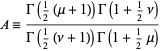 |
(54) |
and  is a gamma function (Gradshteyn and Ryzhik 2000, p. 762, eqn. 7.113.1)
Integrals over ![[-1,1]](http://mathworld.wolfram.com/images/equations/LegendrePolynomial/Inline129.gif) with weighting functions
with weighting functions  and
and  are given by
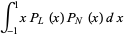 |
 |
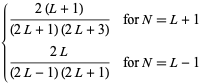 |
(55) |
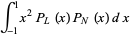 |
 |
 |
(56) |
(Arfken 1985, p. 700).
The Laplace transform is given by
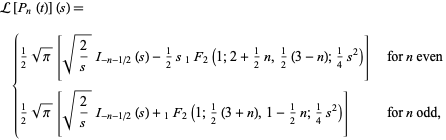 |
(57) |
where  is a modified Bessel function of the first kind.
A sum identity is given by
 |
(58) |
where  is the
  th root of
  (Szegö 1975, p. 348). A similar identity is
![sum_(nu=1)^n(1-x_nu^2)/((n+1)^2[P_(n+1)(x_nu)]^2)=1,](http://mathworld.wolfram.com/images/equations/LegendrePolynomial/NumberedEquation24.gif) |
(59) |
which is responsible for the fact that the sum of weights in Legendre-Gauss quadrature is always equal to 2.
REFERENCES:
Abramowitz, M. and Stegun, I. A. (Eds.). "Legendre Functions" and "Orthogonal Polynomials." Ch. 22 in Chs. 8 and 22 in Handbook of Mathematical Functions with Formulas, Graphs, and Mathematical Tables, 9th printing. New York: Dover, pp. 331-339 and 771-802, 1972.
Arfken, G. "Legendre Functions." Ch. 12 in Mathematical Methods for Physicists, 3rd ed. Orlando, FL: Academic Press, pp. 637-711, 1985.
Bailey, W. N. "On the Product of Two Legendre Polynomials." Proc. Cambridge Philos. Soc. 29, 173-177, 1933.
Bailey, W. N. Generalised Hypergeometric Series. Cambridge, England: Cambridge University Press, 1935.
Byerly, W. E. "Zonal Harmonics." Ch. 5 in An Elementary Treatise on Fourier's Series, and Spherical, Cylindrical, and Ellipsoidal Harmonics, with Applications to Problems in Mathematical Physics. New York: Dover, pp. 144-194, 1959.
Gradshteyn, I. S. and Ryzhik, I. M. Tables of Integrals, Series, and Products, 6th ed. San Diego, CA: Academic Press, 2000.
Hildebrand, F. B. Introduction to Numerical Analysis. New York: McGraw-Hill, 1956.
Iyanaga, S. and Kawada, Y. (Eds.). "Legendre Function" and "Associated Legendre Function." Appendix A, Tables 18.II and 18.III in Encyclopedic Dictionary of Mathematics. Cambridge, MA: MIT Press, pp. 1462-1468, 1980.
Koekoek, R. and Swarttouw, R. F. "Legendre / Spherical." §1.8.3 in The Askey-Scheme of Hypergeometric Orthogonal Polynomials and its  -Analogue. Delft, Netherlands: Technische Universiteit Delft, Faculty of Technical Mathematics and Informatics Report 98-17, p. 44, 1998.
Koepf, W. Hypergeometric Summation: An Algorithmic Approach to Summation and Special Function Identities. Braunschweig, Germany: Vieweg, 1998.
Lagrange, R. Polynomes et fonctions de Legendre. Paris: Gauthier-Villars, 1939.
Legendre, A. M. "Sur l'attraction des Sphéroides." Mém. Math. et Phys. présentés à l'Ac. r. des. sc. par divers savants 10, 1785.
Morse, P. M. and Feshbach, H. Methods of Theoretical Physics, Part I. New York: McGraw-Hill, pp. 593-597, 1953.
Press, W. H.; Flannery, B. P.; Teukolsky, S. A.; and Vetterling, W. T. Numerical Recipes in FORTRAN: The Art of Scientific Computing, 2nd ed. Cambridge, England: Cambridge University Press, p. 252, 1992.
Sansone, G. "Expansions in Series of Legendre Polynomials and Spherical Harmonics." Ch. 3 in Orthogonal Functions, rev. English ed. New York: Dover, pp. 169-294, 1991.
Sloane, N. J. A. Sequences A001790/M2508, A002596/M3768, A008316, A008317, A046161, A060818, A078297, and A078298 in "The On-Line Encyclopedia of Integer Sequences."
Snow, C. Hypergeometric and Legendre Functions with Applications to Integral Equations of Potential Theory. Washington, DC: U. S. Government Printing Office, 1952.
Spanier, J. and Oldham, K. B. "The Legendre Polynomials  " and "The Legendre Functions
  and
and  ." Chs. 21 and 59 in An Atlas of Functions. Washington, DC: Hemisphere, pp. 183-192 and 581-597, 1987.
Strutt, J. W. "On the Values of the Integral  ,
,  ,
,  being LaPlace's Coefficients of the orders
  ,
,  , with an Application to the Theory of Radiation." Philos. Trans. Roy. Soc. London 160, 579-590, 1870.
Szegö, G. Orthogonal Polynomials, 4th ed. Providence, RI: Amer. Math. Soc., 1975.
Whittaker, E. T. and Watson, G. N. A Course in Modern Analysis, 4th ed. Cambridge, England: Cambridge University Press, 1990.
 الاكثر قراءة في التفاضل و التكامل
 اخر الاخبار
اخبار العتبة العباسية المقدسة

الآخبار الصحية


مواضيع ذات صلة
 قسم الشؤون الفكرية يصدر كتاباً يوثق تاريخ السدانة في العتبة العباسية المقدسة
 "المهمة".. إصدار قصصي يوثّق القصص الفائزة في مسابقة فتوى الدفاع المقدسة للقصة القصيرة
 (نوافذ).. إصدار أدبي يوثق القصص الفائزة في مسابقة الإمام العسكري (عليه السلام)