Activities, achievements and accomplishments
It is now accepted practice to divide dynamic verbs into three classes. In fact, although people still talk of classes of verbs, it is clear that the relevant distinctions actually hold between whole clauses, so that strictly speaking it is not the verb but the verb plus its complements that is involved. To talk of classes of verbs is not without justification, however; as shown on the lexicon and on heads, verb phrases and clauses, verbs can be regarded as the heads of clauses and as controlling the types of structures allowed in particular clauses. In many languages, the different clause structures are signaled by differences in the shape of the verb. The three classes of dynamic verbs divide into two groups. The first is that of activity verbs, which denote situations that are seen as going on in the same kind of way over a period of time and as having no built-in boundary; they allow phrases such as for hours. Examples are in (6) and should be contrasted with (7).
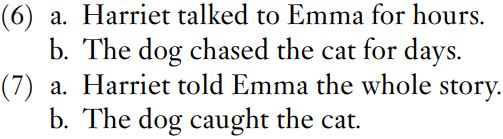
What do we mean by ‘built-in boundary’? We are not concerned with the fact that there are natural limitations on activities, that human beings run out of energy and concentration and become hungry and thirsty. The important point is that in the situation described by (7a) the event of telling a story comes to an end when the end of the story is reached. Harriet and Emma can go off to practise their drawing or Emma can tell the story again, but both count as new events. The situation described by (6a) has no built-in boundary; there is no point at which the event of talking comes to an end and a new event starts. The talking presumably ends when Harriet or Emma has had enough or they are interrupted, but the clause tells us nothing about that.
Similarly, the event described by (7b) comes to an end when the dog has trapped the cat; the event described by (6b) has no built-in boundary. The difference is brought out by the kinds of adverbs that can be added; (6a, b) allow adverbs such as for hours that accord with an activity being stretched out over time. They exclude adverbs such as in twenty minutes which relate to an event reaching its final boundary and being completed. In contrast, (7a, b) allow adverbs such as in twenty minutes but exclude adverbs such as for hours – Harriet told Emma the whole story in twenty minutes is fine, but the following examples are peculiar: *Harriet told Emma the whole story for twenty minutes and *Harriet talked to Emma in twenty minutes.
Example (7b) is an instance of an achievement verb. Achievements often have to do with the beginning or end of an event and are conceived of as having no duration. They might be described as being all boundary. Other achievement verbs are wink, knock, stab, as in Mrs Jennings winked at Eleanor.
The other class of verbs that have a built-in boundary are called accomplishments. They related to situations with two components, an activity phase and then a closing phase. Examples of accomplishment verbs/clauses are given in (8).

In the situations described by (8a, b), there is an activity phase in which the beaver collects materials, say, and builds the dam higher and higher, and an activity phase in which Anne plays the main body of the tune. These events are brought to a close by the beaver putting the final log or branch in place and Anne playing the final note. One difference between accomplishment and achievement verbs is worth pointing out. Both types can occur in the Progressive, but with different interpretations. The beaver was building the dam presents one event of building as ongoing; Mrs Jennings was winking at Eleanor is most straightforwardly taken as presenting not one event of winking but several events.
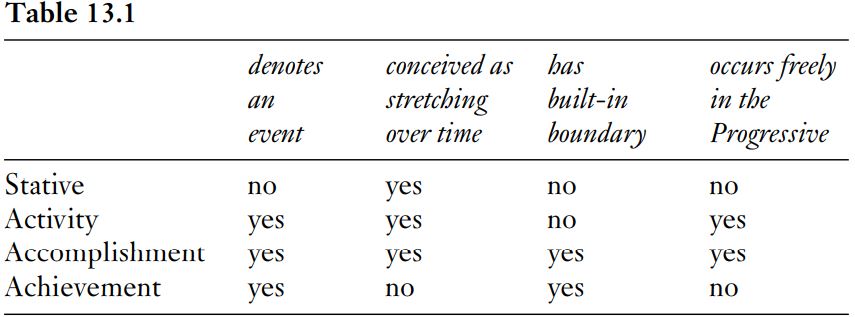
We can summaries the above discussion in the following paragraph and in Table 13.1. Stative verbs do not denote events. They denote states, which do not develop over time in different phases the way that events evolve but remain the same. In English, stative verbs are excluded from clauses answering the question What happened?, are excluded from WH clefts and occur rarely in the Progressive. Activity, accomplishment and achievement verbs all denote events. Activities denote events with no built-in boundary and stretching out over time. Achievements denote events conceived of as occupying no time at all. Accomplishments denote events with an activity phase and a closure phase; they can be spread out over time, but there is a built-in boundary. These differences in meaning are reflected in the different sorts of time adverb that can modify the different classes of verb and in the different interpretation of accomplishment and achievement verbs in the Progressive.