A Brief Survey of Kujamaat Jóola Syntax
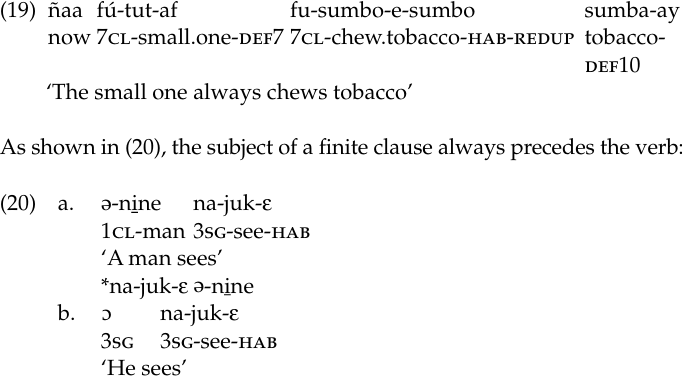
We have spent a great deal of space discussing Kujamaat Jóola morphology. It seems appropriate to conclude with a brief presentation of a few syntactic facts, ones that are related to its morphological analysis. We take as our starting point basic word order, which is SVO (Sapir 1965: 100; example from Hopkins 1990: 82–3):
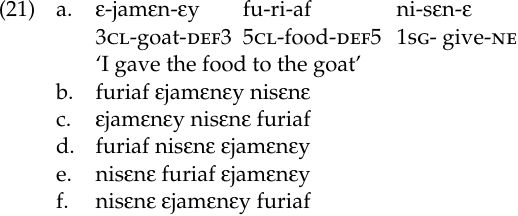
The order of verbal complements, however, is generally free. Any permutation of the sentence in (21a) is permitted, but they differ in what is emphasized:
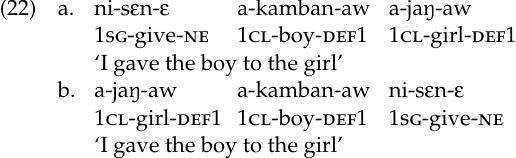
If there is ambiguity, speakers place the direct object closest to the verb. In the case of postverbal complements, the direct object directly follows the verb; in the case of preverbal complements, it directly precedes:
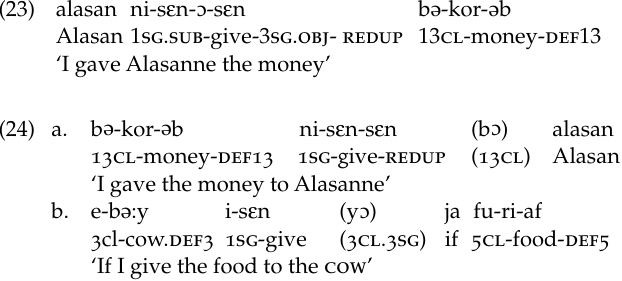
According to Sapir, if a verb is not marked for noun emphasis, a preverbal complement must be restated via a bound person marker or postverbal object pronoun. Restatement of the NP object with a pronoun, bound or freestanding, is obligatory if it is [+ human] (23). Non-human preverbal objects are preferably, but not obligatorily, restated (24):
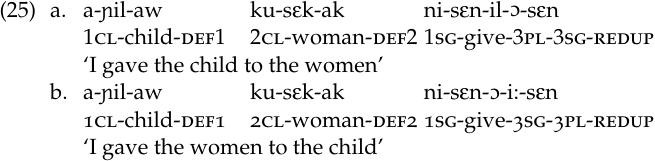
If both the direct and indirect object occur preverbally, both may be restated by bound pronominals. According to Sapir, only one is obligatorily restated, but he does not specify the indirect or direct object (25). The bound indirect object pronoun precedes the direct object pronoun:
If two [−human] objects precede the verb, one – preferably the indirect object – is restated:









