GRAMMATICAL UNITS AND RANK OF UNITS
The moving-around of bits of language, suggests, in Randolph Quirk’s famous simile, that language is not a series of words strung together like beads on a string. Language is patterned, that is, certain regularities can be distinguished throughout every linguistic manifestation in discourse. A unit will be defined as any sequence that constitutes a semantic whole and which has a recognized pattern that is repeated regularly in speech and writing. For instance, the previous sentence is a unit containing other units such as a recognized pattern and in speech and writing. Sequences such as defined as any and repeated regularly in, which also occur in the same sentence, do not constitute units since they have no semantic whole and no syntactic pattern. The following sequence, which comments on the effects of a nuclear accident, constitutes one syntactic unit which is composed of further units:
The effects of the accident are very serious.
In English, it is useful to recognize four structural units which can be arranged in a relationship of componence on what is called a rank-scale:
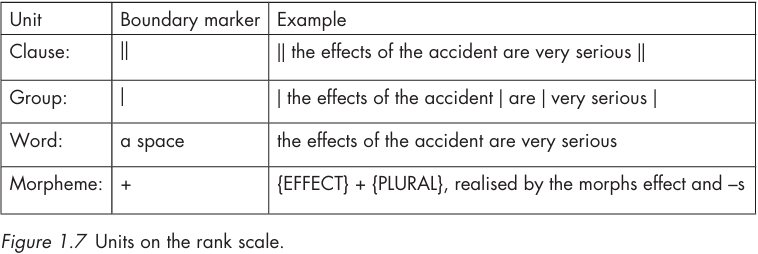
For the initial stages of analysis it may be helpful to mark off the boundaries of each unit by a symbol, such as those adopted in the example. The symbol for ‘clause boundary’ is a double vertical line ǀǀ, that for ‘group boundary’ is a single vertical line ǀ, and that for ‘word boundary’ is simply a space, as is conventionally used in the written language. The independent clause is the equivalent of the traditional ‘simple sentence’.
The relationship between the units is, in principle, as follows. Looking downwards, each unit consists of one or more units of the rank below it. Thus, a clause consists of one or more groups, a group consists of one or more words and a word consists of one or more morphemes. For instance, Wait! consists of one clause, which consists of one group, which consists of one word, which consists of one morpheme. More exactly, we shall say that the elements of structure of each unit are realized by units of the rank below.
Looking upwards, each unit fulfils a function in the unit above it. However, as we shall see later, units may be ‘embedded’ within other units, such as the clause who live in the north within the nominal group people who live in the north. Similarly, the prepositional phrase of the accident is embedded in the nominal group the effects of the accident.
We shall be concerned mainly with two units: clause and group. The structure and constituents of these units will be described later, together with their functions and meanings.








