Grammar
Tenses
Present

Present Simple
Present Continuous
Present Perfect
Present Perfect Continuous
Past
Past Simple
Past Continuous
Past Perfect
Past Perfect Continuous
Future
Future Simple
Future Continuous
Future Perfect
Future Perfect Continuous
Parts Of Speech
Nouns
Countable and uncountable nouns
Verbal nouns
Singular and Plural nouns
Proper nouns
Nouns gender
Nouns definition
Concrete nouns
Abstract nouns
Common nouns
Collective nouns
Definition Of Nouns
Animate and Inanimate nouns
Nouns
Verbs
Stative and dynamic verbs
Finite and nonfinite verbs
To be verbs
Transitive and intransitive verbs
Auxiliary verbs
Modal verbs
Regular and irregular verbs
Action verbs
Verbs
Adverbs
Relative adverbs
Interrogative adverbs
Adverbs of time
Adverbs of place
Adverbs of reason
Adverbs of quantity
Adverbs of manner
Adverbs of frequency
Adverbs of affirmation
Adverbs
Adjectives
Quantitative adjective
Proper adjective
Possessive adjective
Numeral adjective
Interrogative adjective
Distributive adjective
Descriptive adjective
Demonstrative adjective
Pronouns
Subject pronoun
Relative pronoun
Reflexive pronoun
Reciprocal pronoun
Possessive pronoun
Personal pronoun
Interrogative pronoun
Indefinite pronoun
Emphatic pronoun
Distributive pronoun
Demonstrative pronoun
Pronouns
Pre Position
Preposition by function
Time preposition
Reason preposition
Possession preposition
Place preposition
Phrases preposition
Origin preposition
Measure preposition
Direction preposition
Contrast preposition
Agent preposition
Preposition by construction
Simple preposition
Phrase preposition
Double preposition
Compound preposition
prepositions
Conjunctions
Subordinating conjunction
Correlative conjunction
Coordinating conjunction
Conjunctive adverbs
conjunctions
Interjections
Express calling interjection
Phrases
Sentences
Clauses
Part of Speech
Grammar Rules
Passive and Active
Preference
Requests and offers
wishes
Be used to
Some and any
Could have done
Describing people
Giving advices
Possession
Comparative and superlative
Giving Reason
Making Suggestions
Apologizing
Forming questions
Since and for
Directions
Obligation
Adverbials
invitation
Articles
Imaginary condition
Zero conditional
First conditional
Second conditional
Third conditional
Reported speech
Demonstratives
Determiners
Direct and Indirect speech
Linguistics
Phonetics
Phonology
Linguistics fields
Syntax
Morphology
Semantics
pragmatics
History
Writing
Grammar
Phonetics and Phonology
Semiotics
Reading Comprehension
Elementary
Intermediate
Advanced
Teaching Methods
Teaching Strategies
Assessment

The noun channel
 المؤلف:
Bernd Heine and Tania Kuteva
المؤلف:
Bernd Heine and Tania Kuteva
 المصدر:
The Genesis of Grammar
المصدر:
The Genesis of Grammar
 الجزء والصفحة:
P245-C5
الجزء والصفحة:
P245-C5
 2026-03-18
 14
14




+
-
20
The noun channel
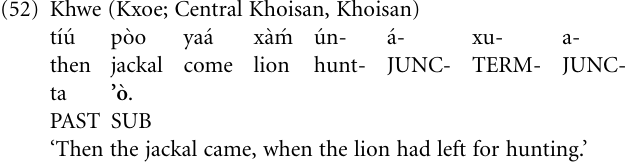
In a way similar to that for complementizers, general locative and temporal nouns such as ‘place’, ‘interior’, ‘time’ provide a common source for adverbial subordinators. In the Namibian language Khwe (Kxoe), o̒o̒ is a noun meaning ‘inside, place’ which appears to have been grammaticalized to a locative postposition ˡo ‘at’ and to a clause-final subordinator (SUB) of temporal, causal, and modal clauses, for example:
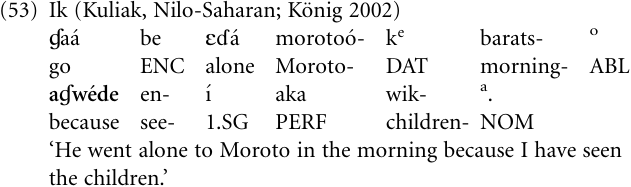
In the Ugandan language Ik, the form aɠwe̒de is composed of the relational noun aɠwa ‘inside’ plus the third person possessive suffix -e̒de, hence its lexical meaning is ‘its inside’, while its grammaticalized function is that of a reason conjunction ‘because’, introducing reason clauses which obligatorily follow the main clause, cf. (53).
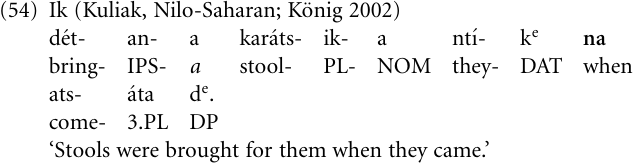
We observed above (“The noun channel”) that the Ik noun na ‘place’ was grammaticalized to a locative complementizer, na ‘where’, which has retained a number of nominal properties: Like its lexical source, it has a locative function, takes the relative clause marker na, even if the use of this marker is optional, and it is case-inflected. As an adverbial clause conjunction it is more strongly grammaticalized: Having either a temporal or conditional function, it has lost the ability to take a relative clause marker and to be inflected for case, cf. (54). Like the complementizer, it can follow or precede the main clause.
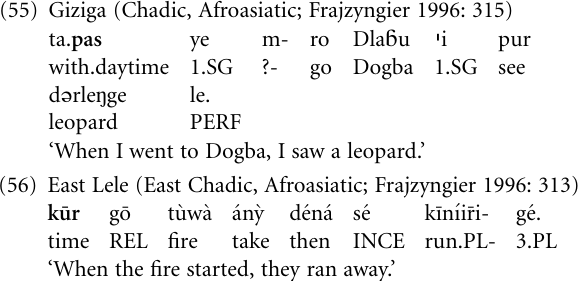
Temporal subordinate clauses are frequently formed via the grammaticalization of nouns for ‘time’. For example, the subordinator most commonly used to explicitly signal a temporal relationship between clauses both in Classical Newari and the Kathmandu dialect of Newari is belas (in the modern dialect bale), which is formed from a noun meaning ‘time’ (Genetti 1991: 235). Much the same observation has been made in other languages. In his detailed study of Chadic languages, Frajzyngier (1996: 313) observes: ‘‘A source for ‘when’ expressions in Chadic that [is] one of the easiest to identify is the word for ‘time’.’’ This grammaticalization involves either a bare noun for ‘time’ or ‘place’, or the noun plus an adposition (55), or a relative clause marker (56).
Nouns for ‘thing’, ‘matter’ provide a common source for complementizers, as we saw in “The noun channel”, but they may also grammaticalize into adverbial clause subordinators. In the Mande language Susu, the noun fe ‘matter’, ‘affair’ appears to have given rise to a de-verbal nominalizer and to the purpose clause subordinator-fe, or-fera (-ra = multi-purpose particle) purpose marker, for example:

We have been looking at a range of different clause types and nominal sources for adverbial clauses. In concluding, one may mention an example that is unusual with reference to both the lexical source and the grammaticalization channel employed, but which demonstrates the flexibility of the channel from noun to clause subordinator. This example concerns the Chadic language Lele (Frajzyngier 1996: 81–3), and the nominal source is the noun a̒là ‘God’ (borrowed from Arabic Allah ‘God’), which appears to have given rise to a marker of adversative clauses (‘but’), as illustrated in (58). The reason for adding this example of the noun-to-subordinator channel is that it illustrates the range of cognitive processes that are at work in the rise of clause subordination.

Frajzyngier (1996: 83) reconstructs the following process of grammaticalization: The noun a̒là ‘God’ came to serve as an exclamation marker of surprise, and from there as a marker of an unexpected proposition, cf. (59). In certain contexts, the marker was reinterpreted as an adversative conjunction, as in (58). Such contexts involved situations where in a sequence of two clauses the second clause was interpreted as the unexpected consequence or outcome of the first clause.
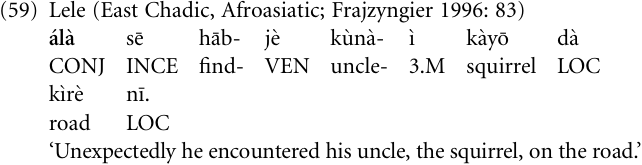
A crosslinguistically salient grammaticalization process concerns the evolution from noun (or noun phrase) to adposition and further to clause subordinator. Accordingly, a number of instances of the process discussed in this section have an intermediate adposition stage.
There is substantial diachronic evidence to show that there is a unidirectional process from noun structure to adverbial clause subordinator. The German conjunction weil ‘because’ is historically derived from the Old High German noun phrase al di wila ‘all the while’ followed by any of the conjunctional elements so, do, or daz. The phrase was first desemanticized to a temporal and later to a cause/reason subordinator. In addition to decategorialization of the erstwhile noun phrase, the process also involved erosion, in that the phrase al di wila + so/do/daz was first shortened to die ŵile and eventually to the form weil of Modern High German.
A similar process from temporal noun to clause subordinator is provided by English while, cognate to the German conjunction weil ‘because’ but being a temporal and concessive rather than a causal conjunction. While originated in Old English in an adverbial phrase þa hwile þe ‘that time that’, consisting of the dative distal demonstrative, the dative noun hwile ‘time’, and the relativizer þe.1
Evidence for a development from noun to adverbial clause conjunction can also be found in signed languages. In German Sign Language (DGS), the noun sign REASON has given rise to a reason subordinator, as in the following example; unlike the noun REASON, the grammaticalized sign REASON shows erosion in that it is linked with the following subordinate clause without any prosodic break:

To conclude, there is clear evidence that adverbial subordinators may go back to noun phrases or adverbial phrases having a noun as their semantic nucleus. This is a unidirectional diachronic process; we are not aware of any clear cases where adverbial subordinate clauses developed into noun phrases or adverbial phrases. And it involved all mechanisms of grammaticalization: The erstwhile noun was exposed to some contexts where the nominal meaning no longer made sense (extension), desemanticization had the effect that the nominal meaning was lost, and a poly-morphemic and poly-syllabic phrase was reduced to an invariable monosyllabic marker (erosion).2
1 The phrase had a number of variants:, ðe hwile ðe, þa hwile þe, þa hwile þa, þa hwila þe, a hwile ðæ, ðe hwile ðæt, etc. There are differences in detail of interpretation; in other accounts, hwile was not a dative but an accusative form.
2 By Late Old English the noun phrase þa hwile þe was already decategorialized and eroded to the simple conjunction wile (Traugott and König 1991: 200–1).
 الاكثر قراءة في Nouns
 اخر الاخبار
اخبار العتبة العباسية المقدسة

الآخبار الصحية


 قسم الشؤون الفكرية يصدر كتاباً يوثق تاريخ السدانة في العتبة العباسية المقدسة
 "المهمة".. إصدار قصصي يوثّق القصص الفائزة في مسابقة فتوى الدفاع المقدسة للقصة القصيرة
 (نوافذ).. إصدار أدبي يوثق القصص الفائزة في مسابقة الإمام العسكري (عليه السلام)