Grammar
Tenses
Present

Present Simple
Present Continuous
Present Perfect
Present Perfect Continuous
Past
Past Simple
Past Continuous
Past Perfect
Past Perfect Continuous
Future
Future Simple
Future Continuous
Future Perfect
Future Perfect Continuous
Parts Of Speech
Nouns
Countable and uncountable nouns
Verbal nouns
Singular and Plural nouns
Proper nouns
Nouns gender
Nouns definition
Concrete nouns
Abstract nouns
Common nouns
Collective nouns
Definition Of Nouns
Animate and Inanimate nouns
Nouns
Verbs
Stative and dynamic verbs
Finite and nonfinite verbs
To be verbs
Transitive and intransitive verbs
Auxiliary verbs
Modal verbs
Regular and irregular verbs
Action verbs
Verbs
Adverbs
Relative adverbs
Interrogative adverbs
Adverbs of time
Adverbs of place
Adverbs of reason
Adverbs of quantity
Adverbs of manner
Adverbs of frequency
Adverbs of affirmation
Adverbs
Adjectives
Quantitative adjective
Proper adjective
Possessive adjective
Numeral adjective
Interrogative adjective
Distributive adjective
Descriptive adjective
Demonstrative adjective
Pronouns
Subject pronoun
Relative pronoun
Reflexive pronoun
Reciprocal pronoun
Possessive pronoun
Personal pronoun
Interrogative pronoun
Indefinite pronoun
Emphatic pronoun
Distributive pronoun
Demonstrative pronoun
Pronouns
Pre Position
Preposition by function
Time preposition
Reason preposition
Possession preposition
Place preposition
Phrases preposition
Origin preposition
Measure preposition
Direction preposition
Contrast preposition
Agent preposition
Preposition by construction
Simple preposition
Phrase preposition
Double preposition
Compound preposition
prepositions
Conjunctions
Subordinating conjunction
Correlative conjunction
Coordinating conjunction
Conjunctive adverbs
conjunctions
Interjections
Express calling interjection
Phrases
Sentences
Clauses
Part of Speech
Grammar Rules
Passive and Active
Preference
Requests and offers
wishes
Be used to
Some and any
Could have done
Describing people
Giving advices
Possession
Comparative and superlative
Giving Reason
Making Suggestions
Apologizing
Forming questions
Since and for
Directions
Obligation
Adverbials
invitation
Articles
Imaginary condition
Zero conditional
First conditional
Second conditional
Third conditional
Reported speech
Demonstratives
Determiners
Direct and Indirect speech
Linguistics
Phonetics
Phonology
Linguistics fields
Syntax
Morphology
Semantics
pragmatics
History
Writing
Grammar
Phonetics and Phonology
Semiotics
Reading Comprehension
Elementary
Intermediate
Advanced
Teaching Methods
Teaching Strategies
Assessment

The noun channel
 المؤلف:
Bernd Heine and Tania Kuteva
المؤلف:
Bernd Heine and Tania Kuteva
 المصدر:
The Genesis of Grammar
المصدر:
The Genesis of Grammar
 الجزء والصفحة:
P230-C5
الجزء والصفحة:
P230-C5
 2026-03-17
 32
32




+
-
20
The noun channel
One major source for complementizers consists of some generic noun (N) having argument status in the main clause and at the same time forming the head noun of a relative clause. The grammaticalization process involved changes structure (27a) into one like (27b), whereby the noun (N) plus the relative clause marker (REL) jointly give rise to a complementizer and the relative clause turns into a complement, or free relative1 clause (the English examples are meant to illustrate the nature of the process concerned).

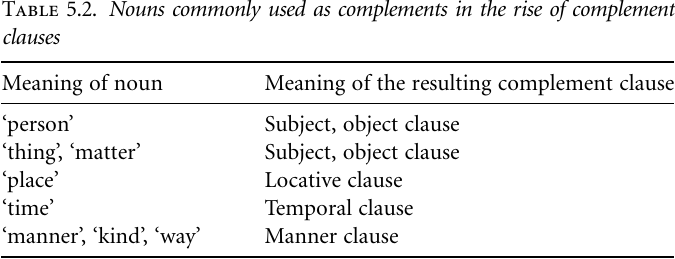
Nouns serving as complements normally have a generic meaning, standing for ontological categories such as PERSON, THING, PLACE, TIME, or MANNER; Table 5.2 lists the kinds of nouns most commonly used cross linguistically. There is some variation in the way this process affects the structure of the emerging complementizer. The following are the most common developments:
(28) The structure of noun-REL derived complementizers
a. The noun and the relative clause marker merge into a complementizer (merger)
b. The relative clause marker is lost (REL-loss)
c. The noun stem is lost (N-loss)
This process differs from the other processes in one fundamental way: It implies that there is already clause subordination, and that one type of subordination (relativization involving generic nouns as heads) is ‘‘exapted’’ for another type (complementation).
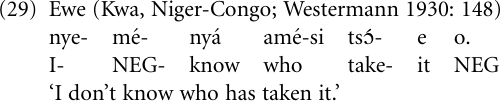
The Ewe language illustrates the use of merger (29): ame̒-si (person-REL) ‘who(m)’, nu̒-si (thing-REL) ‘what’, afı̒-si (place-REL) ‘where’, Ɣe-si-Ɣi (time-REL) ‘when’, for example:
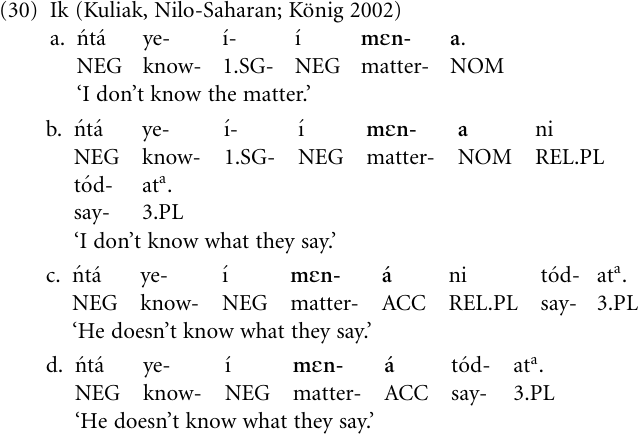
The rise of new complementizers can be demonstrated with the following examples from Ik, a language of northeastern Uganda having verb-initial (VSO) basic word order and an elaborate case system distinguishing seven case categories. What makes Ik an interesting case for our purposes is that it exhibits a typologically unusual property: It has an extremely conservative case system which is retained even if a noun is grammaticalized into some other word category. The result is that in this language there are case-marked adverbs, adpositions, adverbial conjunctions, and complementizers (König 2002). This fact allows us to reconstruct a situation where all the items that are inflected for case are historically derived from nouns. For example, mεna is a plural noun meaning ‘matter’, taking plural agreement. Sentence (30a) illustrates its nominal and (30b) its complementizer use, where mεna is followed by a complement clause. Note that the object noun is inflected in the nominative case (NOM): There is a rule in Ik according to which objects are coded in the nominative when the subject has first- or second-person reference. Consequently, the object appears in the accusative in (30c) since the subject has third-person reference. One might argue that mεna is not a complementizer but a noun in all these sentences. But this analysis would raise a problem: When a noun is followed by a clause, that clause must be introduced by the relative clause marker na, plural ni. This is in fact the case in (30b) and (30c); however, the relative marker can be omitted (optional REL-loss) whenever mεna functions as a complementizer, as in (30d), but never when it is used as a noun. In other words, mεna has the function of a complementizer but, with one exception, the morphosyntax of a noun.
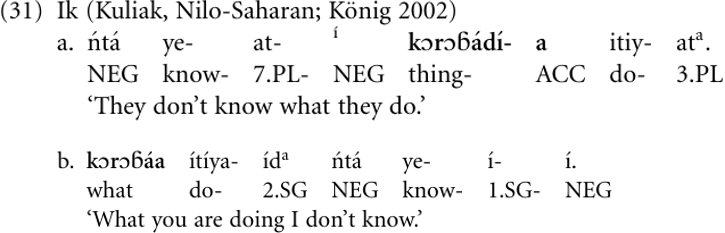
The items kɔrɔa̒a ‘thing’ and na ‘place’ behave exactly like mεna: They are nouns but at the same time also complementizers, as can be seen in (31a). But there is one difference: Unlike mεna, they can occur sentence initially when functioning as complementizers, and in this position they are not inflected for case, cf. (31b).
These properties are shared by the remaining items tʊmεda na and to̒imεn, with one exception: The latter have no more nominal meaning, that is, they are exclusively complementizers. But they are still inflected for case. Thus, the verb en- ‘see’ in (32a) requires a complement in the accusative (ACC), whereas the verb Itεt- ‘reach, notice’ in (32b) must have a complement in the dative case (DAT).
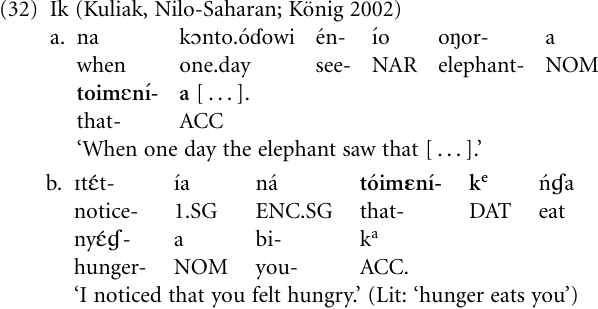
We observed above that the relative clause marker na (in the case of mεna it is the plural marker ni) is used optionally with mεna, kɔrɔɓa̒a, and na, that is, it can be used or omitted with no difference in meaning. In this respect, tʊ̒mεda na and to̒imεn show a different behavior: With the former, na is obligatory, it has become a frozen part of the complementizer (merger), while to̒imεn cannot take na, that is, the relativizer has been lost (REL-loss).
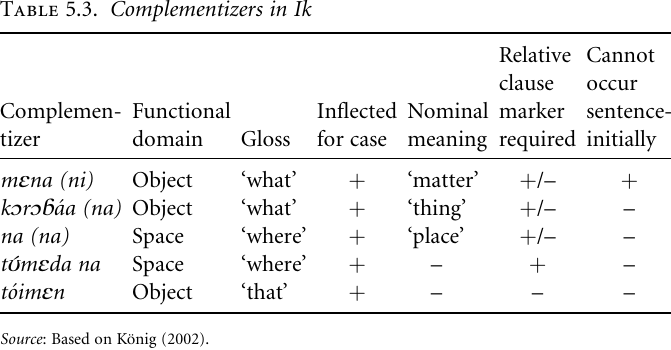
Table 5.3 provides a list of the five complementizers and some of their properties. On the one hand, the situation of these complementizers is typologically unusual; it is probably hard to find other languages where functional items such as clause subordinators consistently take case inflections. On the other hand, it illustrates in a nutshell the evolution of one salient type of complementizers, namely that derived from nouns, which allows for the following generalizations:
(a) There are nouns (or noun phrases) pressed into service as functional categories to code complement clauses (or headless relative clauses).
(b) In this process the nouns are desemanticized, losing their lexical meaning, and decategorialized, losing most of their nominal properties, such as the ability to take plural markers or modifiers.
(c) However, they tend to retain some properties bearing witness to their lexical origin. In the present case, such properties include the ability to be case-inflected, and the optional use (in the case of tʊmεda na the obligatory use) of the relative clause marker.
(d) As a result of the process from noun to complementizer, nominal properties are extended to also become properties of subordinate clauses. For example, case inflections are crosslinguistically a characteristic of nouns (in some languages also of noun phrases), but in Ik they have become part of clause subordination as well (see König 2002 for details).
(e) Clause subordinators in a given language are frequently not a homogeneous class, some are more strongly grammaticalized, others less so. Thus, Table 5.3 suggests that the Ik complementizers can be arranged along a cline of grammaticalization: At one end there is mεna, which largely still behaves like a noun, and many of its uses can be interpreted with reference to its nominal meaning. At the other end there is to̒imεn, which has lost most of its associations with nouns, having no function other than introducing complement clauses.
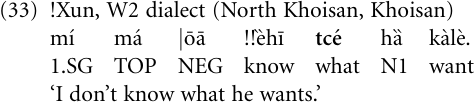
As a result of decategorialization and erosion, complementizers tend to become increasingly dissimilar from their lexical sources, losing both nominal properties and phonetic substance. The following example (33) from the !Xun language of southwestern Africa illustrates the grammaticalized output of the process: The complementizer tce̒ is the compressed version of a noun phrase, consisting diachronically of the noun tcı̒ ‘thing’ and the relative clause marker-è, hence tcı̒-è > tce̒. Thus, (33) means historically ‘I don’t know the thing that he wants’.
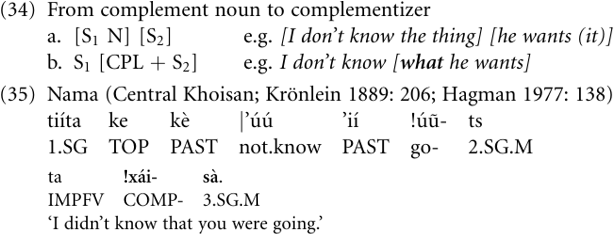
Conceivably, some languages have experienced a process straight from relative marker to complementizer (Lehmann 1995: 1213–14; Heine and Kuteva 2002a). For example, the relative marker xa= of the Oto-Manguean language Chalcatongo Mixtec is said to have given rise to a complementizer (Macaulay 1996: 153, 160), and the same is claimed for the Thai relative marker thı̂i (Bisang 1998: 780) and the relative pronoun she/ asher of Early Biblical Hebrew (Cristofaro 1998: 64–5). Note, however, that—as pointed out already in Heine and Kuteva (2002a: 254)—more research is needed on the structure, and the genetic and areal distribution of this development. In other languages again there is no evidence of relativization; the following examples suggest that the complement clause is added to the complement noun without any formal marking. The result is that the complement noun is grammaticalized to a complementizing pronoun; thus, instead of (27) we have (34).2 The following examples, both involving verb-final languages, illustrate this channel; note that in these languages the modifier precedes its head. In the Namibian Khoisan language Nama, the noun !xa̒i-s (!xa̒i-sà oblique case) ‘matter, story’ has given rise to the object clause complementizing pronoun !xa̒i-’è, !xa̒i-sà ‘that’, ‘whether’, and, as such, is still inflected like a noun, cf. (35).
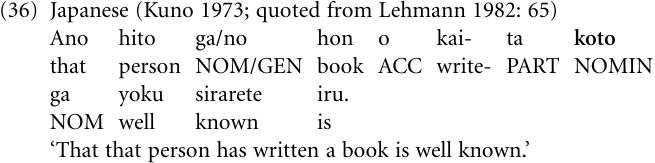
In a similar fashion, the Japanese nominalizer or complementizer koto has the etymological meaning ‘thing’ (Lehmann 1982: 65); the following example illustrates its use as a complementizer. Like Nama, Japanese is an SOV language, hence the complementizer follows its complement clause.
1 We follow Fritz Newmeyer (p.c.) in assuming that (27b) is an instance of a free relative, rather than a headless relative clause.
2 Fritz Newmeyer (p.c.) maintains that what in (34b) is a pronoun rather than a complementizer, being the thematic object of want.
 الاكثر قراءة في Nouns
 اخر الاخبار
اخبار العتبة العباسية المقدسة

الآخبار الصحية


 قسم الشؤون الفكرية يصدر كتاباً يوثق تاريخ السدانة في العتبة العباسية المقدسة
 "المهمة".. إصدار قصصي يوثّق القصص الفائزة في مسابقة فتوى الدفاع المقدسة للقصة القصيرة
 (نوافذ).. إصدار أدبي يوثق القصص الفائزة في مسابقة الإمام العسكري (عليه السلام)