Grammar
Tenses
Present

Present Simple
Present Continuous
Present Perfect
Present Perfect Continuous
Past
Past Simple
Past Continuous
Past Perfect
Past Perfect Continuous
Future
Future Simple
Future Continuous
Future Perfect
Future Perfect Continuous
Parts Of Speech
Nouns
Countable and uncountable nouns
Verbal nouns
Singular and Plural nouns
Proper nouns
Nouns gender
Nouns definition
Concrete nouns
Abstract nouns
Common nouns
Collective nouns
Definition Of Nouns
Animate and Inanimate nouns
Nouns
Verbs
Stative and dynamic verbs
Finite and nonfinite verbs
To be verbs
Transitive and intransitive verbs
Auxiliary verbs
Modal verbs
Regular and irregular verbs
Action verbs
Verbs
Adverbs
Relative adverbs
Interrogative adverbs
Adverbs of time
Adverbs of place
Adverbs of reason
Adverbs of quantity
Adverbs of manner
Adverbs of frequency
Adverbs of affirmation
Adverbs
Adjectives
Quantitative adjective
Proper adjective
Possessive adjective
Numeral adjective
Interrogative adjective
Distributive adjective
Descriptive adjective
Demonstrative adjective
Pronouns
Subject pronoun
Relative pronoun
Reflexive pronoun
Reciprocal pronoun
Possessive pronoun
Personal pronoun
Interrogative pronoun
Indefinite pronoun
Emphatic pronoun
Distributive pronoun
Demonstrative pronoun
Pronouns
Pre Position
Preposition by function
Time preposition
Reason preposition
Possession preposition
Place preposition
Phrases preposition
Origin preposition
Measure preposition
Direction preposition
Contrast preposition
Agent preposition
Preposition by construction
Simple preposition
Phrase preposition
Double preposition
Compound preposition
prepositions
Conjunctions
Subordinating conjunction
Correlative conjunction
Coordinating conjunction
Conjunctive adverbs
conjunctions
Interjections
Express calling interjection
Phrases
Sentences
Clauses
Part of Speech
Grammar Rules
Passive and Active
Preference
Requests and offers
wishes
Be used to
Some and any
Could have done
Describing people
Giving advices
Possession
Comparative and superlative
Giving Reason
Making Suggestions
Apologizing
Forming questions
Since and for
Directions
Obligation
Adverbials
invitation
Articles
Imaginary condition
Zero conditional
First conditional
Second conditional
Third conditional
Reported speech
Demonstratives
Determiners
Direct and Indirect speech
Linguistics
Phonetics
Phonology
Linguistics fields
Syntax
Morphology
Semantics
pragmatics
History
Writing
Grammar
Phonetics and Phonology
Semiotics
Reading Comprehension
Elementary
Intermediate
Advanced
Teaching Methods
Teaching Strategies
Assessment

The verb channel
 المؤلف:
Bernd Heine and Tania Kuteva
المؤلف:
Bernd Heine and Tania Kuteva
 المصدر:
The Genesis of Grammar
المصدر:
The Genesis of Grammar
 الجزء والصفحة:
P237-C5
الجزء والصفحة:
P237-C5
 2026-03-17
 28
28




+
-
20
The verb channel
Therearetwomainkindsofverbsthatcrosslinguisticallyprovideconceptual sources for complementizers. The most common kind is provided by speech act verbs meaning ‘say’, the second one being similative verbs meaning ‘be like’, ‘be equal’, or ‘resemble’. We will look at both sources in turn (for further examples, see Heine and Kuteva 2002a: 257–8, 261–5, 273–5).
On the basis of crosslinguistic evidence, a grammaticalization channel typically involving the following main stages has been proposed (see e.g. Lord 1976; Heine, Claudi, and Hünnemeyer 1991: 158; Ebert 1991: 87; Frajzyngier 1996; Klamer 2000; Crass 2002; see also “Clause subordination”):
(37) Main stages in the evolution from verb for ‘say’ to clause subordinator1
a. Speech act verb ‘say’
b. ‘Say’ as a quotative marker
c. Complementizer of object clauses headed by speech-act, perception (e.g. ‘see’, ‘hear’), and cognition verbs (e.g. ‘know’, ‘believe’)
d. Complementizer of subject clauses
e. Subordinator of purpose clauses
f. Subordinator of cause clauses2
(a) John quit the job in order to concentrate on his exams.
(b) John quit the job because he wanted to concentrate on his exams.
(c) John caught a cold because he did not wear a coat.
(d) *John caught a cold in order not to wear a coat.
What appears to happen in this grammaticalization process is that desemanticization has the effect that the purpose meaning is bleached out, with the result that a cause meaning arises.
There is a range of different morphological forms that the verb ‘say’ may take in this grammaticalization; in one language it is used in some nonfinite (infinitival or participial) form, in another it is inflected for person, tense, aspect, etc., or it is used without any morphological trappings. In the course of grammaticalization, the verb form loses verbal properties, gradually being reduced to an invariable conjunction (decategorialization) and losing phonetic substance (erosion).
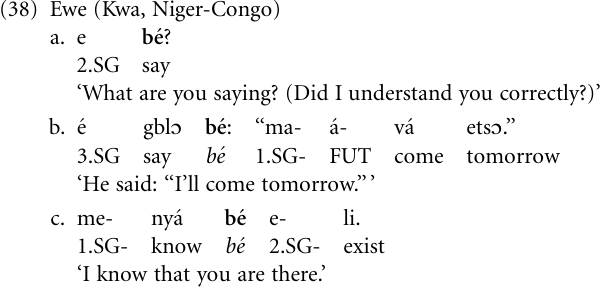
The following examples from Ewe illustrate the process. Sentence (38a) shows the lexical use as a speech act verb, nowadays highly restricted in the contexts in which it can occur, while (38b) shows the quotative use preceding direct-speech sentences and (38c) the object complementizer use after a cognition verb.
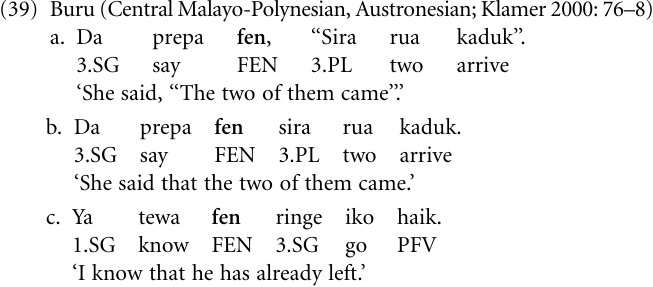
Similarly, the Austronesian language Buru of Indonesia illustrates this grammaticalization channel (Klamer 2000: 75 V.). The item fen(e) is used as a lexical verb meaning ‘think, say, affirm’, it also occurs as a quotative marker (39a), and as a complementizer after speech act verbs (39b) and mental and physical perception verbs (39c). After speech act verbs, the use of fen(e) is optional. There is no evidence that fen(e) has reached the stage of marking subject complement clauses.
This development does not always lead all the way to a complementizer; in a number of languages it has not proceeded beyond the quotative stage. This appears to be the case for example in Georgian (see Harris and Campbell 1995: 168–9 for more details): By the tenth or the eleventh century, the quotative particles metki and tko (with or without complementizer) were introduced, and these are historically derived from the verb forms me v-tkv-i ‘I said (it)’ and tkva ‘may you say (it)’, respectively. In spite of their fairly old age, the two do not appear to have reached the stage of complementizers. However, they exhibit the salient features of grammaticalization: Their lexical meaning appears to have bleached out (desemanticization), they have undergone decategorialization, having lost the ability to distinguish tense, aspect, and modality, being invariable particles, they can no longer stand alone, and they have also undergone erosion, being reduced from me v-tkv-i to metki and from tkva to tko. Finally, they have reached the final stage of context-induced reinterpretation in that they have been conventionalized to the extent that the erstwhile verb can co-occur with the new verb for ‘say’:

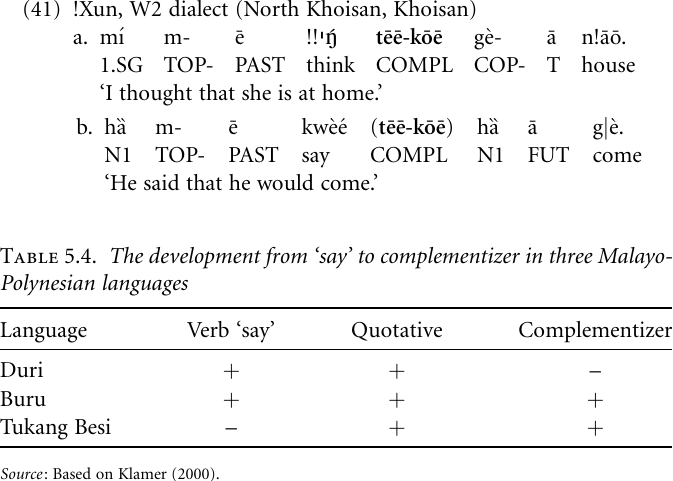
The more grammaticalized an item is, the more likely it is that it will lose its original meaning and come to be used exclusively as a functional category. This appears to have happened in Tukang Besi, a language closely related to Buru: In Tukang Besi, the same grammaticalization chain is found, with one exception: While the item kua of Tukang Besi also functions both as a quotative marker and complementizer, it has no lexical uses as a speech act verb ‘say’. That kua has lost these uses is suggested by the fact that in the related neighboring language Duri, kua is used not only as a quotative marker but also as a verb for ‘say’ (Klamer 2000: 85). In sum, the development of these three Malayo-Polynesian languages can be sketched as in Table 5.4, suggesting that Duri represents the least and Tukang Besi the most strongly grammaticalized stage; there are no data on whether any of the languages has acquired the stage of a subject complementizer.
Similar examples can be found in many other languages. The Khoisan language !Xun of southwestern Africa uses the complementizer tēē-kōē when the main verb is a speech-act or cognition verb. This form is historically derived from the phrase tà kē kwèe̒ (and PASTsay), frequently reduced to tà-ē kwèe̒ ‘and said’. Thus, example (41a) means historically ‘I thought and said: she is at home’. That !Xun speakers may still to some extent be aware of the genesis of the construction is suggested by the fact that they tend to omit the complementizer when the main verb is kwèe̒ (or kòe̒) ‘to say’, as in (41b). Furthermore, the process has not proceeded to the stage where the complementizer marks subject clauses. Thus, the situation is similar to that of Buru (see above).
In Ancient Egyptian, the form r ḏd‘(in order) to say’ seems to have given rise to a general complementizer (Deutscher 2000: 90; Heine and Kuteva 2002a: 261–2), and Deutscher(2000: 66–90)argues that a similar process happened in the Semitic language Old Accadian (c. 2500–2000 bc) of ancient Mesopotamia, where the expression enma, which is hypothesized to be derived from a verb of saying, provided the source for the complementizer umma of Neo-Babylonian (c. 1000–500 bc). Another diachronically attested example of the ‘say’-to-complementizer channel leading all the way to subject complementizer.
While presumably less common than speech act verbs, similative verbs meaning (‘be like’, ‘be equal’, ‘resemble’) also provide a source for complementizers (Güldemann 2001). The exact nature of this evolution is not entirely clear; from the data available it seems that the process typically leads from the similative via quotative to complementizer uses. The following are a few examples of this grammaticalization. In the Nigerian language Idoma, the verb bε̄ ‘resemble’ has given rise to a complementizer after verbs of thinking, seeing, knowing, and hearing, cf. (42). Similarly, in the Ghanaian language Twi, there is a verb sε ‘resemble’, ‘be like’, ‘be equal’, that appears to have provided the source for the complementizer sε (Lord 1993: 160).

In addition to verbs, it may be similative adverbs and other markers (‘like’, ‘thus’) that may be recruited for grammaticalization. The English-based pidgin/creole Tok Pisin provides an example, where the particle olsem ‘thus, like’ became a complementizer (43); cf. also English like, which serves as a non-verbatim quotative (e.g. And I’m like: ‘‘Gimme a break, will you!’’; Romaine and Lange 1991).

1 We are leaving out further specifications of this grammaticalization chain, such as the development of conditional clauses. Note further that there is some evidence that (37d) does not necessarily precede (37e).
2 One may wonder what the conceptual process is that leads from purpose to cause clause. The answer is complex; in a nutshell this process is of the following kind: Purpose clauses entail cause while the opposite does not hold. Thus, purpose clauses, such as (a), can be paraphrased roughly by cause clauses, as in (b), but cause clauses(c) can in many cases not be paraphrased by purpose clauses (d).
 الاكثر قراءة في Verbs
 اخر الاخبار
اخبار العتبة العباسية المقدسة

الآخبار الصحية


 قسم الشؤون الفكرية يصدر كتاباً يوثق تاريخ السدانة في العتبة العباسية المقدسة
 "المهمة".. إصدار قصصي يوثّق القصص الفائزة في مسابقة فتوى الدفاع المقدسة للقصة القصيرة
 (نوافذ).. إصدار أدبي يوثق القصص الفائزة في مسابقة الإمام العسكري (عليه السلام)