Grammar
Tenses
Present

Present Simple
Present Continuous
Present Perfect
Present Perfect Continuous
Past
Past Simple
Past Continuous
Past Perfect
Past Perfect Continuous
Future
Future Simple
Future Continuous
Future Perfect
Future Perfect Continuous
Parts Of Speech
Nouns
Countable and uncountable nouns
Verbal nouns
Singular and Plural nouns
Proper nouns
Nouns gender
Nouns definition
Concrete nouns
Abstract nouns
Common nouns
Collective nouns
Definition Of Nouns
Animate and Inanimate nouns
Nouns
Verbs
Stative and dynamic verbs
Finite and nonfinite verbs
To be verbs
Transitive and intransitive verbs
Auxiliary verbs
Modal verbs
Regular and irregular verbs
Action verbs
Verbs
Adverbs
Relative adverbs
Interrogative adverbs
Adverbs of time
Adverbs of place
Adverbs of reason
Adverbs of quantity
Adverbs of manner
Adverbs of frequency
Adverbs of affirmation
Adverbs
Adjectives
Quantitative adjective
Proper adjective
Possessive adjective
Numeral adjective
Interrogative adjective
Distributive adjective
Descriptive adjective
Demonstrative adjective
Pronouns
Subject pronoun
Relative pronoun
Reflexive pronoun
Reciprocal pronoun
Possessive pronoun
Personal pronoun
Interrogative pronoun
Indefinite pronoun
Emphatic pronoun
Distributive pronoun
Demonstrative pronoun
Pronouns
Pre Position
Preposition by function
Time preposition
Reason preposition
Possession preposition
Place preposition
Phrases preposition
Origin preposition
Measure preposition
Direction preposition
Contrast preposition
Agent preposition
Preposition by construction
Simple preposition
Phrase preposition
Double preposition
Compound preposition
prepositions
Conjunctions
Subordinating conjunction
Correlative conjunction
Coordinating conjunction
Conjunctive adverbs
conjunctions
Interjections
Express calling interjection
Phrases
Sentences
Clauses
Part of Speech
Grammar Rules
Passive and Active
Preference
Requests and offers
wishes
Be used to
Some and any
Could have done
Describing people
Giving advices
Possession
Comparative and superlative
Giving Reason
Making Suggestions
Apologizing
Forming questions
Since and for
Directions
Obligation
Adverbials
invitation
Articles
Imaginary condition
Zero conditional
First conditional
Second conditional
Third conditional
Reported speech
Demonstratives
Determiners
Direct and Indirect speech
Linguistics
Phonetics
Phonology
Linguistics fields
Syntax
Morphology
Semantics
pragmatics
History
Writing
Grammar
Phonetics and Phonology
Semiotics
Reading Comprehension
Elementary
Intermediate
Advanced
Teaching Methods
Teaching Strategies
Assessment

Cross-linguistic patterns
 المؤلف:
PAUL R. KROEGER
المؤلف:
PAUL R. KROEGER
 المصدر:
Analyzing Grammar An Introduction
المصدر:
Analyzing Grammar An Introduction
 الجزء والصفحة:
P181-C10
الجزء والصفحة:
P181-C10
 2026-01-15
 206
206




+
-
20
Cross-linguistic patterns
Up to now we have used the terms COPULA and LINKING VERB interchangeably. However, some languages have a copula which is not a verb. In Hausa, for example, verbs normally occur in the middle of a clause; the basic word order is S–Aux–V–O, with the auxiliary element indicating person, number, gender, and tense/aspect. The copula that appears in equative clauses, however, appears in final position and is inflected only for gender, as illustrated in (21). It does not fit well within either the category V or the category Aux.
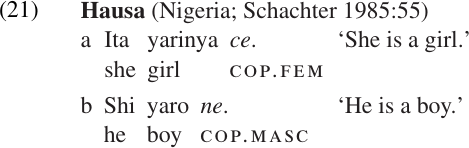
In other languages, the copula may be an invariant particle: one that is never inflected but always appears in the same form, and only serves as the marker of a non-verbal clause type. Payne (1997:117) cites the Sùpyı̀re̒ language of Brazil as one such example.
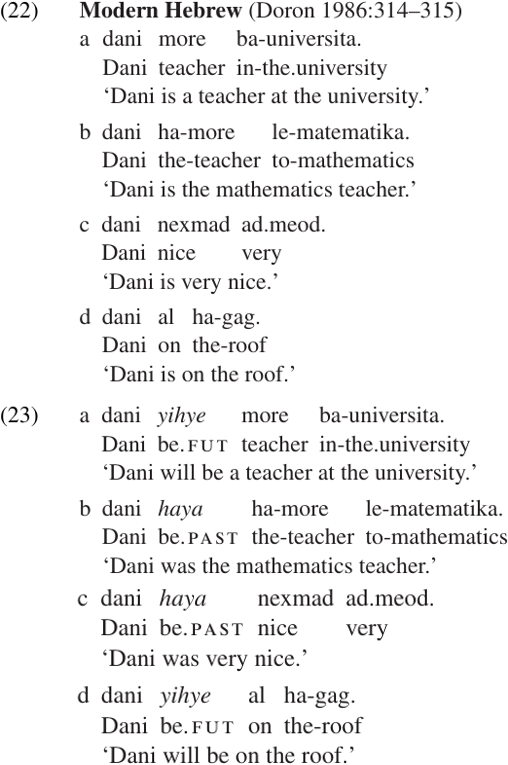
A number of languages have verbal copulae which are only used in non-present tenses. In Modern Hebrew, for example, attributive, equative, and locative clauses in the present tense do not contain any copula, as illustrated in (22), although they may optionally contain a nominative pronoun that doubles the subject NP (not shown here). In past or future tenses, however, an inflected copular verb (root: h.y.y) is obligatory, as illustrated in (23).
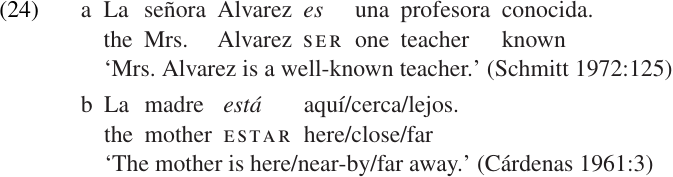
Spanish has two distinct copular verbs, ser and estar. The choice of which copula to use depends partly on the category of the predicate complement and partly on semantic factors. Ca̒rdenas (1961) states that ser is always used when the predicate complement is an NP, as in (24a), while estar is always used when the predicate complement is an adverbial element, as in (24b).
When the predicate complement is a prepositional phrase, ser is used with the preposition de ‘of, from’ in all its various senses; while estar is used with the prepositions en ‘in, on’ and a ‘at.’ Some examples are provided in (25–26).
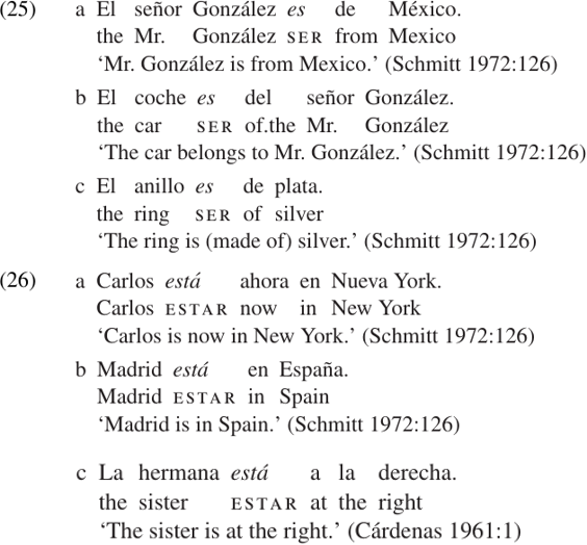
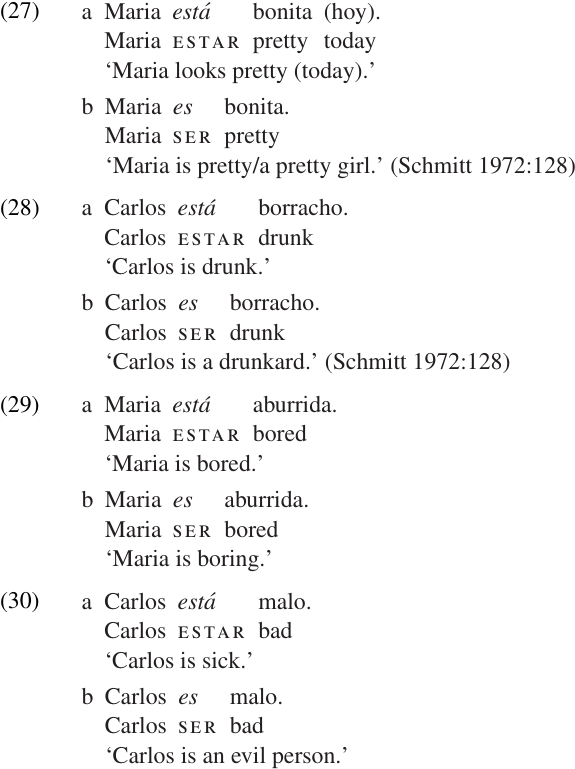
Notice that the choice of copula in locative clauses depends only on the specific preposition used; estar is used with the preposition en whether the location is understood as being temporary (26a) or permanent (26b). When the predicate complement is an adjective phrase, however, either copula may be used. The choice is made on semantic grounds: ser is used to express inherent properties or characteristics; while estar is used to express temporary states. This contrast is illustrated in (27–28). Some adjectives can take on two different meanings depending on which copula is used, as illustrated in (29–30).
We saw that the structure of a possessive construction may depend on the definiteness of the possessed item. This is not a special feature of Tagalog grammar, but is, in fact, a common pattern across languages: definiteness is often a major factor in determining the structure of a possessive clause. A Tagalog clause expressing ownership of a specific, definite item, like example (18b), is structurally very similar to a locative clause. Many other languages also exhibit strong similarities between definite possessive constructions and locative clauses (Clark 1978).
Tagalog clauses expressing possession or ownership of an indefinite or unspecified item, such as (18c), are structurally more similar to existential clauses. An important aspect of the similarity between indefinite possessives and indefinite existentials in many languages is that the same existential predicate is used for both constructions. It turns out that the predicate which is used for these two clause types in Tagalog is not used in stative, equative, or locative clauses. The same situation is found in Dusun, Land Dayak, and a large number of other Austronesian languages: there is a unique predicate for existentials and indefinite possessives, not used in other clause types. Outside of the Austronesian family, Clark (1978) notes the following languages where this same pattern is found: Amharic, Irish, Mandarin, Eskimo, French, Modern Greek, Hebrew, Twi, and possibly Arabic.
Of course, other patterns are also common. In Malay, the existential predicate is used for both possessive and locative clauses, and Clark reports the same pattern in Turkish and Yurok. English uses the copula be for existential and locative clauses, but have for possessives. Some languages use the same copula for all of these clause types.15
As noted above, Tagalog has two existential predicates: the positive may (or mayroon) and the negative walâ. The negative existential is different from the various negatives used in other contexts. Again, a number of other languages also have special negative existential forms. Some examples from various languages are shown in the following table:
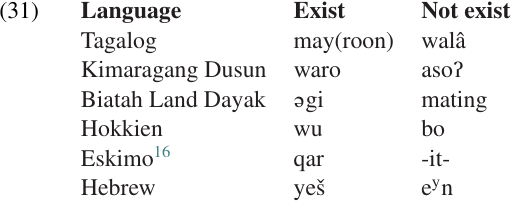
15. Clark cites several examples from the Finno-Ugric (Finnish, Hungarian, and Estonian) and Indo-Iranian (Hindi, Kashmiri, and Bengali [past tense]) families.
16. The Eskimo and Hebrew examples are from Clark (1978:109).
 الاكثر قراءة في Verbs
 اخر الاخبار
اخبار العتبة العباسية المقدسة

الآخبار الصحية


 قسم الشؤون الفكرية يصدر كتاباً يوثق تاريخ السدانة في العتبة العباسية المقدسة
 "المهمة".. إصدار قصصي يوثّق القصص الفائزة في مسابقة فتوى الدفاع المقدسة للقصة القصيرة
 (نوافذ).. إصدار أدبي يوثق القصص الفائزة في مسابقة الإمام العسكري (عليه السلام)