Grammar
Tenses
Present

Present Simple
Present Continuous
Present Perfect
Present Perfect Continuous
Past
Past Simple
Past Continuous
Past Perfect
Past Perfect Continuous
Future
Future Simple
Future Continuous
Future Perfect
Future Perfect Continuous
Parts Of Speech
Nouns
Countable and uncountable nouns
Verbal nouns
Singular and Plural nouns
Proper nouns
Nouns gender
Nouns definition
Concrete nouns
Abstract nouns
Common nouns
Collective nouns
Definition Of Nouns
Animate and Inanimate nouns
Nouns
Verbs
Stative and dynamic verbs
Finite and nonfinite verbs
To be verbs
Transitive and intransitive verbs
Auxiliary verbs
Modal verbs
Regular and irregular verbs
Action verbs
Verbs
Adverbs
Relative adverbs
Interrogative adverbs
Adverbs of time
Adverbs of place
Adverbs of reason
Adverbs of quantity
Adverbs of manner
Adverbs of frequency
Adverbs of affirmation
Adverbs
Adjectives
Quantitative adjective
Proper adjective
Possessive adjective
Numeral adjective
Interrogative adjective
Distributive adjective
Descriptive adjective
Demonstrative adjective
Pronouns
Subject pronoun
Relative pronoun
Reflexive pronoun
Reciprocal pronoun
Possessive pronoun
Personal pronoun
Interrogative pronoun
Indefinite pronoun
Emphatic pronoun
Distributive pronoun
Demonstrative pronoun
Pronouns
Pre Position
Preposition by function
Time preposition
Reason preposition
Possession preposition
Place preposition
Phrases preposition
Origin preposition
Measure preposition
Direction preposition
Contrast preposition
Agent preposition
Preposition by construction
Simple preposition
Phrase preposition
Double preposition
Compound preposition
prepositions
Conjunctions
Subordinating conjunction
Correlative conjunction
Coordinating conjunction
Conjunctive adverbs
conjunctions
Interjections
Express calling interjection
Phrases
Sentences
Clauses
Part of Speech
Grammar Rules
Passive and Active
Preference
Requests and offers
wishes
Be used to
Some and any
Could have done
Describing people
Giving advices
Possession
Comparative and superlative
Giving Reason
Making Suggestions
Apologizing
Forming questions
Since and for
Directions
Obligation
Adverbials
invitation
Articles
Imaginary condition
Zero conditional
First conditional
Second conditional
Third conditional
Reported speech
Demonstratives
Determiners
Direct and Indirect speech
Linguistics
Phonetics
Phonology
Linguistics fields
Syntax
Morphology
Semantics
pragmatics
History
Writing
Grammar
Phonetics and Phonology
Semiotics
Reading Comprehension
Elementary
Intermediate
Advanced
Teaching Methods
Teaching Strategies
Assessment

Treating events like objects
 المؤلف:
Bernd Heine and Tania Kuteva
المؤلف:
Bernd Heine and Tania Kuteva
 المصدر:
The Genesis of Grammar
المصدر:
The Genesis of Grammar
 الجزء والصفحة:
P100-C2
الجزء والصفحة:
P100-C2
 2026-02-27
 338
338




+
-
20
Treating events like objects
We observed in “Nouns and verbs” that nouns may behave like verbs and verbs like nouns and that so far it has not been possible to establish any significant directionality regarding the grammaticalization of the two kinds of categories. Nevertheless, the relationship between the two is far from symmetric; rather, there appears to be a unidirectional development whereby expressions reserved for nouns, or nominal concepts, are exploited for encoding actions or events, that is, concepts that are typically expressed by verbs; conversely, there is no evidence to suggest that verbs are regularly grammaticalized to express nominal concepts. Crosslinguistic data suggest that there are cognitive-communicative strategies such as the following:
(a) verbal predicates tend to be structured in terms of nominal morph ology (subordination);
(b) verbs tend to be presented like nouns (auxiliation);
(c) verbal complements are treated like nominal complements (negation);
(d) actions and events tend to be treated pronominally like nouns.
We will deal with each of these strategies in turn; for a more detailed treatment of some of the issues discussed here.
(a) Treat subordinate clauses like nouns (subordination) As we will see in more details, this strategy can most readily be described by looking at case languages, that is, languages that express arguments of the clause by means of case clitics or affixes. In most case languages that we are familiar with, the use of some case marker or markers is extended productively from nouns to verbal predicates—with the effect that a subordinate clause structure arises. When a nominal structure is reinterpreted as a clausal structure, the result may be that a genitive case marker, marking the nominal modifier, is reinterpreted as an ergative or agent case marker (see e.g. Dixon 1994). Conversely, when in a given language there is an ergative case marker which is the same as, or is historically derived from a genitive marker, this is likely to reflect a historical process leading from nominal to clausal structure.
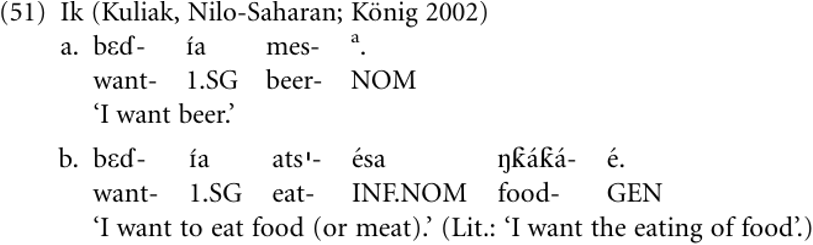
One possible effect of this grammaticalization from nominal case to verbal subordination marker is that the resulting subordinate clause exhibits nominal properties whereas the main clause does not; we will deal with this effect in more detail in “Expansion”. Dixon (1994: 192) observes that in the Carib languages of South America, subordinate clauses generally have the status of nominalizations and show an ergative pattern. In the following example from the Nilo-Saharan language Ik of Uganda, the (non-finite) complement verb ‘to eat’ in (51a) appears in the nominative case (NOM)11 and the ‘‘object’’ (patient) of the complement clause in the genitive case (GEN). What characterizes this pathway is that complement clauses are structured on the model of nouns. In (51a), the verb bεɖ - ‘want’ has a nominal complement in the nominative, and this structure is similar to that of the complement clause of (51b), exhibiting morphosyntactic properties characteristic of the nominal structure. Thus, the literal meaning of (51b) is something like ‘I want the eating of food’.
In other languages, the extension from nominal case suffix to verbal predicate does not affect the structure of the subordinate clause, which takes the form of a finite-verb clause. Thus, in the following example from Imbabura Quechua the complement clause (in square brackets) has the finite structure of a main clause but receives the case marking that would be used if there were a nominal complement:

Languages of this type tend to use this kind of construction only for complement clauses with a limited spectrum of main clause (matrix) verbs, most of all speech-act, cognition, and/or verbs of volition as matrix verbs. Furthermore, many of these languages restrict this structure to complement clauses where the subject of the complement clause is co-referential with that of the main clause subject.
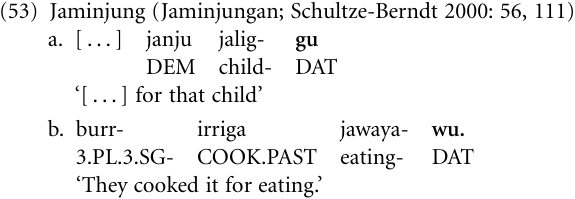
A wide spread strategy concerns the extension of allative/goal or benefactive/dative case markers from nouns to verbs in order to introduce purpose clauses. Thus, the benefactive/dative case suffix-gu or-wu (DAT) of the Jaminjung language of Northern Australia serves as a nominal case suffix in (53a) but as a marker of non-finite purpose clauses in (53b).
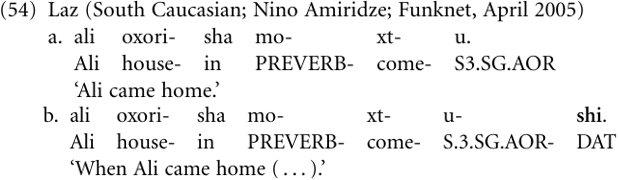
In the South Caucasian language Laz, spoken in Turkey, it is possible to have a dative marker cliticized to a finite verb form, thereby turning a main clause, as in (54a), into a subordinate one (54b):
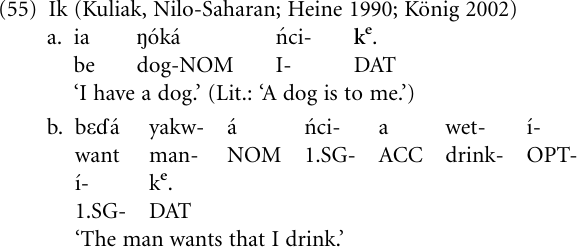
Essentially the same process appears to have happened in the Ik language of northeastern Uganda: The dative suffix-ke, illustrated in (55a), has been added to the finite verb form, which is constructed in the optative mood (using the suffix-ı̒), and in this usage has been generalized both as a clause subordinator and as a complementizer, as in (55b) (see Heine 1990 for details).
In a similar fashion, nominal case markers have been extended in Omotic languages of Ethiopia to serve as clause subordinators. For example, the dative (benefactive) case suffix-m preceded by the absolutive case suffix-o, illustrated in (56a), appears to have developed into the purpose clause subordinator-o̒m (PURP) in the Maale language, cf. (56b). Decategorialization had the effect that the two nominal case suffixes merged into one form.
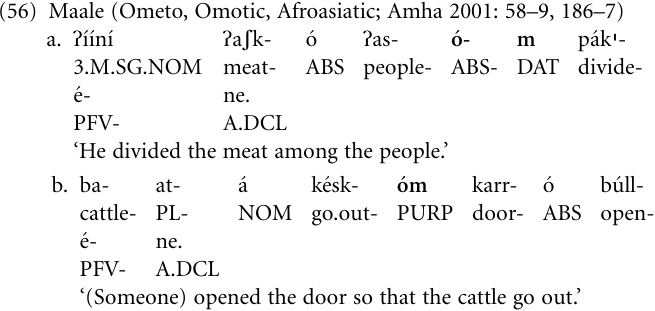
Massive evidence showing that nominal case markers are grammaticalized to clause subordinators comes from the Tibeto-Burman Bodic languages. There is a wealth of data describing the move from prepositions or postpositions, being heads of noun phrases, to adverbial clause markers, that is, heads of adverbial clauses (see Genetti 1986 for examples from Bodic languages; we will return to this situation in “Expansion”).
Obviously, the treat-subordinate-clauses-like-nouns strategy is found to be at work most of all in what Givo̒n (2006) calls nominalizing languages, such as Tibeto-Burman, Turkic, Carib, Quechuan, Northern Uto-Aztecan, Omotic, Finno-Ugric languages, or the Gorokan languages of the Papuan Highlands. But the very same strategy, whereby adpositions, case affixes, or other noun-specific morphologies are grafted onto verbal structures, can also be observed in many other languages, even if the implications are less pervasive. English has a number of instances of it, involving prepositions such as after, before, for, until, etc.; consider the example in (57), where the use of the prepositional form in terms of appears to have been extended to nominal to adverbial clause complements—in accordance with the general conceptual and syntactic process that we sketched earlier.
(57) English (Hopper and Traugott 2003: 185)
They’re a general nuisance in terms of they harass people trying to enjoy the park.
What distinguishes this English example from the ones discussed earlier is the fact that it represents only an incipient stage of grammaticalization: in terms of has not, or not yet, developed into a regular marker of adverbial clause subordination; rather, it appears to be a discourse option that is available in some registers of spoken English but has not been generalized across the speech community.
(b) Treat verbs like nominal complements (auxiliation) There is a universally attested diachronic process of grammaticalization leading from structure (58a) to (58b).

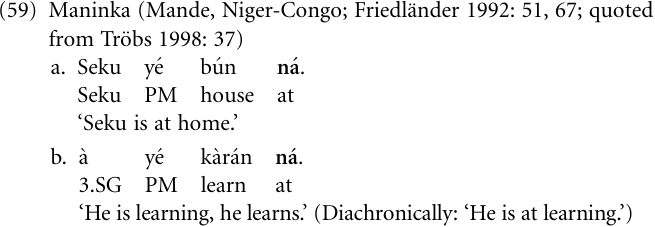
Since this is a gradual process, it involves many intermediate stages; we are restricted here to the most salient stages of the process. Examples that we discussed illustrate this process. We may add two further examples to show that the process is crosslinguistically regular. The first example comes from the West African language Maninka, where verbs in the progressive aspect (59a) are treated like locative nouns (59b).
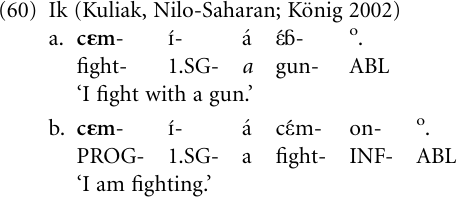
The second example is taken from the Ik language, where the use of the verb cεm-eε̒s ‘to fight’ was extended from nominal complements, as in (60a), to non-finite verbs, and finally to verbs that were reinterpreted as new main verbs—with the effect that cεm-eε̒s was ‘‘downgraded’’ to an auxiliary, grammaticalized to a progressive marker, as in (60b), where its lexical semantics is completely bleached out. That cεm-eε̒s is fully grammaticalized, that is, has reached the stage of conventionalization, and thus is a fully-fledged functional category, can be seen in the fact that the auxiliary can co-occur with its lexical source (60b). And just as the auxiliary requires the main verb to take the ablative suffix in (60b), so does the main verb with its complement in (60a).
(c) Treat verbal complements like nominal complements Another manifestation of the extension from nominal to verbal structures can be observed in the rise of negation markers that we mentioned above in “The second layer: verbs”: In some languages the use of negative existential verbs has been extended from nominal (N) complements (‘there is no N’) to verbal (V) complements (‘there is no V’ > ‘V does not happen’), and in the latter case the existential verb may assume the function of a negation marker.
We saw one example of this process earlier (“The second layer: verbs”): In Chinese, the negative existential me̒i [yŏu] takes nominal complements, as in (29b), but its use appears to have been extended to verbal complements, as in (29c), with the result that there now is a new negation marker of completed actions. For more examples and details of this process, see Croft (1991).
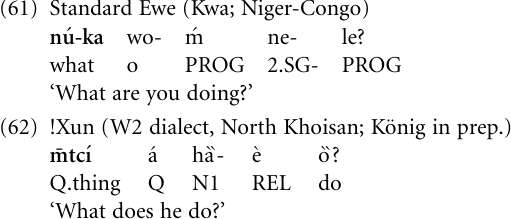
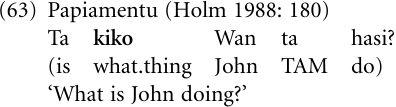
(d) Treat verbal interrogatives like nouns That there is a unidirectional development whereby the use of nominal structures is extended to verbal structures can be demonstrated with other kinds of evidence. One piece of evidence concerns pronominalization. For example, a typological survey of question pronouns suggests that there is a widespread process whereby interrogative pronouns referring to inanimate objects (‘what?’) are extended to also refer to actions and events (Heine, Claudi, and Hünnemeyer 1991: 56 V.). Evidence for this directionality comes in particular from languages where the interrogative pronoun is etymologically transparent: In such languages the pronoun is not infrequently derived from a phrase ‘which thing?’ For example, in the Ewe language of Togo and Ghana, the pronoun nu̒-ka ‘what?’ means historically ‘thing-which?’, but is used in the same way for nominal and for verbal referents, as in (61), and the interrogative pronoun m̄tcı̒ ‘what?’ of the !Xun language of south western Africa, which is historically composed of the interrogative element *m̄13 and the noun tcı̒ ‘thing’, is not restricted to nominal referents but is used in much the same way to refer to actions and events, cf. (62).
Further data is found in pidgins and creoles, where not uncommonly the question word referring to actions (‘what?’) is transparently derived from the phrase ‘which thing?’, as in the following example from the Spanish-based creole Papiamentu:
Essentially the same kind of evidence comes from affirmative pronouns (‘that’): It is demonstrative pronouns, that is, items typically reserved for nominal referents, that tend to be extended to also refer to actions and events, for example English Don’t do that again.
Evidence for directionality To conclude, the evidence presented here, suggests that there is a unidirectional relationship between nominal and verbal concepts, whereby the former tend to be recruited as templates for expressing the latter—a relationship that appears to be based on a common human strategy to conceptualize and describe non-time-stable, dynamic phenomena (actions and events) in terms of time-stable, thing-like phenomena (nouns). This relationship is of a different kind than the one we were dealing with in all other cases discussed elsewhere (hence, it is marked with a dotted line in Figure 2.1 in “A scenario of evolution”)—however it is one that shows the same kind of regularity.
The evidence for this regularity is taken from diachronic observations: There are historically attested examples of change from nominal case marker to clause subordinator while we are unaware of any examples where clause subordinators developed into case suffixes14 (Heine and Kuteva 2002a). And much the same applies to the auxiliation process: There are attested cases where, in accordance with (58), a structure [verb nominal complement] was grammaticalized to another structure [auxiliary main verb]. For example, in the history of English it was possible to say something like John is going to town before it was possible to also say John is going to come, that is, English to go could take nominal complements long before its use was extended to verbal complements in a future tense construction. And once again, there is essentially no evidence for a process in the opposite direction, that is, where a tense or aspect construction developed into one of nominal complementation.
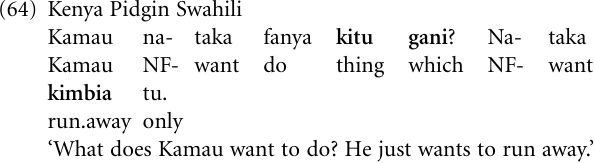
And finally, there is also evidence to show that nouns meaning ‘thing’ were recruited to form interrogative pronouns (‘which thing’) that refer not only to nominal participants but also actions and events. In Swahili, the noun kitu ‘thing’ is unambiguously a noun denoting thing-like entities. In Kenya Pidgin Swahili this noun has been grammaticalized in combination with the attributive interrogative gani ‘which?’ to a question word (kitu gani ‘what?’) referring not only to thing-like entities but in the same way to actions and events, for example:
11 Ik has a general rule according to which clausal objects are encoded in the nominative (NOM) when the subject has first- or second-person reference, as in the present example, but in the accusative (ACC) when the subject has third-person reference.
12 The constituent ordering in (58) is the one to be expected in verb-initial (VSO) and verb medial (SVO) languages; in verb-final (SOV) languages, the reverse order would be expected.
13 *m̄ is no longer a productive morpheme in !Xun.
14 Even if such examples should become available they would clearly be exceptional.
 الاكثر قراءة في Grammar
 اخر الاخبار
اخبار العتبة العباسية المقدسة

الآخبار الصحية


 قسم الشؤون الفكرية يصدر كتاباً يوثق تاريخ السدانة في العتبة العباسية المقدسة
 "المهمة".. إصدار قصصي يوثّق القصص الفائزة في مسابقة فتوى الدفاع المقدسة للقصة القصيرة
 (نوافذ).. إصدار أدبي يوثق القصص الفائزة في مسابقة الإمام العسكري (عليه السلام)