Grammar
Tenses
Present

Present Simple
Present Continuous
Present Perfect
Present Perfect Continuous
Past
Past Simple
Past Continuous
Past Perfect
Past Perfect Continuous
Future
Future Simple
Future Continuous
Future Perfect
Future Perfect Continuous
Parts Of Speech
Nouns
Countable and uncountable nouns
Verbal nouns
Singular and Plural nouns
Proper nouns
Nouns gender
Nouns definition
Concrete nouns
Abstract nouns
Common nouns
Collective nouns
Definition Of Nouns
Animate and Inanimate nouns
Nouns
Verbs
Stative and dynamic verbs
Finite and nonfinite verbs
To be verbs
Transitive and intransitive verbs
Auxiliary verbs
Modal verbs
Regular and irregular verbs
Action verbs
Verbs
Adverbs
Relative adverbs
Interrogative adverbs
Adverbs of time
Adverbs of place
Adverbs of reason
Adverbs of quantity
Adverbs of manner
Adverbs of frequency
Adverbs of affirmation
Adverbs
Adjectives
Quantitative adjective
Proper adjective
Possessive adjective
Numeral adjective
Interrogative adjective
Distributive adjective
Descriptive adjective
Demonstrative adjective
Pronouns
Subject pronoun
Relative pronoun
Reflexive pronoun
Reciprocal pronoun
Possessive pronoun
Personal pronoun
Interrogative pronoun
Indefinite pronoun
Emphatic pronoun
Distributive pronoun
Demonstrative pronoun
Pronouns
Pre Position
Preposition by function
Time preposition
Reason preposition
Possession preposition
Place preposition
Phrases preposition
Origin preposition
Measure preposition
Direction preposition
Contrast preposition
Agent preposition
Preposition by construction
Simple preposition
Phrase preposition
Double preposition
Compound preposition
prepositions
Conjunctions
Subordinating conjunction
Correlative conjunction
Coordinating conjunction
Conjunctive adverbs
conjunctions
Interjections
Express calling interjection
Phrases
Sentences
Clauses
Part of Speech
Grammar Rules
Passive and Active
Preference
Requests and offers
wishes
Be used to
Some and any
Could have done
Describing people
Giving advices
Possession
Comparative and superlative
Giving Reason
Making Suggestions
Apologizing
Forming questions
Since and for
Directions
Obligation
Adverbials
invitation
Articles
Imaginary condition
Zero conditional
First conditional
Second conditional
Third conditional
Reported speech
Demonstratives
Determiners
Direct and Indirect speech
Linguistics
Phonetics
Phonology
Linguistics fields
Syntax
Morphology
Semantics
pragmatics
History
Writing
Grammar
Phonetics and Phonology
Semiotics
Reading Comprehension
Elementary
Intermediate
Advanced
Teaching Methods
Teaching Strategies
Assessment

Nouns and verbs The fifth layer
 المؤلف:
Bernd Heine and Tania Kuteva
المؤلف:
Bernd Heine and Tania Kuteva
 المصدر:
The Genesis of Grammar
المصدر:
The Genesis of Grammar
 الجزء والصفحة:
P93-C2
الجزء والصفحة:
P93-C2
 2026-02-27
 298
298




+
-
20
Nouns and verbs
The fifth layer
We have demonstrated how linguistic expressions having fairly transparent lexical meanings are grammaticalized to forms that still preserve properties of their lexical sources but at the same time form cross linguistically stable functional categories: Most languages distinguish demonstratives, adpositions, or verbal aspects as salient concepts of linguistic categorization. The present section concerns a range of grammatical functions that are commonly derived historically from such categories. It is hard to find a common semantic or syntactic denominator characterizing this group of functional taxa other than that they are the product of the grammaticalization of other functional taxa of layer IV or any other preceding layer. Furthermore, it is also virtually impossible to narrow down the range of functional taxa that could reasonably be allocated to this layer—considering that there is a bewildering variety of grammatical categories in the languages of the world that in some way or other belong to this layer. To discuss all the path ways of grammaticalization that emanate from the layers examined in the preceding sections would clearly be beyond the scope of the present treatment, quite apart from the fact that appropriate crosslinguistic typological information is absent for most of them; we will be confined to a small range of such pathways. The categories concerned are devoid of any lexical content, their primary, or their only function being to establish relations among participants of linguistic discourse, such as linking constituents of discourse (agreement), manipulating the argument structure (passives), and marking relations between different levels of syntactic structure (subordination).
As elsewhere in this section, we are confined to pathways that are crosslinguistically salient, ignoring further pathways that are only locally found. For example, in the Cariban language Panare of South America, a development from demonstrative pronoun to tense marker has been observed (Gildea 1993), which is ignored here since we are not aware of similar developments in other languages.
Case marker > subordinator There is a wide range of conceptual sources leading to the growth of adverbial clause subordinators (see “Adverbial clauses”), such as Noun >subordinator, Verb > subordinator, Adposition > subordinator, Complementizer > subordinator, but these do not exhaust the range of possibilities; mention should be made, for example, of the fact that relative markers may give rise to other forms of subordination including adverbial clause subordination (Heine and Kuteva 2002a: 254–5; see also “From complementizer or relativizer to adverbial clause subordinator”). Since we are confined here to the crosslinguistically most salient developments, we have excluded such pathways. But one development that is salient concerns that from nominal to clausal syntax. Examples demonstrating that the use of markers expressing distinctions of case on nouns or noun phrases is also extended to marking subordinate clauses can be found across the world in languages that have productive paradigms of case inflections. Most of these instances of extension from nominal case marker to clause subordinator, however, involve non-finite subordinate clauses, that is, verbs in such clauses are not inflected for person, number, tense–aspect, etc. (see “Expansion”). However, there are sufficient examples to show that this extension may also lead to case-marked finite subordinate clauses.
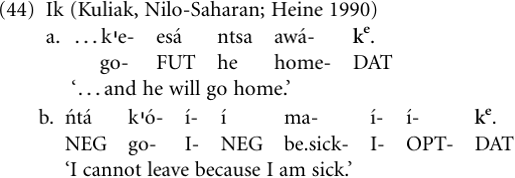
We will deal with this process in more detail in “Treating events like objects”; the following example illustrates the process. In the Ik language of north-eastern Uganda, which has an elaborate paradigm of case inflections, one of these inflections, the dative suffix-ke, has been extended to use as a clause subordinator (Heine 1990; König 2002). Example (44a) illustrates the use of the suffix as a nominal case inflection, while (44b) shows the very case marker being used as a subordinator. That this was a unidirectional process from nominal to clausal inflection is suggested by the fact that the former, but not the latter, can be reconstructed back to Proto Kuliak, the hypothetical ancestor of the family to which Ik belongs.
Complementizer, relativizer > subordinator Complementizers and adverbial clause subordinators are both means of clause subordination, but the evidence available suggests that they do not belong to the same level of grammatical development. We will discuss this evidence, hence we are confined here to summarizing the main lines of development leading from markers of complement clauses to markers of adverbial clause subordination. The development of complementizers includes two major pathways of grammaticalization, one involving demonstrative pronouns (e.g. English that) and the other involving a verb meaning ‘say’ (e.g. Ewe be̒ ‘say’). Once these two kinds of forms have been established as markers introducing clausal complements, they may undergo extension in that their use is extended to present subordinate clauses that are not part of the valence of the main (or matrix) verb.
Note, however, that the pathways discussed here concern only a small range of subordinators; in the vast majority of cases where new categories of subordinators evolve there is no intermediate stage of complementizers. An example from relative clause marker to subordinator will be discussed in “The rise of a relative clause construction”.
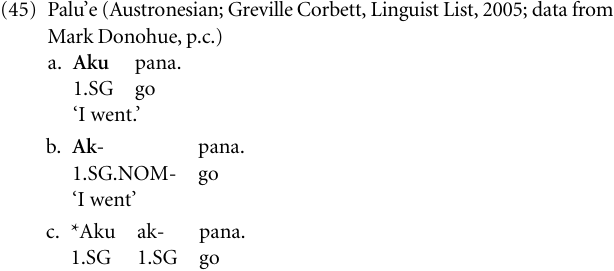
Pronoun > agreement Morphological forms described as agreement markers are, as a rule, the result of processes whereby functional categories having a clear-cut lexical or grammatical function are desemanticized to the effect that they have no more meaning other than signalling syntactic relations across words and phrases, and decategorialized in losing their independent status and becoming clitics or affixes. A paradigm instance is provided by personal subject pronouns which become obligatory clitics or affixes on verbs (see Donohue 2003 for examples in the Skou language of New Guinea). In the Palu’e language of Flores, Indonesia, there is no agreement, and none of the closely related languages has agreement. But Palu’e does have one agreement clitic, the proclitic ak-, related to aku ‘first person singular’ (45a), which can only mark a nominative argument (45b). It is clearly part of the same phonological word as the verb it attaches to, although it has not become an obligatory part of the verb, being exclusory of any free pronoun, cf. (45c).
Existing personal pronouns can be replaced by a set of new personal pronouns but survive as verbal clitics or affixes, although they have no more distinctive function since distinctions of personal deixis are now expressed by the new set of personal pronouns. The only function that the old pronouns may have is to express coreference with the pronominal or nominal subject, that is, to mark agreement between the subject and the verb.
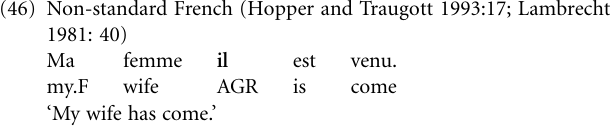
For example, the personal suffixes of Latin verbs functioned as personal pronouns since they expressed distinctions of personal deixis, for example am-at ‘s/he loves’, am-amus ‘we love’. In the development from Latin to French, distinctions of personal deixis came to be encoded by either absolute pronouns or nouns, with the result that the old personal pro nouns lost their function as deictic markers and survived as predictable markers of agreement between verb and subject, for example il aime ‘he loves’, nous aim-ons ‘we love’. But French appears to be undergoing a second development from personal pronoun to agreement marker: The new French personal pronoun il ‘he’ (derived from the Latin distal demonstrative ille (masculine) ‘that (one)’) has become an agreement marker in non-standard French, that is, a predictable form bound to the verb, no longer distinguishing number or gender, cf. (46). Accordingly, French il is suggestive of an extended pathway Demonstrative > pronoun >agreement (see Demonstrative > pronoun).
The final stage of grammaticalization is in fact reached when the erstwhile personal pronoun is no longer functionally distinctive, thereby becoming a ‘‘meaningless’’ appendage of the verb. For example, the English personal pronoun he turned in English-based Melanesian pidgins such as Tok Pisin of Papua New Guinea or Bislama of Vanuatu into a redundant proclitic i placed before the verb, initially only after third person subjects and later on via extension also to first and second person subjects, as in the following example:

While less common, roughly the same process may also lead to object agreement, whereby personal pronouns in object function become obligatory markers on the verb (see Lehmann 1982: 42).
Evidence for this pathway also comes from signed languages, where the signing space, in combination with pointing signs (or eye gaze), is recruited as the primary means for defining distinctions of personal deixis and agreement. Thus, Pfau and Steinbach (2006: 34) reconstruct the following grammaticalization chain for agreement markers: Pointing gesture > locative > demonstrative pronoun > personal pronoun > agreement marker.
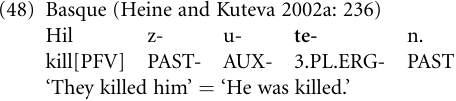
Pronoun > passive There is a wide variety of forms and structures leading to the emergence of passive markers and constructions (Haspelmath 1990; Givo ´n 2004; see also Verb > passive). Here we are concerned with only one pathway, whereby personal pronouns are reinterpreted as markers of passive constructions. The way this happens is that third-person plural subject pronouns of transitive sentences undergo desemanticization, losing their meaning and turning into markers whose only function it is to signal a syntactic configuration (see Haspelmath 1990; Heine and Kuteva 2002a: 236–7 for examples; Givo̒n 2004). Many languages exhibit the initial stage of this process, even if this is usually not appreciated by grammarians; the following is an example from Basque:
In a number of languages, this process has given rise to fully-fledged passive constructions, where an adjunct noun phrase has been introduced to present the agent which was formerly expressed by the third-person plural subject pronoun (see Givo̒n 1979b: 188, 211 for a canonical ex ample and discussion; see also Givo̒n 2004). In the following example from the Congolese Bantu language Luba, the pronoun ba- ‘they’ of the human noun class 2 (C2) has been reinterpreted as a passive prefix, the patient is structurally a direct object, and the new agent is presented in the form of an existential phrase:

The Maasai dialect of the East Nilotic language Maa shows the final stage of this process, where the third-person plural pronoun *ki ‘they’ has lost its function as a personal pronoun and is now exclusively a passive suffix (-ki or-i) (Greenberg 1959; Heine and Claudi 1986: 79–84).
An equally widespread pathway from pronoun to passive marker concerns reflexive pronouns. Unlike the process just sketched, in this pathway it is not pronouns as subject arguments but rather pronouns serving as complements, typically as clausal objects, that undergo grammaticalization. Once again, this process entails desemanticization, in that the function of the reflexive marker to express reference identity is lost and that marker is reduced to signaling a syntactic relation. However, this process does not lead straight to the passive but involves one or more intermediate stages, where the reflexive first assumes an intransitivizing, deobjective, and/or anticausative function before becoming a passive marker (Kemmer 1993; Haspelmath 1990; Heine & Miyashita 2004); we will return to this process in “A scenario of evolution”.
 الاكثر قراءة في Grammar
 اخر الاخبار
اخبار العتبة العباسية المقدسة

الآخبار الصحية


 قسم الشؤون الفكرية يصدر كتاباً يوثق تاريخ السدانة في العتبة العباسية المقدسة
 "المهمة".. إصدار قصصي يوثّق القصص الفائزة في مسابقة فتوى الدفاع المقدسة للقصة القصيرة
 (نوافذ).. إصدار أدبي يوثق القصص الفائزة في مسابقة الإمام العسكري (عليه السلام)