Lagrange Interpolating Polynomial
The Lagrange interpolating polynomial is the polynomial  of degree
  that passes through the
  points
  ,
,  , ...,
  , and is given by
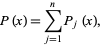 |
(1)
|
where
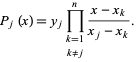 |
(2)
|
Written explicitly,
The formula was first published by Waring (1779), rediscovered by Euler in 1783, and published by Lagrange in 1795 (Jeffreys and Jeffreys 1988).
Lagrange interpolating polynomials are implemented in the Wolfram Language as InterpolatingPolynomial[data, var]. They are used, for example, in the construction of Newton-Cotes formulas.
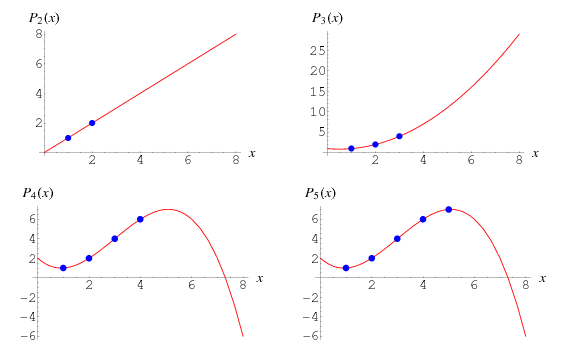
When constructing interpolating polynomials, there is a tradeoff between having a better fit and having a smooth well-behaved fitting function. The more data points that are used in the interpolation, the higher the degree of the resulting polynomial, and therefore the greater oscillation it will exhibit between the data points. Therefore, a high-degree interpolation may be a poor predictor of the function between points, although the accuracy at the data points will be "perfect."
For  points,
Note that the function  passes through the points
  , as can be seen for the case
  ,
,
Generalizing to arbitrary  ,
,
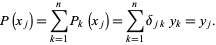 |
(9)
|
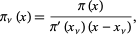
The Lagrange interpolating polynomials can also be written using what Szegö (1975) called Lagrange's fundamental interpolating polynomials. Let
so that  is an
is an  th degree polynomial with zeros at
  , ...,
  . Then define the fundamental polynomials by
 |
(14)
|
which satisfy
 |
(15)
|
where  is the Kronecker delta. Now let
  , ...,
  , then the expansion
 |
(16)
|
gives the unique Lagrange interpolating polynomial assuming the values  at
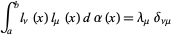
at  . More generally, let
  be an arbitrary distribution on the interval
 ![[a,b]](https://mathworld.wolfram.com/images/equations/LagrangeInterpolatingPolynomial/Inline52.gif) ,
, ![<span style=]() {p_n(x)}" src="https://mathworld.wolfram.com/images/equations/LagrangeInterpolatingPolynomial/Inline53.gif" style="height:15px; width:43px" /> the associated orthogonal polynomials, and
{p_n(x)}" src="https://mathworld.wolfram.com/images/equations/LagrangeInterpolatingPolynomial/Inline53.gif" style="height:15px; width:43px" /> the associated orthogonal polynomials, and  , ...,
  the fundamental polynomials corresponding to the set of zeros of a polynomial
  . Then
 |
(17)
|
for  , 2, ...,
  , where
  are Christoffel numbers.
Lagrange interpolating polynomials give no error estimate. A more conceptually straightforward method for calculating them is Neville's algorithm.
REFERENCES:
Abramowitz, M. and Stegun, I. A. (Eds.). Handbook of Mathematical Functions with Formulas, Graphs, and Mathematical Tables, 9th printing. New York: Dover, pp. 878-879 and 883, 1972.
Beyer, W. H. (Ed.). CRC Standard Mathematical Tables, 28th ed. Boca Raton, FL: CRC Press, p. 439, 1987.
Jeffreys, H. and Jeffreys, B. S. "Lagrange's Interpolation Formula." §9.011 in Methods of Mathematical Physics, 3rd ed. Cambridge, England: Cambridge University Press, p. 260, 1988.
Pearson, K. Tracts for Computers 2, 1920.
Press, W. H.; Flannery, B. P.; Teukolsky, S. A.; and Vetterling, W. T. "Polynomial Interpolation and Extrapolation" and "Coefficients of the Interpolating Polynomial." §3.1 and 3.5 in Numerical Recipes in FORTRAN: The Art of Scientific Computing, 2nd ed. Cambridge, England: Cambridge University Press, pp. 102-104 and 113-116, 1992.
Séroul, R. "Lagrange Interpolation." §10.9 in Programming for Mathematicians. Berlin: Springer-Verlag, pp. 269-273, 2000.
Szegö, G. Orthogonal Polynomials, 4th ed. Providence, RI: Amer. Math. Soc., pp. 329 and 332, 1975.
Waring, E. Philos. Trans. 69, 59-67, 1779.
Whittaker, E. T. and Robinson, G. "Lagrange's Formula of Interpolation." §17 in The Calculus of Observations: A Treatise on Numerical Mathematics, 4th ed. New York: Dover, pp. 28-30, 1967.








