Sharing Problem
A problem also known as the points problem or unfinished game. Consider a tournament involving  players playing the same game repetitively. Each game has a single winner, and denote the number of games won by player
  at some juncture
  . The games are independent, and the probability of the
  th player winning a game is
  . The tournament is specified to continue until one player has won
  games. If the tournament is discontinued before any player has won
  games so that
  for
for  , ...,
  , how should the prize money be shared in order to distribute it proportionally to the players' chances of winning?
For player  , call the number of games left to win
  the "quota." For two players, let
  and
and  be the probabilities of winning a single game, and
  and
and  be the number of games needed for each player to win the tournament. Then the stakes should be divided in the ratio
  , where
(Kraitchik 1942).
If  players have equal probability of winning ("cell probability"), then the chance of player
  winning for quotas
  , ...,
  is
is
 |
(3)
|
where  is the Dirichlet integral of type 2D. Similarly, the chance of player
  losing is
 |
(4)
|
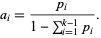
where  is the Dirichlet integral of type 2C. If the cell quotas are not equal, the general Dirichlet integral
  must be used, where
 |
(5)
|
If  and
and  , then
  and
and  reduce to
  as they must. Let
  be the joint probability that the players would be statistically ranked in the order of the
  s in the argument list if the contest were completed. For
  ,
,
 |
(6)
|
For  with quota vector
  and
and  ,
,
An expression for  is given by Sobel and Frankowski (1994, p. 838).
REFERENCES:
Kraitchik, M. "The Unfinished Game." §6.1 in Mathematical Recreations. New York: W. W. Norton, pp. 117-118, 1942.
Sobel, M. and Frankowski, K. "The 500th Anniversary of the Sharing Problem (The Oldest Problem in the Theory of Probability)." Amer. Math. Monthly 101, 833-847, 1994.








