X IS LIKE Y: The emergence of similarity mappings in children’s early speech and gesture
Does gesture pave the way for ‘X IS LIKE Y’ constructions?
As examples 32 to 45 illustrate, gesture was often used to convey a target or a source domain in an ‘X IS LIKE Y’ construction that was not specified in speech. The question we turn to next is whether gesture served as a precursor, signaling the onset of the ‘X IS LIKE Y’ construction in speech, as has been found with respect to a number of other linguistic constructions (Özçalıs̡kan and Goldin-Meadow 2005a, 2006). In other words, did children use gesture and speech together to highlight a comparison between objects before they were able to produce the word like? The short answer to this question is yes (see also Özçalıs̡kan and Goldin-Meadow, under review).
We found a number of gesture-speech combinations in which the relation between the object conveyed in gesture and the object conveyed in speech was similarity. For example, the child points at a cat and says doggie. An utterance of this sort might be an error on the child’s part. Alternatively, the utterance could reflect the child’s intent to highlight dimensions of similarity between the cat and the dog (e.g., four-legged, furry). Gesture-speech combinations of this sort might constitute the child’s earliest efforts in similarity mapping and, accordingly, might serve as a stepping-stone for the onset of ‘X IS LIKE Y’ constructions in their speech (i.e., a dog is like a cat). If so, we would expect the emergence of gesture-speech combinations that highlight the similarity between two objects to precede the appearance of the ‘X IS LIKE Y’ constructions in children’s speech. Moreover, we would expect children to produce fewer gesture-speech combinations of this sort once they have begun to use ‘X IS LIKE Y’ constructions routinely in their speech.
The children in our study produced many gesture-speech combinations in which the object conveyed in gesture and the object conveyed in speech were similar in overall appearance, shape, or color (see examples 47–61). These utterances thus resembled the types of comparisons found in the children’s early ‘X IS LIKE Y’ constructions, with the exception that they did not contain the word like.
(47) Dog + CHILD POINTS TO SQUIRREL [1;2]
(48) Juice + CHILD POINTS TO MILK [1;2]
(49) Mommy + CHILD POINTS TO FEMALE EXPERIMENTER [1;6]
(50) Car + CHILD POINTS TO TRUCK [1;6]
(51) A butterfly + CHILD POINTS TO BOW TIE [1;10]
(52) Boot + CHILD POINTS TO SOCK [1;10]
(53) Donkey + CHILD POINTS TO HORSE [1;10]
(54) Raining + CHILD POINTS TO SNOW FALL [2;2]
(55) Purple + CHILD POINTS TO BLUE BLOCK [2;2]
(56) He has the moon + CHILD POINTS TO WHITE HAIR ON NOAH’S HEAD [2;2]
(57) They have a penis + CHILD POINTS TO PIG’S TAIL [2;6]
(58) A square + CHILD HOLDS UP A DIAMOND SHAPE [2;6]
(59) More sugar + CHILD POINTS TO FLOUR [2;10]
(60) Every whale loves a bubble bath + CHILD POINTS TO OCEAN WITH WAVES [2;10]
(61) I think these are cats + CHILD POINTS TO FOX [2;10]
As can be seen in Figure 5 (see below), the frequency of children’s gesture speech combinations expressing similarity relations without the word like changed significantly over time (F(5, 170)= 3.45, p<0.01), increasing from age 1;2 (M=0.40) to age 1;6 (M=2.23). Children’s production of these combinations remained relatively unchanged between ages 1;6 and 2;6, but began to decline thereafter. Importantly, the decline at age 2;6 coincided with an increase in ‘X IS LIKE Y’ constructions. Thus, the children became less likely to produce gesture-speech combinations expressing similarity relations without the word like at just the point when they began producing similarity-based mappings in appropriate syntactic packaging (i.e., with the word like).
Consistent with the hypothesis that gesture is playing a bootstrapping role in the emergence of ‘X IS LIKE Y’ constructions, the onset of gesture-speech combinations expressing similarity relations without the word like routinely preceded the onset of ‘X IS LIKE Y’ constructions in speech. Of the 40 children in our sample, 29 (73%) produced a gesture-speech combination of this sort before producing an ‘X IS LIKE Y’ construction in speech, compared to only one child who displayed the opposite pattern (29 vs. 1, X2(1) = 38.88, p<0.001). Of the remaining 10 children, 5 produced gesture-speech combinations of this sort but had not yet produced the ‘X IS LIKE Y’ construction in speech; we expect these children to produce ‘X IS LIKE Y’ in speech in subsequent sessions.
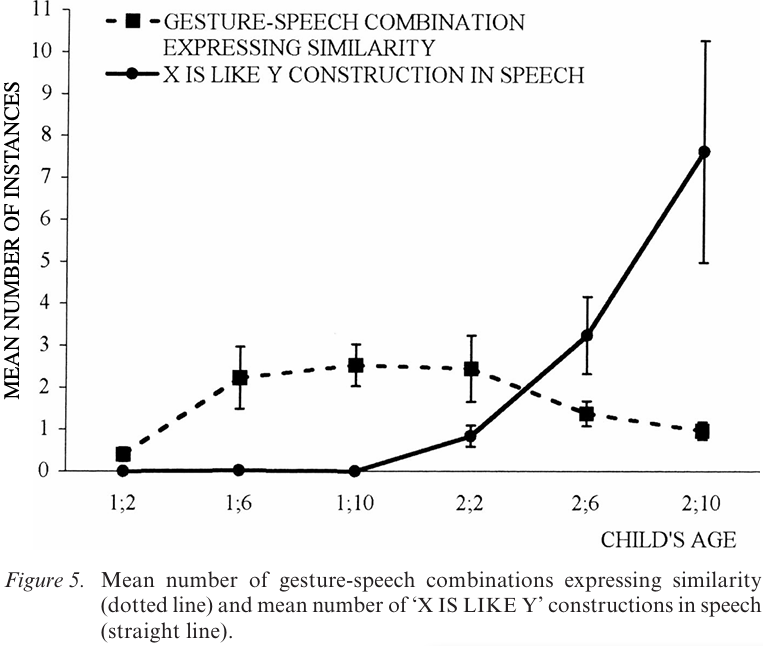
The remaining 5 children produced their first gesture-speech combination expressing a similarity relation without the word like and their first ‘X IS LIKE Y’ construction in speech during the same observation session; it is likely that we missed the onset time for the constructions in these children, possibly due to the relatively long time interval between observations (~4 months). As a result, the data for these 5 children neither support nor refute our predictions. Thus, 34 (97%) of the 35 relevant children in our sample first produced a gesture-speech combination expressing a similarity mapping without the word like, compared to 1 (2%) who first produced the ‘X IS LIKE Y’ construction in speech. Thus, gesture-speech combinations expressing a similarity relation clearly preceded the ‘X IS LIKE Y’ construction in speech, signaling a child’s readiness to make similarity-based mappings in appropriate syntactic packaging.








