X IS LIKE Y: The emergence of similarity mappings in children’s early speech and gesture
Children’s use of gesture in their ‘X IS LIKE Y’ constructions
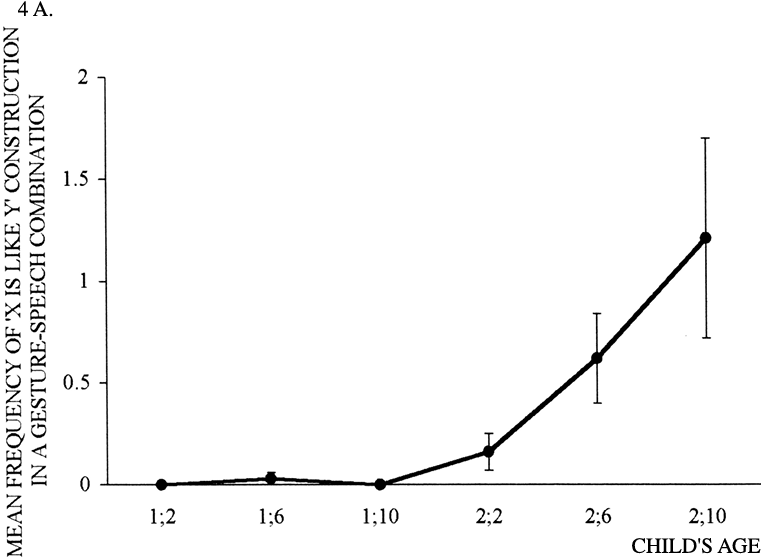
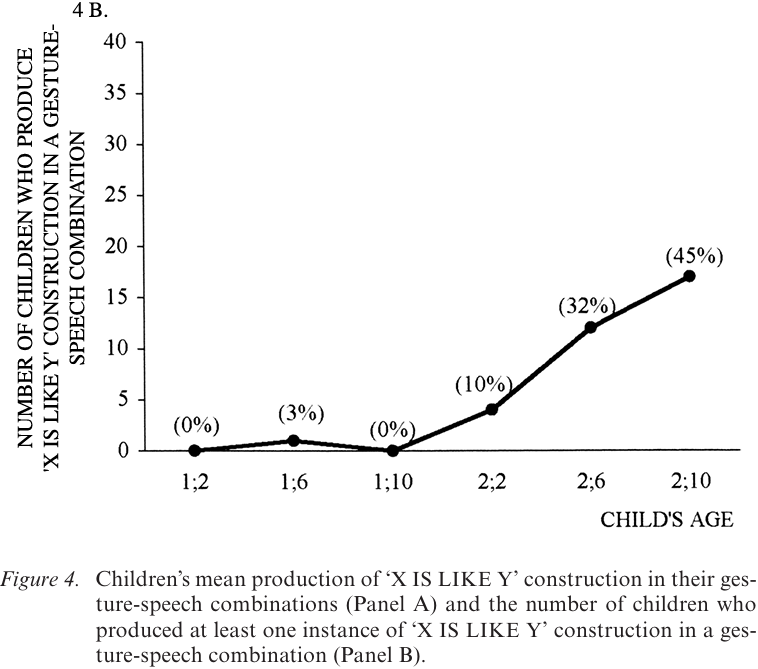
We begin by asking how often children used gesture (as opposed to other non-verbal cues) to specify either the target or the source domain in an ‘X IS LIKE Y’ construction. Figure 4A shows children’s mean production of gesture in ‘X IS LIKE Y’ constructions and Figure 4B shows the number of children who produced gesture in these constructions over the six time periods. As the figures illustrate, gesture was used in ‘X IS LIKE Y’ con structions as soon as children began producing these construction in speech, that is, at age 2;2. The number of times the children used gesture in the ‘X IS LIKE Y’ construction increased steadily over time (F(5, 170)=4.61, p<0.001), as did the number of children who used gesture. Four children used gesture in these constructions at age 2;2 (M=0.16);5 at 2;6, one third of the children (N=12/37) used gesture in at least one instance of the construction (M=0.62); and by age 2;10, almost half of the children (N=17/38) used gesture in the construction (M=1.21). Thus, gesture was used more and more often in the ‘X IS LIKE Y’ constructions over time.
Gesture served two functions in children’s ‘X IS LIKE Y’ constructions. First and most often, gesture clarified a source or a target domain that was conveyed by a pronominal in speech. Second, gesture conveyed a source or a target domain that was not conveyed in speech at all.
In terms of clarifying a pronominal reference in speech, pointing gestures were used to specify the entity in either the target domain (see examples 32–34) or the source domain (see examples 35–36) and iconic gestures were used to specify the action in the source domain (see examples 37–41).
(32) This like earl grey + CHILD POINTS TO CUP OF COFFEE [2;2]
‘Coffee is like earl grey tea’
(33) Those are like strawberries but they are not strawberries + CHILD POINTS AT TOY TOMATOES [2;6]
‘Toy tomatoes are like strawberries but they are not strawberries’
(34) Is that look like grandpa Johndeer? + CHILD POINTS AT TRACTOR PICTURE [2;6]
‘Does the tractor picture look like grandpa’s Johndeer tractor?’
(35) Shelley has sticky tape just like this one + CHILD POINTS AT STICKY TAPE ON DESK [2;10]
‘Shelley has sticky tape just like the sticky tape on desk’
(36) I can hug a baby like this one + CHILD POINTS AT BABY MOUSE IN BOOK [2;6]
‘I can hug a baby like the baby mouse in book’
(37) I eat like this + CHILD PERFORMS THE ICONIC GESTURE OF EATING WITH FIST BY MOVING FIST BACK AND FORTH TO MOUTH [2;2]
‘I eat like I eat with my fist’
(38) Like this + CHILD PERFORMS THE ICONIC GESTURE OF PLAYING THE ACCORDION BY MOVING ARMS INWARD AND OUTWARD [2;6]
‘I play the accordion like I play it in a particular style’
(39) Give it to me like this + CHILD PERFORMS THE ICONIC GESTURE OF PUTTING PRETEND NECKLACE ON NECK BY HOLDING TWO PINCHED FINGERS IN AIR [2;6]
‘Give the necklace to me like you put it around my neck’
(40) I go like that over my cup + CHILD PERFORMS THE ICONIC GESTURE OF DROPPING SOMETHING INTO THE CUP BY OPENING A CLOSED FIST IN AIR (iconic) [2;10]
‘I go like I drop something into my cup’
(41) Knocked over like this + CHILD PERFORMS THE ICONIC GESTURE OF SWAYING BY MOVING ARM OUTWARD FORCEFULLY (iconic) [2;10]
‘I knocked it over like I knocked it over by swaying it’
In terms of specifying a source or a target domain that was not encoded in speech, pointing gestures were used to convey the entity in the target domain that was not mentioned in speech (examples 42–45) and iconic gestures were used to convey the action in the source domain that was not mentioned in speech (example 46).6
(42) Like ice-cream cone + CHILD POINTS TO MUSHROOM [2;2]
‘Mushroom is like ice-cream cone’
(43) Like a sun + CHILD POINTS TO CIRCULAR OBJECT ON TV [2;10]
‘Object on TV is like a sun’
(44) Like a sheep + CHILD POINTS TO SHEEP PICTURE [2;10]
‘Sheep picture is like a sheep’
(45) Like a square + CHILD POINTS TO BLOCK STRUCTURE [2;10]
‘Block structure is like a square’
(46) You do it like + CHILD PERFORMS THE ICONIC GESTURE OF THROWING BY MOVING HER HAND FORWARD FORCEFULLY [2;6]
‘You do it like you throw it forcefully’
5. The only exception was one child who produced one instance of the construction in a gesture-speech combination at age 1;6; this was the same child who also produced one instance of the construction in speech at age 1;6.
6. Children also produced several gesture-speech combinations that drew on a similarity-based comparison by using linguistic devices other than the word like. In these instances, gesture encoded the target domain of the mapping, and speech conveyed information about the source domain (e.g., It is chocolate–kind of chocolate + CHILD HOLDS UP BROWN MARKER; Color is an apple +CHILD POINTS TO A GREEN BALLOON THAT LOOKS LIKE A GREEN APPLE). We first observed such instances at age 2;6, after the onset of the ‘X IS LIKE Y’ construction in children’s speech.








