Grammar
Tenses
Present

Present Simple
Present Continuous
Present Perfect
Present Perfect Continuous
Past
Past Simple
Past Continuous
Past Perfect
Past Perfect Continuous
Future
Future Simple
Future Continuous
Future Perfect
Future Perfect Continuous
Parts Of Speech
Nouns
Countable and uncountable nouns
Verbal nouns
Singular and Plural nouns
Proper nouns
Nouns gender
Nouns definition
Concrete nouns
Abstract nouns
Common nouns
Collective nouns
Definition Of Nouns
Animate and Inanimate nouns
Nouns
Verbs
Stative and dynamic verbs
Finite and nonfinite verbs
To be verbs
Transitive and intransitive verbs
Auxiliary verbs
Modal verbs
Regular and irregular verbs
Action verbs
Verbs
Adverbs
Relative adverbs
Interrogative adverbs
Adverbs of time
Adverbs of place
Adverbs of reason
Adverbs of quantity
Adverbs of manner
Adverbs of frequency
Adverbs of affirmation
Adverbs
Adjectives
Quantitative adjective
Proper adjective
Possessive adjective
Numeral adjective
Interrogative adjective
Distributive adjective
Descriptive adjective
Demonstrative adjective
Pronouns
Subject pronoun
Relative pronoun
Reflexive pronoun
Reciprocal pronoun
Possessive pronoun
Personal pronoun
Interrogative pronoun
Indefinite pronoun
Emphatic pronoun
Distributive pronoun
Demonstrative pronoun
Pronouns
Pre Position
Preposition by function
Time preposition
Reason preposition
Possession preposition
Place preposition
Phrases preposition
Origin preposition
Measure preposition
Direction preposition
Contrast preposition
Agent preposition
Preposition by construction
Simple preposition
Phrase preposition
Double preposition
Compound preposition
prepositions
Conjunctions
Subordinating conjunction
Correlative conjunction
Coordinating conjunction
Conjunctive adverbs
conjunctions
Interjections
Express calling interjection
Phrases
Sentences
Clauses
Part of Speech
Grammar Rules
Passive and Active
Preference
Requests and offers
wishes
Be used to
Some and any
Could have done
Describing people
Giving advices
Possession
Comparative and superlative
Giving Reason
Making Suggestions
Apologizing
Forming questions
Since and for
Directions
Obligation
Adverbials
invitation
Articles
Imaginary condition
Zero conditional
First conditional
Second conditional
Third conditional
Reported speech
Demonstratives
Determiners
Direct and Indirect speech
Linguistics
Phonetics
Phonology
Linguistics fields
Syntax
Morphology
Semantics
pragmatics
History
Writing
Grammar
Phonetics and Phonology
Semiotics
Reading Comprehension
Elementary
Intermediate
Advanced
Teaching Methods
Teaching Strategies
Assessment

Other restricted systems
 المؤلف:
Bernd Heine and Tania Kuteva
المؤلف:
Bernd Heine and Tania Kuteva
 المصدر:
The Genesis of Grammar
المصدر:
The Genesis of Grammar
 الجزء والصفحة:
P198-C4
الجزء والصفحة:
P198-C4
 2026-03-11
 24
24




+
-
20
Other restricted systems
The hypothesis that grammaticalization, and hence the development of a more elaborate grammar, requires, first, regular and frequent communication and, second, a system that is passed on from one group of speakers to another can be tested by looking at other kinds of restricted linguistic systems. In the present section we provide a summarizing discussion of a number of systems that lack these properties.
Homesigns One testing ground is provided by homesign systems (in short, homesigns).19 Homesigns, which have been documented in at least thirteen different countries, are developed by congenitally deaf children born to hearing parents who did not expose these children to a conventional sign language. The children spontaneously use and conventionalize gestures (= homesigns) in order to communicate even if they are not exposed to a conventional sign language model, and thus lack a usable signed or spoken input (e.g. Goldin-Meadow 1982, 2002; Goldin-Meadow and Mylander 1990; Goldin-Meadow, Mylander, and Butcher 1995; Mor ford and Goldin-Meadow 1997; Morford 2002; van den Bogaerde 2004).
Homesigning children were found to have stable gesture vocabularies distinguishing nouns and verbs, they could combine gestures productively into sentences, and they could form sequences of sentences by combining gestures into at least two propositions, mostly but not exclusively involving a temporal sequence of events, and they could refer to objects, actions, attributes, and locations that were not in the here and now (Goldin-Meadow and Mylander 1990; Morford and Goldin-Meadow 1997). But we have found no clear evidence that there is explicit clause subordination, nor do there appear to be grammaticalized distinctions relating, for example, to tense, aspect, number, adpositions, or to nominal and verbal modification, even if there may be some means for signaling aspectual notions by means of movements (Beppie van den Bogaerde, p.c.); nor did we find any clues that grammaticalization parameters such as desemanticization and decategorialization had been drawn on by the homesigners.
There are occasionally gestures that can be interpretated as being suggestive of functional categories. For example, Morford and Goldin Meadow (1997: 424–5) found the homesigner David to use a gesture for the question word ‘where’ (a shrug with upturned hands), and another gesture for the habitual location of a non-present object (patting the top of his head), and Goldin-Meadow (2003: 144) describes what she calls a narrative gesture ‘away’ (a palm or point hand extended or arced away from the body) marking a piece of gestural discourse as a narrative. And homesigners also appear to use strategies, or create structures, that are a prerequisite for grammaticalization, involving the extension mechanism. This concerns the ability to productively combine word units; for ex ample, in the homesign variety of Nicaragua, homesigns for ‘fruits’ are a sequence where preparation of the fruit for eating is followed by the sign EAT, for example, PEEL EAT ‘banana’, RUB-ON-SHIRT EAT ‘apple’, SLICE-OFF-TOP-WITH-MACHETE EAT ‘pineapple’ (Morford 2002: 333). All this, however, is not sufficient to argue that homesigners do grammaticalize.
Homesign systems are not normally transmitted from one generation to the next. This suggests that homesigners do not dispose of an appropriate sociolinguistic environment that appears to be a requirement for grammaticalization to take place; hence, they do not grammaticalize.
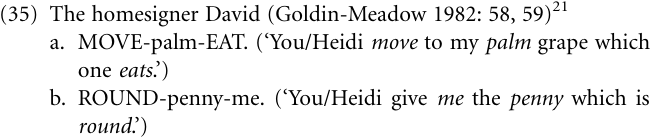
Goldin-Meadow (1982) argues that homesigners use recursion in structuring their discourses. However, in the data available we found no clear evidence that there is embedding recursion.20 For example, Goldin Meadow interprets the utterance (35a) as being suggestive of subordinate linkage analogous to relativized sentences in English. Example (35a) was produced by the homesigner David to request Heidi to give him a toy grape. While we do not wish to exclude the possibility that this example reflects recursion, the evidence available is not sufficient to establish that it does. In a similar fashion, example (35b) might be suggestive of recursive noun modification [[adjective]–noun], but once again, more data would be required to show that such a structure really exists.
The situation is different when a homesign is transmitted to another group of people, as has happened in Nicaragua in the transition from a homesign of the first cohort to Nicaraguan Sign Language of the second cohort around 1985 (see “Grammaticalization—a human faculty?”), and presumably also in some other community homesigns (Beppie van den Bogaerde, p.c.). Such situations are likely to lead to some form of grammaticalization (see “Who were the creators of early language?”; “Grammaticalization—a human faculty?”). Morford describes the transition from homesign to Nicaraguan Sign Language thus:
Homesigners started with inconsistent gesture as input, and innovated structure. Nicaraguan signers started with structured input (i.e., homesign) and grammaticized elements of the input. (Morford 2002: 333)
Twins’ languages22 These are forms of communication that are created and spoken by two (sometimes even more) hearing children who acquire language simultaneously and, while having access to normal spoken language in their critical stage of language acquisition, do not find much parental attention, receiving more language input from one another than from their parents, and using each other as models of speech formation (Bakker 1987a, 1987b, 1990, 2006). The children differ neither mentally nor physically from other children; it would seem that it is on the one hand a strong mutual psychological bond and on the other hand relative social isolation from other children and family members that are the main contributing factors for the emergence of twins’ languages. Note that the children are not necessarily twins, they may be close siblings or close friends; but the probability that a twins’ language will arise is highest with monozygotic and with same-sex twins, and even higher with triplets. Being spoken mostly between the ages of 4 and 6, the languages tend to disappear gradually thereafter, in that more and more words and grammatical rules of the matrix language (i.e. their parents’ language) are adopted.
Twins’ languages are neither ‘‘invented’’ nor are they intended to be secret languages since their speakers are as a rule monolingual; they usually arise as first languages, believed by some to be fossilized forms of child language. The children understand their matrix language, which in the thirteen cases documented was Danish, English, Estonian, German, Swiss German, Icelandic, or Russian. It has been claimed that twins’ languages, also known as secret languages or autonomous languages, or as manifestations of idioglossia or cryptophasia, can be found in some way in 40 percent of twins in early childhood, but documented cases are few.
The cases that have been documented are spoken systems with little gesturing or signing. They show drastic phonological, morphological, and syntactic simplification vis-à-vis their respective matrix languages. There is a stock of mostly lexical items which can be combined and remain stable in combinations. These items are overwhelmingly noun- or verb-like, but there are also a few other kinds of items, such as terms for colors or numbers. While onomatopoetic forms are not uncommon (e.g. tutu ‘train’ in an English, hihi ‘horse’ in an Icelandic, or düdüdüt ‘post coach’ in a Swiss German twins’ language), the lexicon is derived mainly (at least 90 percent) from lexical items of the matrix language, being basically arbitrary and multi-functional, not uncommonly belonging simultaneously to several grammatical categories. The form hapn of a German twins’ language, for instance, means both ‘food’ and ‘to eat’.
Utterances consist mostly of nouns and verbs strung together, they are mono-propositional, although occasionally sequences of propositions do occur, as in (36). Word order is fairly free, but old information, or information that is uppermost in the speaker’s mind, tends to be presented first, while new information is placed later. A common feature across twins’ languages is that utterances are frequently introduced by vocative nouns, cf. (37). Compounds are occasionally encountered, for example koko-dach ‘store’ (< German Kauf+ Dach ‘buy+ roof’) in a German twins’ language, but are not necessarily suggestive of a head–modifier construction. No form of grammaticalization has been found in any of the twins’ languages.
There is no inflectional morphology; grammatical forms such as copulas, plural markers, case markers, adpositions, tense–aspect markers, or conjunctions are absent, but reduplication is not uncommon. The few functional elements that do exist, in particular distinct words for negation and yes–no questions, appear to be derived in some way or other from the matrix language that the children are exposed to rather than having been created via grammaticalization, cf. the negation marker in (37) and (38) or the question marker in (39). There is no clause subordination of any kind, nor is there any kind of recursive structure. But a possibly note-worthy characteristic is that some of these systems show complex predicates consisting of combinations of two verbs, as in example (37).
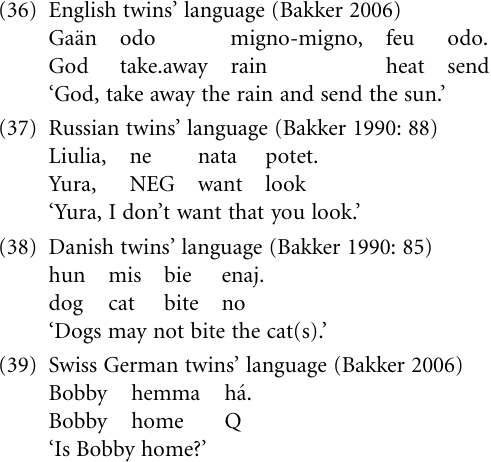
Exactly what the status of twins’ languages is vis-a `-vis other forms of first language acquisition remains a question that cannot be answered conclusively on the basis of the limited data available. We follow Bakker (1987a, 1987b, 1990, 2006) in assuming that they represent a specific structural type: First, they share a number of sociolinguistic and linguistic properties, such as the ones mentioned above, second, they are fairly efficient media of communication for their speakers, spoken fast and fluently, usually being unintelligible to non-speakers, third, they are apparently not transmitted to other groups of speakers, fourth, it seems that they cannot be reduced to being impoverished variants of the respective matrix languages or representing a frozen stage of first language acquisition. Even if the lexicon is overwhelmingly derived from the respective matrix language, the grammar is not, showing principles of discourse organization that are not the same as those underlying the latter. And finally, twins’ languages do not exhibit any of the prerequisites for grammaticalization that we mentioned in the introduction, hence there is no grammaticalization—in particular no inflection, derivation, clause subordination, or recursive structure.
Isolated children But what about feral human beings who in their childhood have been raised intentionally in social and linguistic isolation—in short, ‘‘isolated children’’? There are three cases that provide a reasonable basis for answering this question, the persons concerned being Kaspar Hauser, Genie, and Chelsea (Curtiss 1977, 1994: 225–31; MacSwan and Rolstad 2005; for more information on feral children, see Aitchison 1989, and Candland 1993). The following sketchy remarks are restricted to language-like behavior that allow for comparisons across the different kinds of human and animal behavior.
All the available data suggest that Kaspar Hauser was kept in total isolation in a small room from the age of 3 or 4 until about 15 or 16 years of age, being released and discovered in Nuremberg in 1828, but he was assassinated in 1833 at age 21. Within this short period of five years he learned to read and write, and he mastered semantic aspects of the German language.
A few months after his discovery, Kaspar acquired a sizable vocabulary and began to combine words into ‘‘sentences.’’ While being able to actively participate in intellectual discussions, there was little in terms of morph ology or syntax. Kaspar’s verbs were restricted mostly to infinitive forms, and there were almost no conjunctions, participles, or adverbs; there is no evidence of grammaticalization of any kind. And he rarely used the first-person pronoun ich, referring to himself in the third person (Kaspar). The linguistic categories he created were not necessarily those that he learned from the people who looked after him; for example, he developed a distinction between human and non-human concepts, the former expressed by bua (from Bavarian bua ‘boy’, High German Bub) and the latter by ross (from German Ross ‘horse’). The semantic over-generalizations that we observed in animals were also characteristic of Kaspar’s speech. His ability to create novel expressions by re-combining existing ones is illustrated by these examples: He referred to a fat man as ‘the man with the mountain’ and to a woman whose shawl dragged on the ground as ‘the lady with the tail.’
Genie was isolated from age 1;8 to 13;7—that is, for a period of twelve years she was imprisoned by her father in a small bedroom in the back of the family home in California. She had little linguistic input; her brother and father were her primary caretakers but did not speak to her. Her blind mother managed to escape with her from the home when Genie was 13, and when Genie was discovered in 1970 she could barely walk, chew or bite, and she did not understand nor speak language.
Genie began to produce words within a few months, and three to four months later she had acquired an expressive vocabulary of 100 to 200 words, including words for colors, numbers, and lexical taxonomic hierarchy (superordinate, basic, subordinate), and she could combine two words. She produced increasingly longer strings of words, but her utterances remained what Curtiss (1994: 228) describes as ‘‘agrammatic and hierarchically flat.’’ As the following utterance illustrates, propositions are simply juxtaposed, and there are essentially no personal pronouns, with distinctions of personal deixis being expressed by means of proper names.
(40) Genie (MacSwan and Rolstad 2005: 232)
Father hit Genie cry long time ago.
‘When my father hit me, I cried, a long time ago.’
She was able to talk about persons and objects in their absence, and about events to come. There remained a discrepancy between her lexical and semantic achievements on the one hand and her grammatical ones on the other. After eight years, her speech was still essentially without closed-class morphology, there were no categories such as prepositions or pronouns, and hardly any syntactic devices; accordingly, there was no grammaticalizing behavior, and no recursion.23 Nevertheless, Genie’s competence for effective communication was well in place but her grasp of the linguistic skills that are important for social participation in conversations (e.g. use of social rituals) remained generally poor. And she relied heavily on simple propositions or on repetition for expressing pragmatic functions.
The case of the hearing-impaired Chelsea is of a different nature; she was an adult who attempted first language acquisition only in her thirties. Unlike Genie, she acquired a reasonable command of social rituals and conversational operators. But as in the cases of Kaspar and Genie, there is a marked disparity between lexical achievements and the ability to com bine vocabulary into appropriate and grammatical utterances: While her ability to acquire a lexicon progressed steadily, her multi-word utterances were for the most part grammatically ill formed and remained frequently propositionally unclear. But conceivably she acquired the use of noun modification, as examples such as (41) might suggest. Whether such examples reflect the ability to understand the concept of taxonomic inclusion (see “Taxonomic concepts”), however, remains unclear.
(41) Chelsea (MacSwan and Rolstad 2005: 233)
Missy girl same both girl.
[Comparing the gender of two animals]
Combining semantically relevant nouns was all Chelsea could achieve in terms of expressive language. There are no indications that Chelsea used grammaticalization in her utterance production. Curtiss (1994: 230) notes that while lexical and propositional semantics developed with apparent ease in the cases of both Kaspar and Genie, Chelsea experienced problems with propositional form.
19 Our interest here is exclusively with systems developed by children; the behavior of adult homesigners would seem to require a separate treatment. The term ‘‘homesign’’ is not entirely satisfactory since the linguistic units making up such systems are to be described more appropriately as gestures rather than as signs (Bencie Woll, p.c.).
20 Note that Goldin-Meadow (1982: 54) uses the term recursion in a wider sense—one that includes iteration (see “Embedding, iteration, and succession”).
21 In these examples, the following conventions are used: lowercase = referents of deictic signs; capitals = glosses for the referents of characterizing signs (Goldin-Meadow 1982: 7)
22 The following account is based entirely on Bakker (1987a, 1987b, 1990, 2006). We are grateful to Peter Bakker for having made his materials available to us. In earlier publications, Bakker preferred the term ‘‘autonomous language’’ to twins’ language.
23 Here we differ from Goldin-Meadow (1982: 53), who argues that Genie learned recursion. That Genie was in fact able to use adjective–noun combinations productively is suggested by utterances such as the following: Ask teacher yellow material. Blue paint. Yellow green paint. Genie have blue material (Bickerton 1990: 117). But whether this should be interpreted as being suggestive of noun phrase recursion is a question that is hard to answer on the basis of the evidence available.
 الاكثر قراءة في Linguistics fields
 اخر الاخبار
اخبار العتبة العباسية المقدسة

الآخبار الصحية


مواضيع ذات صلة
 قسم الشؤون الفكرية يصدر كتاباً يوثق تاريخ السدانة في العتبة العباسية المقدسة
 "المهمة".. إصدار قصصي يوثّق القصص الفائزة في مسابقة فتوى الدفاع المقدسة للقصة القصيرة
 (نوافذ).. إصدار أدبي يوثق القصص الفائزة في مسابقة الإمام العسكري (عليه السلام)