Grammar
Tenses
Present

Present Simple
Present Continuous
Present Perfect
Present Perfect Continuous
Past
Past Simple
Past Continuous
Past Perfect
Past Perfect Continuous
Future
Future Simple
Future Continuous
Future Perfect
Future Perfect Continuous
Parts Of Speech
Nouns
Countable and uncountable nouns
Verbal nouns
Singular and Plural nouns
Proper nouns
Nouns gender
Nouns definition
Concrete nouns
Abstract nouns
Common nouns
Collective nouns
Definition Of Nouns
Animate and Inanimate nouns
Nouns
Verbs
Stative and dynamic verbs
Finite and nonfinite verbs
To be verbs
Transitive and intransitive verbs
Auxiliary verbs
Modal verbs
Regular and irregular verbs
Action verbs
Verbs
Adverbs
Relative adverbs
Interrogative adverbs
Adverbs of time
Adverbs of place
Adverbs of reason
Adverbs of quantity
Adverbs of manner
Adverbs of frequency
Adverbs of affirmation
Adverbs
Adjectives
Quantitative adjective
Proper adjective
Possessive adjective
Numeral adjective
Interrogative adjective
Distributive adjective
Descriptive adjective
Demonstrative adjective
Pronouns
Subject pronoun
Relative pronoun
Reflexive pronoun
Reciprocal pronoun
Possessive pronoun
Personal pronoun
Interrogative pronoun
Indefinite pronoun
Emphatic pronoun
Distributive pronoun
Demonstrative pronoun
Pronouns
Pre Position
Preposition by function
Time preposition
Reason preposition
Possession preposition
Place preposition
Phrases preposition
Origin preposition
Measure preposition
Direction preposition
Contrast preposition
Agent preposition
Preposition by construction
Simple preposition
Phrase preposition
Double preposition
Compound preposition
prepositions
Conjunctions
Subordinating conjunction
Correlative conjunction
Coordinating conjunction
Conjunctive adverbs
conjunctions
Interjections
Express calling interjection
Phrases
Sentences
Clauses
Part of Speech
Grammar Rules
Passive and Active
Preference
Requests and offers
wishes
Be used to
Some and any
Could have done
Describing people
Giving advices
Possession
Comparative and superlative
Giving Reason
Making Suggestions
Apologizing
Forming questions
Since and for
Directions
Obligation
Adverbials
invitation
Articles
Imaginary condition
Zero conditional
First conditional
Second conditional
Third conditional
Reported speech
Demonstratives
Determiners
Direct and Indirect speech
Linguistics
Phonetics
Phonology
Linguistics fields
Syntax
Morphology
Semantics
pragmatics
History
Writing
Grammar
Phonetics and Phonology
Semiotics
Reading Comprehension
Elementary
Intermediate
Advanced
Teaching Methods
Teaching Strategies
Assessment

Grammaticalization in other pidgins
 المؤلف:
Bernd Heine and Tania Kuteva
المؤلف:
Bernd Heine and Tania Kuteva
 المصدر:
The Genesis of Grammar
المصدر:
The Genesis of Grammar
 الجزء والصفحة:
P187-C4
الجزء والصفحة:
P187-C4
 2026-03-10
 43
43




+
-
20
Grammaticalization in other pidgins
That a pidgin, after having undergone a ‘‘stripping’’ process, may acquire new grammatical structures is well documented, especially for extended pidgins or creoles such as Tok Pisin and other English-based pidgins in Oceania (e.g. SankoV and Laberge 1973; SankoV and Brown 1976; SankoV 1979; Keesing 1991; Romaine 1992a, 1992b, 1995, 1999; Aitchison 1996; Meyerhoff 2001); in fact, some of the best described cases of grammaticalization in the literature on this Weld are devoted to Tok Pisin (Romaine 1995, 1999). SankoV (1979) shows how in Tok Pisin new grammatical categories evolved, such as markers for number, tense, and causativity, or complementizers and relative clause markers, and how meaningful morphemes, such as personal pronouns, may develop into largely obligatory and redundant elements of clause structure. Keesing (1991) describes how English-based extended pidgins such as Solomons Pijin or Bislama of Vanuatu developed new grammatical profiles as a result of the influence from Austronesian languages,1 and similar processes have been reported for Ghanaian Pidgin English (Huber 1996, 1999). What these processes have in common is that they are essentially always based on grammaticalization. In the remainder of this section we provide a few examples to illustrate these processes; the reader is referred to the works listed above for a wealth of additional examples.
We discussed a process leading from adverbs to demonstratives and another process from demonstratives to relative clause markers, in accordance with the universal pathway in (24).
(24) Locative adverb > demonstrative > relative marker
An example of this pathway is provided by the English-based Tok Pisin and other varieties of Melanesian PE, where the English adverb here was grammaticalized to a demonstrative and a relative clause marker ia (or ya). Since its origins around 1880, strategies of relativization have been gradually arising in Tok Pisin. According to Romaine (1992a: 146, 170), zero-marked relative clauses may have been the original strategy in Tok Pisin, and relative clauses are comparatively recent developments in the history of the language, and this applies especially to ‘‘bracketing relative clauses’’ (Romaine 1992a: 166–7). SankoV and Brown (1976) discuss how the new relativizer ia developed from a demonstrative or generalized deictic particle in discourse. The following examples illustrate the various stages in this development, where (25a) shows the use as a place adverbial, (25b) as a postposed deictic or demonstrative, and (25c) as a double-bracketed relativizer.
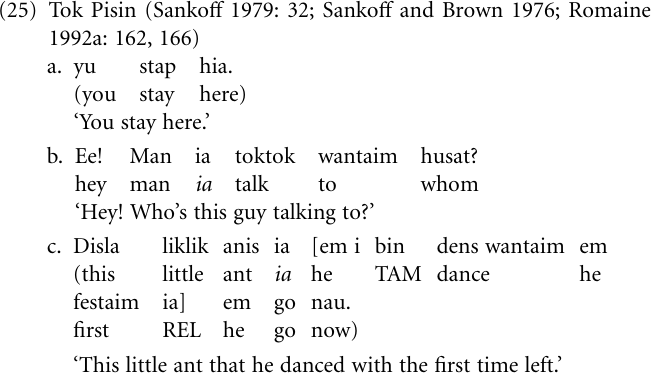
Sankoff describes this process in the following way:
We argued that relativization grew out of the need in discourse for ‘‘bracketing’’ devices for use in the organization of information, and that as the use of Tok Pisin expanded, the slot occurring after ia (itself always postposed to the noun it qualifies) was a strategic location for the insertion of further qualifying information. As this information came more and more to take the shape of a full sentence, ia became available for reanalysis as a relativizing particle. (SankoV 1979: 32)
And Tok Pisin provides further information on the rise of clause subordination. One concerns the grammaticalization from question word to clause subordinator—a process that is particularly common in European languages (see “The interrogative channel”). There appear to have been two different ways of using the interrogative-to-relativizer grammaticalization in Tok Pisin. One concerns the marker husat, presumably derived from a propositional meaning who is that?. Romaine (1992a: 159) says that the emergence of the relativizer husat is more characteristic of written Tok Pisin and does not normally occur in the spoken language:

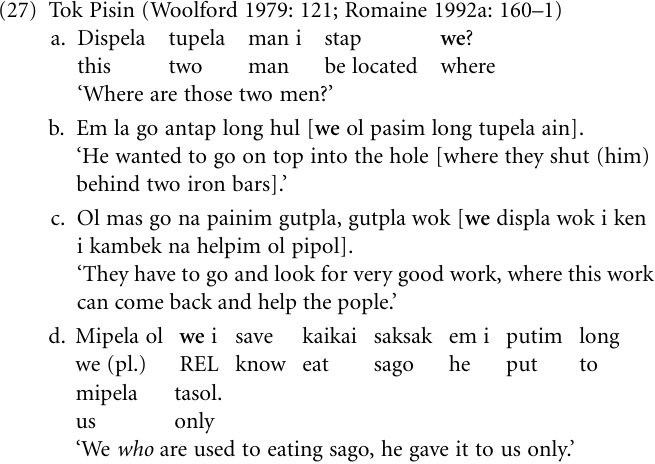
The second is the one we discussed above, namely we, historically derived from the English place interrogative adverb where. In accordance with its conceptual source, it is used mainly for marking locative relatives, although its use has been extended marginally to subject and object relatives (Romaine 1992a: 159).
On the basis of the data available it is possible to reconstruct the development of the relativizer we (see Romaine 1992a: 160–1): At stage 0, it was used exclusively as a question word, as it is up to today; cf. (27a). At stage 1, its use was extended to locative relatives, as in (27b). Stage 3 marks the transition from locative to object relative, where the head noun wok ‘work’ is repeated, cf. (27c). At the final stage 4, we no longer allows a locative interpretation; it is now a general relativizer, as in (27d).
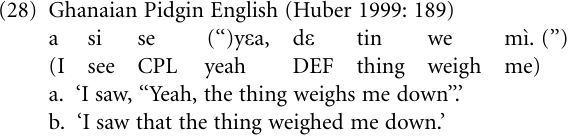
The development of new modes of clause subordination is virtually predictable in the later development of pidgins. The following is an example from Ghanaian Pidgin English of West Africa, illustrating the process from a speech act verb ‘say’ to a complementizer. The following sentence can be interpreted in the same way as a direct-speech utterance, where the erst while verb se ‘say’ functions as a quotative marker (28a), or as a [main clause–complement clause] structure, where se has the function of a complementizer2 after the perception verb si ‘see’ (28b).3
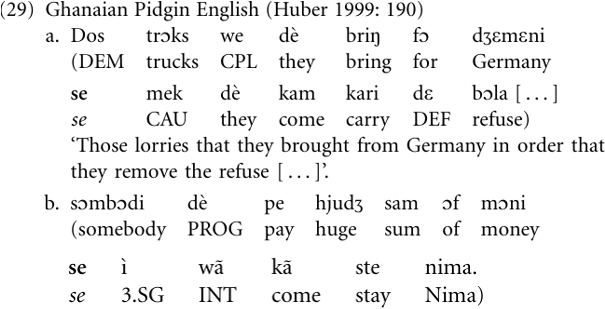
Ghanaian Pidgin English illustrates another component of the development from ‘say’ to clause subordinator. Complementizers may grammaticalize further into purpose clause markers (see “From complementizer or relativizer to adverbial clause subordinator”), and se also serves as a purpose clause marker (29a), but this pidgin has gone one step further, in grammaticalizing the ‘say’-verb to a marker of cause clauses, cf. (29b).
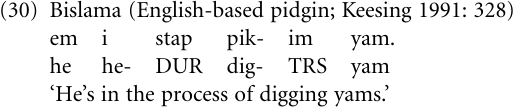
More examples of grammaticalization can be found in other English-based extended pidgins. In Bislama, a pidgin of Vanuatu, speakers used an expression commonly recruited crosslinguistically to develop progressive and durative aspect markers (Heine and Kuteva 2002a: 127, 198), namely the verb stap ‘stay, be present, exist’, historically derived from English stop, to develop a durative aspect marker:4
The following example from Solomons Pijin illustrates the magnitude of grammaticalization that can be observed in the English-based pidgins of Melanesia and Oceania: The future (FUT) marker bae is a grammaticalized form of the English adverb by-and-by, the particle das (or des, tes), which is presumably a grammaticalized form of English just, expresses an immediate future tense when combined with the future marker bae, the transitivizing suffix-im (TRS) arose via the grammaticalization of the English object pronoun him, and the inclusive personal pronoun iumi ‘we (including hearer)’ is diachronically a combination of English you and me, being one of a number of examples where the pidgin has grammaticalized new categories of personal deixis for which there are no equivalents in the English source language. These four categories are all creations that arose in the process of pidgin development.5

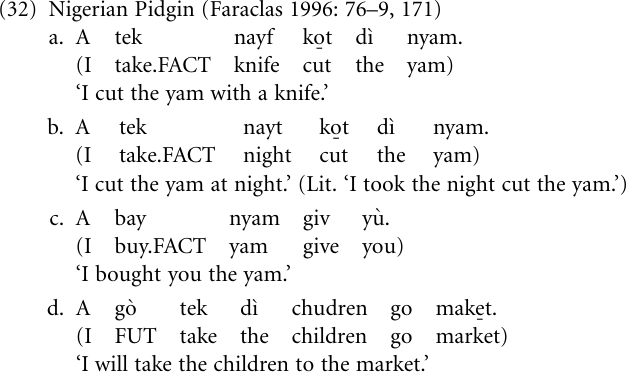
In Nigerian Pidgin English, a number of verbs were grammaticalized to prepositions and markers of argument structure. Accordingly, the verb tek ‘take’ (< English take) is used for instrumental (32a) and a number of other participants, such as time in (32b), giv ‘give’ (< give) for benefactive participants (32c), and the motion verbs go ‘go’ (< go) and kom ‘come’ (< come) for directed motion, cf. (32d).
These are but a few examples showing that the situation that we found in KPS is by no means unusual: Once pidgins have passed the ‘‘stripping’’ phase, they will—under appropriate conditions—undergo the same kind of grammaticalization processes as any other languages. Indeed, these cases are frequently young or incipient grammaticalizations, but this would be predicted by grammaticalization theory on account of the young age of the linguistic systems concerned. A wealth of additional cases have been documented for Tok Pisin and related pidgins; suffice it to mention the rise of a proximative aspect category (Romaine 1999), or of pronominal dual and trial markers out of the numerals tu ‘two’ and tri ‘three’ (see Heine and Kuteva 2005). The examples provided suggest that grammaticalization is not restricted to extended pidgins: At no stage in its short history would KPS qualify as an extended pidgin; all the processes that we described in “The rise of new functional categories” took place within an extremely short timespan.
Even in pidgins that have been claimed to ‘‘have no structure’’ (Bickerton 1990: 120–2) there is clause subordination: Both pidgin varieties discussed by Bickerton, one spoken by immigrants to Hawaii and the other (Russo-norsk) used in trading contacts between Russian and Scandinavian sailors, have conditional subordinate clauses. And there are also indications that grammaticalization is at work, as the following example suggests:
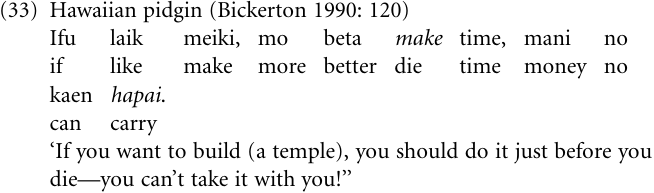
Bickerton observes that mo beta (more better) roughly corresponds to the English auxiliary should. There is a crosslinguistically attested grammaticalization process whereby expressions like ‘‘It is enough/fitting/suitable/ good (that)’’ are grammaticalized to deontic modals of necessity or obligation, meaning ‘must’ or ‘should’ (Heine and Kuteva 2002a). We saw one instance of this process in “The rise of new functional categories”, and it would seem plausible that mo beta of Hawaiian pidgin is another instance, whereby something like ‘(it is) better (to) do’ is reinterpreted as ‘(you) should do’ in an incipient process of grammaticalization.6
1 Tok Pisin, Solomons Pijin, and Bislama are all to a very large extent continuations and further developments of East Australian Aboriginal Pidgin English. This is due to the ‘‘labour trade’’ whereby men from these islands were ‘‘recruited,’’ often against their will, to work in Queensland (from 1863) for three years. A great many features of these pidgins, some of them to be discussed below, are already attested East Australian Aboriginal Pidgin English (Philip Baker, p.c.).
2 Note, however, that there is a caveat with the complementizer se of Ghanaian Pidgin English: ‘‘[ . . . ] se, one of whose main functions is to introduce subordinate clauses after verbs of cognition, perception, or saying. This particle appears to be cognate with English say but its position in WAPE [West African Pidgin English; a.n.] has probably been consolidated by the near-homophonous Akan form se ‘that, whether, if’ which in turn may go back to se ‘say’ [...]’’ (Huber 1999:188).
3 Huber comments on this example thus: ‘‘The ambiguity of these sentences attests to the fact that the complementizer results from a grammaticalization of the main verb se ‘say’, and shows that intermediate stages of this process are still observable in GhaPE [Ghanaian Pidgin English; a.n.].’’ (Huber 1999: 189).
4 Our interpretation of this case rests on Keesing (1988). The grammaticalization of verbs meaning ‘stay, be present, exist’ as durative or progressive markers is crosslinguistically widespread (see Heine and Kuteva 2002a). Note further that this grammaticalization is not confined to Bislama, it can also be observed in Tok Pisin and Solomons Pijin, and it remains unclear whether the process looked at here took place independently of these other cases.
5 That in all of them language contact played some role (Keesing 1991; Heine and Kuteva 2005) is irrelevant for the present purposes.
6 The corresponding English construction, as in You’d better go now appears to be another instance of this process, which may have served as a model to these speakers of Hawaiian pidgin English.
 الاكثر قراءة في Linguistics fields
 اخر الاخبار
اخبار العتبة العباسية المقدسة

الآخبار الصحية


مواضيع ذات صلة
 قسم الشؤون الفكرية يصدر كتاباً يوثق تاريخ السدانة في العتبة العباسية المقدسة
 "المهمة".. إصدار قصصي يوثّق القصص الفائزة في مسابقة فتوى الدفاع المقدسة للقصة القصيرة
 (نوافذ).. إصدار أدبي يوثق القصص الفائزة في مسابقة الإمام العسكري (عليه السلام)