Simple clitics
Bound words
Bound words are the most obvious kind of simple clitic: words which are phonologically bound (attached to a host), but otherwise behave like normal words. Bound words belong to one of the established lexical categories of the language, and generally have the same distribution and other syntactic properties as free words belonging to the same category. The Indonesian clitic pronouns provide a typical example.
Indonesian has two different kinds of personal pronouns, bound (i.e. clitic) and free. For simplicity, we will focus on the third person singular forms: the free pronoun dia and the enclitic=nya. The fact that=nya is phonologically bound to its host can be demonstrated by stress placement. Cohn (1989) states that primary stress in Standard Indonesian always occurs on the next-to-last syllable of the phonological word. This makes it easy to identify phonological word boundaries, since wherever we find a syllable that bears primary stress, we know that the next syllable must occur at the end of a phonological word. As Cohen demonstrates, primary stress must shift one syllable to the right when either a suffix (7d) or an enclitic (7c) is added.
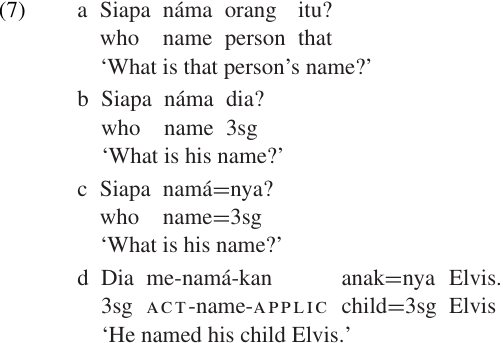
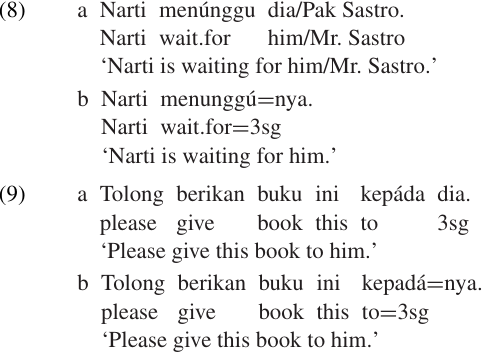
Pronouns belong to the category NP, and can occur wherever NPs occur. The clitic pronouns occur in the same position as the free forms; in most contexts the two are freely interchangeable, as illustrated in (8–9), except that clitic pronouns cannot occur in subject position. Notice that the clitic pronoun =nya attaches to a variety of different hosts: nouns (7c), verbs (8b), prepositions (9b), etc. This pattern of “promiscuous attachment” is a strong indication that =nya is a clitic and not a suffix.
The English reduced auxiliary forms illustrated in (5) and (6) are frequently cited as examples of bound words. Again, these forms are largely interchangeable with equivalent free forms. The existence of a corresponding free form is not, however, a necessary property of bound words. For example, Roberts (1996) states that all the post-positions in Amele are clitics (bound words); there are no alternate free forms.








