Metathesis
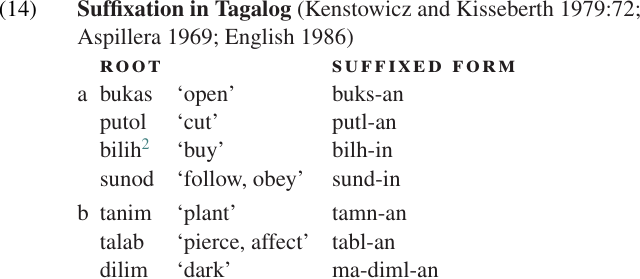
The term METATHESIS refers to the reversal of two elements: xy → yx. PHONOLOGICAL METATHESIS, i.e. a morphophonemic process that reverses the order of two phonemes in a particular phonological context, is not too unusual. For example, some roots in Tagalog lose the vowel of their final syllable when a suffix is added, as illustrated in(14a). If this vowel deletion creates a consonant cluster in which a labial follows a dental/alveolar, as in(14b), the order of the consonants in the cluster is reversed. This kind of metathesis can be viewed as a “repair strategy” which a language may use to deal with impermissible clusters or other syllable patterns which are not allowed in that language.
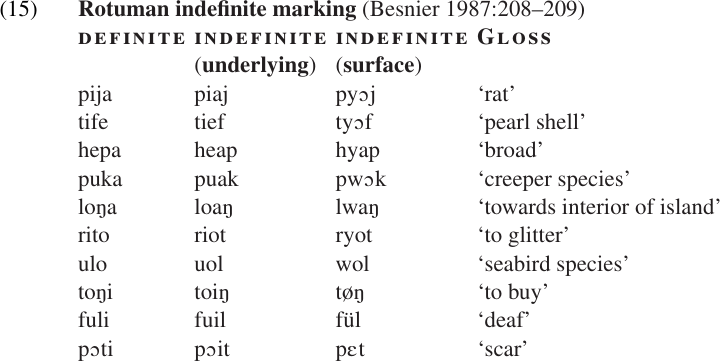
Cases of MORPHOLOGICAL METATHESIS, i.e. cases in which the metathesis itself is used as the marker for a particular grammatical feature, are much harder to find. One of the most famous examples is the Malayo-Polynesian language Rotuman, spoken east of Fiji. The basic syllable pattern in Rotuman is (C) V, so most words end with a vowel in their basic or “citation” form. This is also the form that would be used in a noun phrase that refers to a definite, specific entity. When a noun phrase is used within definite or non-specific reference, the last word in the NP is marked by reversing the order of the final vowel and consonant. The resulting CVVC sequence is then “squeezed” down into a single C(C)VC syllable by various phonological processes such as glide formation, vowel coalescence, etc. Some of these processes are illustrated in (15). (Notice that many of the words in this list are not nouns. This is because indefiniteness is marked only on the last word of the NP, which is not necessarily the head noun. In relative clauses, for example, the modifying clause follows the head noun, so the last word of the phrase could belong to virtually any category.) The key point here is that the metathesis is triggered by a syntactic (or perhaps pragmatic) feature, [-definite], rather than a specific phonological context. Such examples are quite rare.
2. The final–h in bilih is not written in the standard orthography, but is assumed to be present in the underlying form.








