Grammar
Tenses
Present

Present Simple
Present Continuous
Present Perfect
Present Perfect Continuous
Past
Past Simple
Past Continuous
Past Perfect
Past Perfect Continuous
Future
Future Simple
Future Continuous
Future Perfect
Future Perfect Continuous
Parts Of Speech
Nouns
Countable and uncountable nouns
Verbal nouns
Singular and Plural nouns
Proper nouns
Nouns gender
Nouns definition
Concrete nouns
Abstract nouns
Common nouns
Collective nouns
Definition Of Nouns
Animate and Inanimate nouns
Nouns
Verbs
Stative and dynamic verbs
Finite and nonfinite verbs
To be verbs
Transitive and intransitive verbs
Auxiliary verbs
Modal verbs
Regular and irregular verbs
Action verbs
Verbs
Adverbs
Relative adverbs
Interrogative adverbs
Adverbs of time
Adverbs of place
Adverbs of reason
Adverbs of quantity
Adverbs of manner
Adverbs of frequency
Adverbs of affirmation
Adverbs
Adjectives
Quantitative adjective
Proper adjective
Possessive adjective
Numeral adjective
Interrogative adjective
Distributive adjective
Descriptive adjective
Demonstrative adjective
Pronouns
Subject pronoun
Relative pronoun
Reflexive pronoun
Reciprocal pronoun
Possessive pronoun
Personal pronoun
Interrogative pronoun
Indefinite pronoun
Emphatic pronoun
Distributive pronoun
Demonstrative pronoun
Pronouns
Pre Position
Preposition by function
Time preposition
Reason preposition
Possession preposition
Place preposition
Phrases preposition
Origin preposition
Measure preposition
Direction preposition
Contrast preposition
Agent preposition
Preposition by construction
Simple preposition
Phrase preposition
Double preposition
Compound preposition
prepositions
Conjunctions
Subordinating conjunction
Correlative conjunction
Coordinating conjunction
Conjunctive adverbs
conjunctions
Interjections
Express calling interjection
Phrases
Sentences
Clauses
Part of Speech
Grammar Rules
Passive and Active
Preference
Requests and offers
wishes
Be used to
Some and any
Could have done
Describing people
Giving advices
Possession
Comparative and superlative
Giving Reason
Making Suggestions
Apologizing
Forming questions
Since and for
Directions
Obligation
Adverbials
invitation
Articles
Imaginary condition
Zero conditional
First conditional
Second conditional
Third conditional
Reported speech
Demonstratives
Determiners
Direct and Indirect speech
Linguistics
Phonetics
Phonology
Linguistics fields
Syntax
Morphology
Semantics
pragmatics
History
Writing
Grammar
Phonetics and Phonology
Semiotics
Reading Comprehension
Elementary
Intermediate
Advanced
Teaching Methods
Teaching Strategies
Assessment

Tagalog: verbless clauses
 المؤلف:
PAUL R. KROEGER
المؤلف:
PAUL R. KROEGER
 المصدر:
Analyzing Grammar An Introduction
المصدر:
Analyzing Grammar An Introduction
 الجزء والصفحة:
P178-C10
الجزء والصفحة:
P178-C10
 2026-01-15
 289
289




+
-
20
Tagalog: verbless clauses
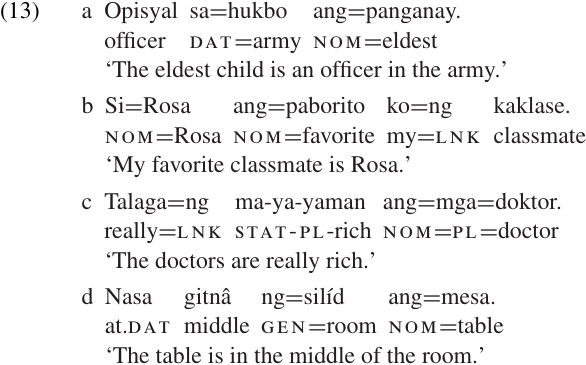
As we saw in (3), attributive, equative, and locative clauses in Tagalog do not contain a copula. Some slightly more complex examples are given in (13). (13a) shows an equative clause with an indefinite predicate NP; (13b) shows an equative clause with a definite predicate NP; (13c) shows an attributive clause with a complex AP as predicate; and (13d) shows a locative clause.1
How shall we represent the structure of these verbless clauses? Some linguists assume that languages like Tagalog employ a “silent” (or invisible) copula, and that the structure of these clauses is essentially the same as the structure of their English translations. However, at least for Tagalog there seems to be no language-internal evidence for this assumption. In fact, there is good evidence that the structure of verbless clauses is very different from the structure of clauses which contain a verb.2 Rather than assuming an invisible copula as the grammatical head of these clauses, it seems preferable (at least for Tagalog) simply to assume that the grammatical head is the NP, AP, or PP which expresses the semantic predicate. This analysis is indicated in the PS rules in (14).
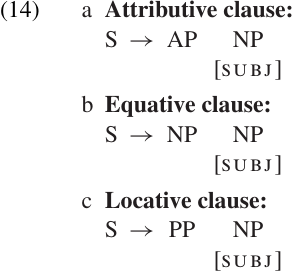
But these rules raise an interesting question. The Coherence condition implies that the complement relations (SUBJ, OBJ, OBJ2, OBL, and now XCOMP) can only occur in a clause when they are subcategorized, i.e. selected by the lexical entry of their predicate. If Tagalog verbless clauses have the structure shown in (14), how are the SUBJ phrases in (3) and (13) subcategorized? Can adjectives, nouns, and prepositions assign the SUBJ relation?
Bresnan (2001) has argued that the answer is “yes,” not just for languages like Tagalog but even for English. She presents a variety of evidence, which we will not discuss here, showing that an XCOMP of any category must assign the SUBJ relation to the phrase of which it is predicated. For example, the XCOMPs in (8a, b) assign the SUBJ relation to the subjects of those sentences, and the XCOMPs in (8c, d) assign the SUBJ relation to the objects of those sentences.3 Bresnan argues that adjectives have argument structures similar to verbs, which include a SUBJ argument; and that nouns and prepositions may optionally acquire argument structures by a regular process of predicate formation.
Without going into the formal details, we will adopt Bresnan’s analysis. Clauses generated by the PS rules in (14) will be well-formed because their non-verbal predicates have argument structures and assign the SUBJ relation.
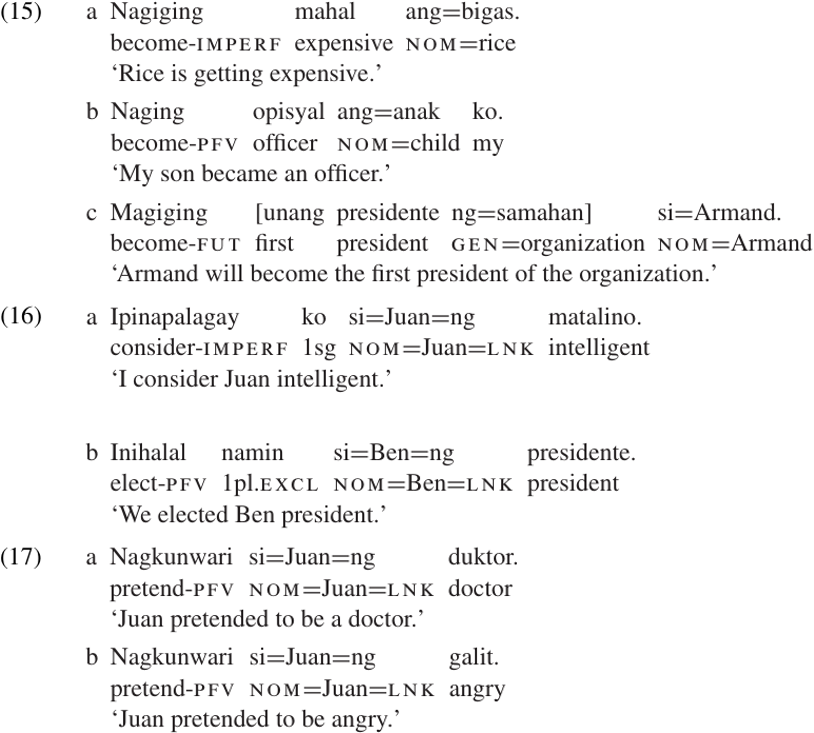
Even languages which have no copula may contain other verbs that require a predicate complement. One such verb in Tagalog is maging ‘become,’ which can take either AP (15a) or NP (15b) complements.4 The verb maging forms a tight constituent with its predicate complement, and is sometimes written as a prefix.5 However, its complement is a full phrasal category and not just a single word, as shown by examples like (15c);soit is (at least in its syntactic properties) a free form, and not an affix. Some other Tagalog verbs which take predicate complements are illustrated in (16–17).
1. The predicate in Tagalog normally occurs as the initial element in its clause, and this is clearly the case in (13a), (13c), and (13d). In (13b), where both NPs are definite, there is some disagreement as to which should be identified as predicate and which as the SUBJ. This construction is sometimes identified as a cleft sentence, and on this analysis the “clefted” NP, i.e. the one in initial position, is regarded as the subject.
2. This evidence relates to the potential for discontinuous constituency and the distribution of second position clitics; see Kroeger (1993, 1998) for details.
3. Under this analysis the SUBJ of the XCOMP gets two Grammatical Relations, just as Mary bears two Grammatical Relations (OBJ of persuade and SUBJ of dance) in the sentence John persuaded Mary to dance. See Kroeger (2004), Lexical entries and well-formed clauses for further explanation.
4. The initial /n-/ in these examples indicates realis aspect.
5. No clitic pronoun or particle may intervene between maging and its complement. See Clitics for a fuller discussion of clitics and related issues.
 الاكثر قراءة في Phrases
 اخر الاخبار
اخبار العتبة العباسية المقدسة

الآخبار الصحية


مواضيع ذات صلة
 قسم الشؤون الفكرية يصدر كتاباً يوثق تاريخ السدانة في العتبة العباسية المقدسة
 "المهمة".. إصدار قصصي يوثّق القصص الفائزة في مسابقة فتوى الدفاع المقدسة للقصة القصيرة
 (نوافذ).. إصدار أدبي يوثق القصص الفائزة في مسابقة الإمام العسكري (عليه السلام)