Grammar
Tenses
Present

Present Simple
Present Continuous
Present Perfect
Present Perfect Continuous
Past
Past Simple
Past Continuous
Past Perfect
Past Perfect Continuous
Future
Future Simple
Future Continuous
Future Perfect
Future Perfect Continuous
Parts Of Speech
Nouns
Countable and uncountable nouns
Verbal nouns
Singular and Plural nouns
Proper nouns
Nouns gender
Nouns definition
Concrete nouns
Abstract nouns
Common nouns
Collective nouns
Definition Of Nouns
Animate and Inanimate nouns
Nouns
Verbs
Stative and dynamic verbs
Finite and nonfinite verbs
To be verbs
Transitive and intransitive verbs
Auxiliary verbs
Modal verbs
Regular and irregular verbs
Action verbs
Verbs
Adverbs
Relative adverbs
Interrogative adverbs
Adverbs of time
Adverbs of place
Adverbs of reason
Adverbs of quantity
Adverbs of manner
Adverbs of frequency
Adverbs of affirmation
Adverbs
Adjectives
Quantitative adjective
Proper adjective
Possessive adjective
Numeral adjective
Interrogative adjective
Distributive adjective
Descriptive adjective
Demonstrative adjective
Pronouns
Subject pronoun
Relative pronoun
Reflexive pronoun
Reciprocal pronoun
Possessive pronoun
Personal pronoun
Interrogative pronoun
Indefinite pronoun
Emphatic pronoun
Distributive pronoun
Demonstrative pronoun
Pronouns
Pre Position
Preposition by function
Time preposition
Reason preposition
Possession preposition
Place preposition
Phrases preposition
Origin preposition
Measure preposition
Direction preposition
Contrast preposition
Agent preposition
Preposition by construction
Simple preposition
Phrase preposition
Double preposition
Compound preposition
prepositions
Conjunctions
Subordinating conjunction
Correlative conjunction
Coordinating conjunction
Conjunctive adverbs
conjunctions
Interjections
Express calling interjection
Phrases
Sentences
Clauses
Part of Speech
Grammar Rules
Passive and Active
Preference
Requests and offers
wishes
Be used to
Some and any
Could have done
Describing people
Giving advices
Possession
Comparative and superlative
Giving Reason
Making Suggestions
Apologizing
Forming questions
Since and for
Directions
Obligation
Adverbials
invitation
Articles
Imaginary condition
Zero conditional
First conditional
Second conditional
Third conditional
Reported speech
Demonstratives
Determiners
Direct and Indirect speech
Linguistics
Phonetics
Phonology
Linguistics fields
Syntax
Morphology
Semantics
pragmatics
History
Writing
Grammar
Phonetics and Phonology
Semiotics
Reading Comprehension
Elementary
Intermediate
Advanced
Teaching Methods
Teaching Strategies
Assessment

English: copula plus predicate complement
 المؤلف:
PAUL R. KROEGER
المؤلف:
PAUL R. KROEGER
 المصدر:
Analyzing Grammar An Introduction
المصدر:
Analyzing Grammar An Introduction
 الجزء والصفحة:
P176-C10
الجزء والصفحة:
P176-C10
 2026-01-14
 364
364




+
-
20
English: copula plus predicate complement
As noted above, attributive, equative, and locative clauses in English must contain the copula, or linking verb, be. The AP, NP, or PP which follows the copula, as in (7a, b, c, respectively), is called a PREDICATE COMPLEMENT. A traditional definition of this term is “a constituent which is needed to complete the meaning of the predicate.”
(7) a The Mayor is [extremely angry at the press] AP. ATTRIBUTIVE
b Arthur is [a former Governor] NP. EQUATIVE
c His money is [under the mattress] PP. LOCATIVE
We defined a COMPLEMENT as a phrasal dependent which is selected by the head word. The complements of a verb are those elements which are specified in the verb’s subcategorization set. Up to this point, we have discussed complements which bear the Grammatical Relations SUBJ, OBJ, OBJ2, and OBL and generally identify participants. But the phrases that follow the copula in sentences like (7a–c) do not bear any of these relations; they are a different kind of complement. In semantic terms, these complements express predicates, rather than participants; hence the name PREDICATE COMPLEMENT.
The copula is by no means the only verb in English that takes a predicate complement. Some examples of other verbs that require predicate complements are given in (8).
(8) a Arthur became [the Governor of Texas].
b The Mayor seems [extremely angry].
c We elected John [chairman of the board].
d They all consider me [crazy].
We will use the annotation XCOMP to designate the Grammatical Relation of a predicate complement. The “X” stands for any major category (N, A, V, or P), reflecting the fact that predicate complements may be NPs, APs, PPs, or even VPs (though we will not discuss VP complements here). We can represent the structure of an English sentence containing a predicate complement with a rule like (9), where XP stands for any phrasal category (NP, AP, PP, or VP). Notice that this single rule will account for the sentences in (7), which contain a copula, as well as those in (8), which contain other verbs.

The lexical entries for the verbs in (8), and for the copula, must include a predicate complement as part of the verb’s subcategorization. The problem of specifying the category (NP, AP, or PP) of the predicate complements which can occur with a particular English verb is somewhat complex.1 For simplicity, we will assume that the lexical entry for each verb specifies the possible categories of its XCOMPs. As predicted by the rule in (9), no verb takes more than one predicate complement in the same clause, regardless of category. Possible lexical entries for the verbs consider and become are proposed in (10–11).

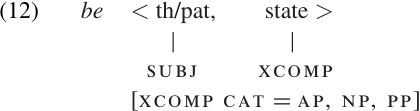
Designing a lexical entry for the copula is somewhat more challenging, largely due to the lack of lexical semantic content.2 However, ignoring this complication for the moment, we can adopt the entry in (12) as a first approximation (example sentences given in (7)).
1. Maling (1983) argues that the restrictions on which type of predicate complement can occur with which verb are actually semantic, rather than categorial. Other writers, however, have argued that some information about categories must be included in the verb’s subcategorization.
2. The subject NPs in (7) should probably not be considered semantic arguments of the copula. Thus, the lexical entry for the copula should probably be similar to that for a Raising predicate; see Kroeger (2004), Lexical entries and well-formed clauses .
 الاكثر قراءة في Phrases
 اخر الاخبار
اخبار العتبة العباسية المقدسة

الآخبار الصحية


مواضيع ذات صلة
 قسم الشؤون الفكرية يصدر كتاباً يوثق تاريخ السدانة في العتبة العباسية المقدسة
 "المهمة".. إصدار قصصي يوثّق القصص الفائزة في مسابقة فتوى الدفاع المقدسة للقصة القصيرة
 (نوافذ).. إصدار أدبي يوثق القصص الفائزة في مسابقة الإمام العسكري (عليه السلام)