Imaging agents
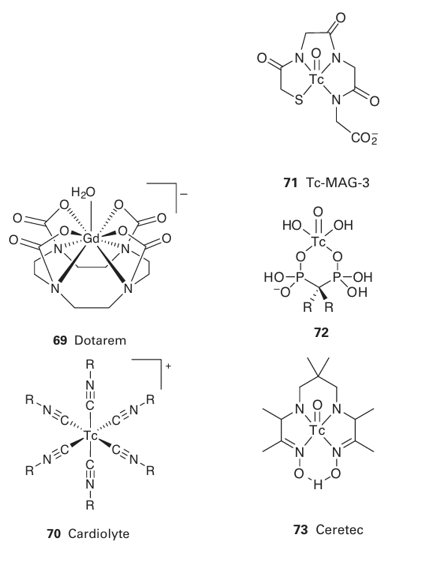
Key point: Particular organs and tissues are targeted according to the ligands that are present. Complexes of gadolinium (III) (f7) are used in magnetic resonance imaging (MRI), which has become an important technique in medical diagnosis. Through their effect on the re laxation time of 1H-NMR spectroscopic resonances, Gd (III) complexes are able to enhance the contrasts between different tissues and highlight details such as the abnormalities of the blood–brain barrier. A number of Gd (III) complexes are approved for clinical use, each exhibiting different degrees of rejection or retention by certain tissues, as well as stability, rates of water exchange, and magnitude of relaxation parameters. All are based on chelating ligands, particularly those having multiple carboxylate groups. One example is the complex (69) formed with the macrocyclic aminocarboxylate ligand DOTA, which is known as dotarem. Technetium is an artificial element that is produced by a nuclear reaction, but it has found an important use as an imaging agent. The active radionuclide is 99mTc (m for metastable), which decays by γ-emission and has a half-life of 6 h. Production of 99mTc involves bombarding 98Mo with neutrons and separating it as it is formed from the unstable product 99Mo:

High-energyγ-rays are less harmful to tissue than α- or β-particles. The chemistry of technetium resembles manganese except that higher oxidation states are much less oxidizing. A variety of substitution-inert Tc complexes can be made that, when injected into the patient, target particular tissues and report on their status. Complexes have been developed that target specific organs such as the heart (revealing tissue damage due to a heart attack), kidney (imaging renal function), or bone (revealing abnormalities and fracture lines). A good basis for organ targeting appears to be the charge on the complex: cationic complexes target the heart, neutral complexes target the brain, and anionic complexes target the bone and kidney. Of the different imaging agents, [Tc (CNR)6] (70) is the best established: known as cardiolyte, it is widely used as a heart imaging agent. The compound of Tc(V) with mercaptoacetyltriglycine (71), known as Tc-MAG-3, is used to image kidneys because of its rapid excretion. For imaging bone, complexes of Tc (VII) with hard diphosphonate ligands (72) are effective. Brain imaging is carried out with compounds such as ceretec (73). To produce Tc tracers, radioactive 99MoO4-2 is passed onto an anion exchange column, where it binds tightly until it decays to the pertechnate ion 99mTcO4 and the lower charge causes it to be eluted. The eluate is treated with a reducing agent, usually Sn (II), and the ligands required to convert it into the desired imaging agent. The resulting compound is then administered to the patient.
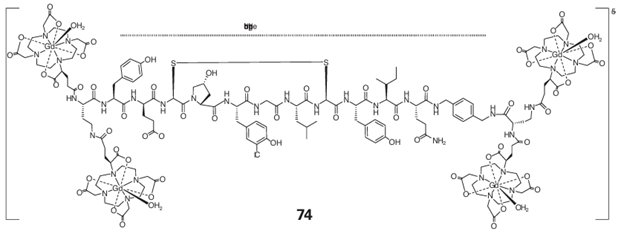
Tracers are being developed that are much more specific for their targets. These tracers contain the metal in a stable coordination sphere that is covalently linked to a biologically active fragment. An example is the Gd contrast agent EP-210R (74), which contains four Gd3 complexes linked to a peptide that recognizes and binds to fibrin, a molecule produced by thrombi (blood clots).