Assessing creativity
Given the diverse nature of creativity, there is no single measure that can fully capture its essence. As commented by Puccio and Murdock (1999), "it is a non-productive way to approach creative assessment to assume that all-purpose creativity measures exist" (Puccio & Murdock 1999, p.10).
The assessment criteria can also be vague. As stated by Sefton-Green and others, "Inevitably, published criteria for assessment are largely comparative, although precisely what is being compared often remains unclear" (Buckingham, Fraser & Sefton-Green 2000). McGowan also discovered problems in assessment. She found disparity in the attempt to acquire consistency when dance teachers assessed the same solo dance pieces using common criteria. Common criteria for creative assessment that is not designed for the particular context can be vague. Wording such as "creative", "imaginative", or "novelty", with no particular reference and explanation, can be interpreted differently from person to person and even from time to time by the same person (McGowan 1982). One way to approach the assessment of this multi-dimensional attribute is to take a more ecological or interactionist approach (Amabile 1982). This means to employ multiple measurement methods to create a profile of information. Similar approaches have also been used by Guilford (1986), MacKinnon (1978) and many others in their studies.
Among the different measurements of the creativity of a person, the process, the product and the environment, MacKinnon (1978) referred to the creative product as the "bedrock" of creativity research. MacKinnon argued that the product was the one area through which researchers could discover much about the other facets of creativity. Examination of the product reflects qualities of the person who created the product, the process used to form the product, and aspects of the environment in which the product was developed. As Amabile (1982) stated, "a product-centered operational definition is clearly most useful for empirical research in creativity" (p.1001). The relationship between the four components is shown clearly in Treffinger's COCO Model (Figure 1). Many other researchers have also conducted research focused on the creative product. Besemer & Treffinger (1981) focused on the qualities that distinguish creative products from those that are less creative while Rogers (1983) was interested in the adoption of new ideas, practices, or objects by society.
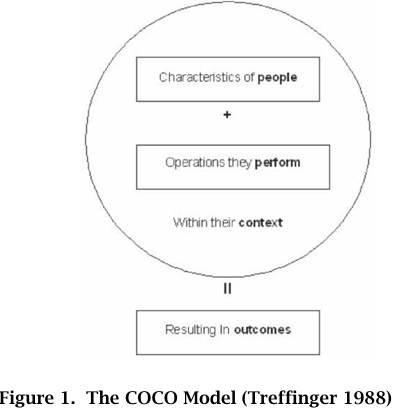
Among the 4 essential components of creativity in the filmmaking context, approaching from the product aspect is considered most appropriate because the ultimate goal of making a film is for it to be projected in front of an audience. The final film (product) can reveal the ideology as well as the creative ability of the filmmaker (person). As Rhodes (1961) stated, "Products are the artefacts of thoughts." It is also the accumulation of the work process, from script to screen (process). Often, the finished film reflects its cultural and social context. For example, many Hollywood musicals were made during the Great Depression to cheer up the audience.
Analyzing creative products has long played an important role in the study of creativity and continues to be a significant concern of those involved in its assessment. Research studies on the level of creativeness of a product have been conducted by Treffinger and Poggio (1972), Skager, Schultz and Klein (1966), Besemer & Treffinger (1981) and many others. However, there are recurring problems such as definitions, aspects of originality, perceptions of those other than the creator and the practical administration of an assessing instrument. Besemer & Treffinger stated, "There is yet no conclusive 'set of criteria' for evaluating creative products." They suggested that "stating definitions and gaining consensus" can be helpful in achieving a set of criteria that is suitable for assessing creative products in a defined context (1981). Their statement sets the conceptual framework of my study.








