
Exemplars Content
 المؤلف:
Paul Lam & Paula Hodgson & Josephine Csete
المؤلف:
Paul Lam & Paula Hodgson & Josephine Csete
 المصدر:
Enhancing Teaching and Learning through Assessment
المصدر:
Enhancing Teaching and Learning through Assessment
 الجزء والصفحة:
P396-C33
الجزء والصفحة:
P396-C33
 2025-08-09
 390
390
Exemplars
Content
Interaction with content in an online environment can be accomplished in an ever-increasing variety of ways. However, to date the most widely used format continues to be online quizzes. This was supported in the present study in which 13 of the 14 interaction-with-content examples were in the form of quizzes.
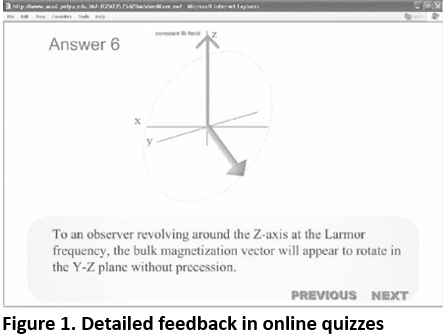
Providing elaborated feedback on quizzes is one of the more prevalent ways of creating interaction-enriched assessment where students interact with online content. A teacher of chemistry technology prepared online tutorials with a rich collection of pictures and animations to better illustrate the movement of electrons under the influence of strong magnetic fields when teaching about magnetic resonance imaging (MRI).
This was done because many former students who had taken this course found it difficult to master these abstract concepts. Thus, a number of questions were designed to let students cross-check their understanding. Apart from providing simple 'yes' or 'no' feedback to students when they attempted these questions, the teacher went to the trouble of writing detailed explanations, some with animated diagrams, as feedback when students tested their understanding (Figure 1). Giving students a better preparation before assignments and examinations in this way can ensure prompt feedback and clarification of misconceptions during the course of study.
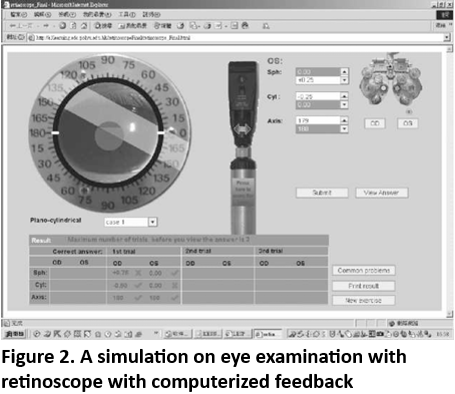
Another example of enriched interaction-with-content type of assessment is in developing simulations that react to students' actions in a similar way to a real-life situation. The teachers of an optometry course felt that their student optometrists had limited practice with real clients in eye examinations using an apparatus known as a retinoscope. They therefore created a virtual retinoscope for their students to practice examining patients' eyes online. The retinoscope simulation is programed so that its operation very closely resembles how the real equipment operates. For example, adjusting the 'knob' horizontally would simulate a yellow light beaming into a client's eye. Just like would happen in a "real" eye examination, the student optometrist then needs to adjust the angle of the beam until it is parallel to the reflected beam appearing in the pupil as a red band observed in the middle of the lens. In the simulated retinoscope the student optometrist must then adjust a lens of different focal lengths by clicking the figures on the screen until the reflected red band makes the correct response (stops moving in the opposite direction to the yellow light). After completing the test on the right eye, a similar procedure is then carried out with the left eye. When examination of both eyes has been completed, the student can then check their findings against the correct answer. In this way, the virtual machine is able to provide very accurate feedback that reflects the level of skill required to handle the actual apparatus (Figure 2). An enriched bilateral interaction between students and the online content is thus achieved when students can repeatedly practice and be assessed on accuracy.
 الاكثر قراءة في Teaching Strategies
 اخر الاخبار
اخبار العتبة العباسية المقدسة









