
Course audits
 المؤلف:
Chris Dillon & Catherine Reuben & Maggie Coats & Linda Hodgkinson
المؤلف:
Chris Dillon & Catherine Reuben & Maggie Coats & Linda Hodgkinson
 المصدر:
Enhancing Teaching and Learning through Assessment
المصدر:
Enhancing Teaching and Learning through Assessment
 الجزء والصفحة:
P284-C24
الجزء والصفحة:
P284-C24
 2025-07-22
 540
540
Course audits
Audit is a way of checking the match between course learning outcomes and assessment. The LOTA approach put an emphasis on transparency; the work showed that auditing assessment and teaching material against the intended learning outcomes identifies gaps between:
• the intended learning outcomes and the assessment of those outcomes;
• what is assessed and what is taught; what is actually assessed and what is assumed to be assessed;
• the information and guidance given to students and that given to tutors.
Auditing was carried out by experienced ALs working as consultants to course teams. This brought a degree of independence to the process and highlighted gaps between the assumptions of the course designers and the actualities of course delivery. Addressing those gaps suggested ways the assessment and feedback process might be improved and used to enhance learning:
• Assessment tasks should be linked explicitly to relevant learning outcomes. That is, assessment needs to be specifically devised to match the relevant outcomes. Assessment should provide opportunities for important outcomes to be revisited several times during a course, and feedback to students should make reference to this.
• Recognize the developmental aspect of assessment by explaining to students the assessment strategy of a course and how they can use it to support their own learning. Opportunities for self-assessment against the learning outcomes are as important as summatively assessed tasks, and help support the development of the student as an independent learner.
• Use outcomes as criteria to prompt feedback and 'feedforward' comments from tutors. Feedback addresses existing students' performance while feedforward offers guidance to improve performance.
• Use the language of outcomes in student guidance (including course, program and qualification descriptors), notes for tutors and staff development activities as a way of talking about expectations, development and achievement.
• Support students in using outcomes in self-assessment and personal development planning (PDP) activities and encourage them to see outcomes as a way of describing their achievements to others, such as employers.
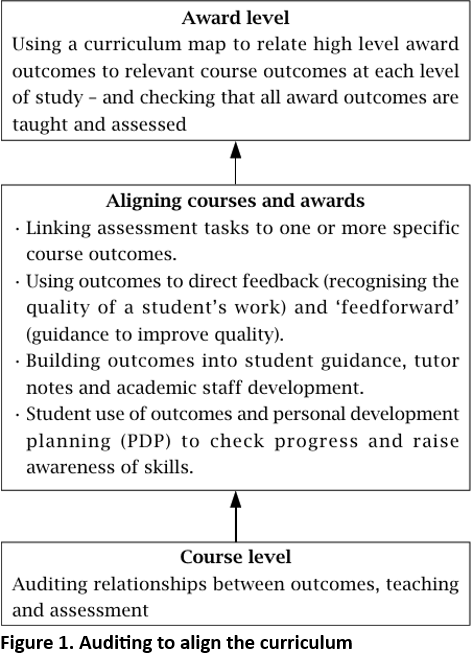
Figure 1 summarizes the audit process and links audit to curriculum alignment. In the highly modular course environment of the Open University explicitly linking outcomes, assessment, courses and awards is important. As adults already in employment many OU students will expect to use their studies and qualifications to improve their careers. Typically a student may spend about six years studying part-time with the OU.
Within that time personal goals, prospects and job opportunities may change. Waiting until the end of their degree before changing or developing their career may not be a realistic option. To take advantage of new career opportunities as and when they arise, therefore, students need to be able to talk about, and give examples of, the skills and knowledge they are gaining during their studies. In a competitive job market students may be disadvantaged if they are not able to be clear to others about their wider skills as well as their detailed subject knowledge. Learning outcomes offer concise statements to help students describe their learning.
Assessment provides milestones and checkpoints for the student to monitor and evaluate their progress against the learning outcomes. It also provides examples of applications of skills and attributes - for example: planning; time management; finding, selecting, organizing and using information; effective communication; and independent learning - that the student can draw on to provide evidence of their achievements.
 الاكثر قراءة في Teaching Strategies
 اخر الاخبار
اخبار العتبة العباسية المقدسة









