
Conclusions of The Impact of Assessment Modes on Collaborative Group Design Projects
 المؤلف:
Richard Tucker
المؤلف:
Richard Tucker
 المصدر:
Enhancing Teaching and Learning through Assessment
المصدر:
Enhancing Teaching and Learning through Assessment
 الجزء والصفحة:
P219-C19
الجزء والصفحة:
P219-C19
 2025-07-08
 421
421
Conclusions of The Impact of Assessment Modes on Collaborative Group Design Projects
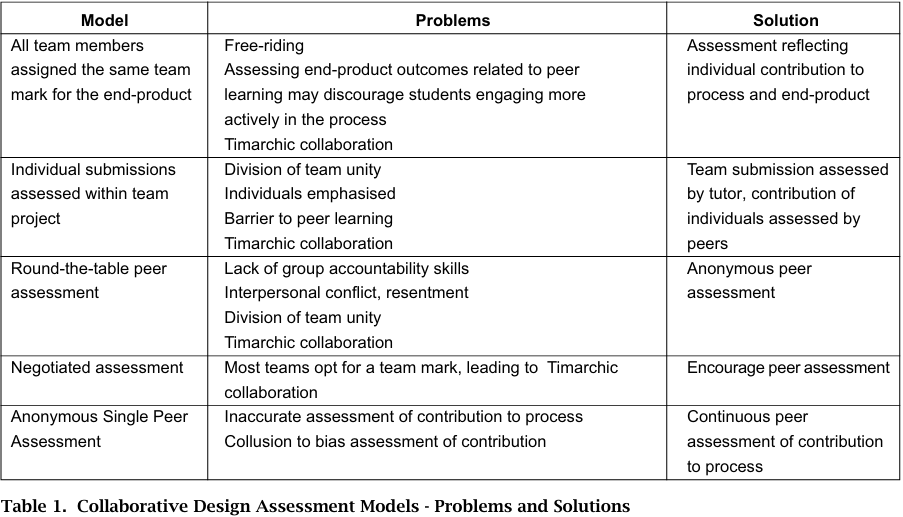
In recognition of the escalating financial and time constraints within teaching departments leading to an increase of group focused teaching models, we have proposed an enquiry into the effects of group management and the assessment of these groups in the student design studio. At the time of writing, the first of the questionnaires polling the 2005 cohort on their opinions of the success of the group and assessment models developed over the last three years has been completed by sixty-eight of the ninety-five students in their third year. From the findings of this survey some significant conclusions can be drawn. They can be summarized as follows: 80% of students felt that the reason for group projects within the architecture course was to help prepare them for collaborative working in the architectural profession, compared to 5% who felt that group projects were prompted by a lack of teaching resources. Encouragingly, 66% of students felt that the group design projects that they had been involved in prior to their third-year were good preparation for professional practice, and 70% of students found these projects a positive experience for reasons largely relating to constructive learning experiences. Yet this positive impression of group work is somewhat countered by students' preference for individually assessed assignments, for only 35% preferred group work over individual.
Given a choice of four types of assessment:
1. the same mark awarded to the whole team,
2.by open round-the-table student self and peer assessment of contribution of team members,
3.by anonymous self and peer assessment of contribution of team members and
4. by tutors assessing team members' contributions through individual submissions alongside the team submissions.
• The majority of students, namely 69%, preferred anonymous on-line peer and self-assessment. This is not surprising in light of the fact that 70% of students felt that in previous group projects not everyone had contributed evenly.
• In contrast, in 2005, with six peer assessments of the relative contribution of team members, only 42% of students felt that not everyone had contributed evenly. When asked whether the 2005 peer assessment model "was a fair way of assessing group design projects," the mean score on a 5-point Likert scale, where strongly agree is 0 and strongly disagree is 5, was keenly in favor of the model to produce a score of 2.145.
• This is not the only positive reflection of our revised assessment methods, for the collaborative working structures of the groups seem to have responded favorably too. We recall that 35% of the teams in 2003 could be termed as 'timarchic collaborators,' as their teamwork was characterized by conflict.
In 2004, groups were engineered to contain a range of different experiences and abilities, which resulted in many more timarchic teams, indeed 60% could be described as such - for grouping strangers rather than friends led to much more internal strife and conflict was a common occurrence. In 2005, the timarchic collaborative teams numbered only 20% of the cohort. In this case, the peer assessment process acted as a pressure valve alleviating many of the grievances generated by perceptions of unequal workload and unfair mark allocation. In our opinion, and in the opinions of those students who attended the focus groups, continuous peer assessment throughout the unit, which allowed for penalty and reward, significantly discouraged free-riding by team-members. By creating a non-confrontational forum for expressing dissatisfaction with under-per forming team members, the continuous peer assessment model also prevented disunity within teams and fostered, therefore, a more positive collaborative learning environment is created.
Let us now move on to consider what students felt of continuous assessment in 2005. The continuous assessment model this year had been refined from that of 2004 to only six assessed exercises, which preceded the six on-line peer assessments. As these exercises focused on the process of design rather than its end product, their assessment was in tune with how students operate upon and develop their design solutions. The cohort was asked to agree or disagree on a 5-point Likert scale with seven statements relating to continuous assessment. These were as follows:
Continuous assessment of the design process through assessed weekly tasks is better than assessing just the end product of design;
Continuous assessment throughout Atelier has more evenly distributed my workload;
Continuous assessment throughout Atelier has added to my workload;
The weekly assessed tasks throughout 3A (third year design) helped the development of our designs for the Atelier Geelong project;
The weekly assessed tasks throughout 3A were an obstacle to the development of our designs for the Atelier Geelong project;
Continuous assessment throughout 3A has enhanced my learning experience, and;
Continuous assessment throughout 3A has given me a greater understanding of what has been expected of me in the unit.
If we reverse the results of the two negatively posed questions, then we get an overall mean of 2.4 strongly in favor of continuous assessment (3 would be an average between strongly agree and strongly disagree).
If we look at student outcomes as measured in grades there are further positive signs for continuous assessment happening in tandem with staged peer assessment. In 2003, with one assessed submission and no peer assessment, the average mark for each individual student for the team design project was 57.8%. In 2004, with nine assessed submissions and one peer assessment at the completion of the project, the average mark was 59.3%. Then in 2005, with six assessed submissions and six peer assessments the average mark was 69.5%, which is the highest average mark for a third-year project at Deakin, and this for a cohort that has performed comparatively equally with other cohorts on previous projects and in other subject areas.
We might draw from the trends that can be seen in this data the following conclusions. Firstly, that students perform better in group design projects than in individual design projects - a finding confirmed by questionnaires we have received from unit coordinators in design schools world-wide that have shown that the average grade achieved by students is 5% higher for group design projects; secondly, that the quality of work as measured in grades increases with continuous assessment that is anonymously peer-assessed; thirdly, that students prefer continuous peer assessment of an individual's contribution to a team to other methods of assessing individual contribution; fourthly, that students prefer continuous assessment to design projects assessed largely on final submissions; and finally that students certainly see the learning value of continuously assessed tasks as a means of developing design solutions.
These preliminary findings have successfully advanced the aim of researching and developing an improved teaching methodology for group work in the design studio. This conclusion is supported not only by the theoretical and practical experience of the researchers and tutors involved but is moreover directly informed by the students' experience of the design studio students who are the direct consumers of the different teaching, assessment and group models explored and developed here. Although these models still require further testing and development there are already significant findings allowing for improvements to be made to the teaching methodology and assessment models of the student design studio.
 الاكثر قراءة في Teaching Strategies
 اخر الاخبار
اخبار العتبة العباسية المقدسة









