
Syllables and Suprasegmentals
 المؤلف:
Mehmet Yavas̡
المؤلف:
Mehmet Yavas̡
 المصدر:
Applied English Phonology
المصدر:
Applied English Phonology
 الجزء والصفحة:
P20-C1
الجزء والصفحة:
P20-C1
 2025-02-25
 664
664
Syllables and Suprasegmentals
So far, we have considered the phonetic characteristics of individual speech sounds or segments. However, segments do not exist in isolation but are part of larger units, such as syllables, which in turn make up larger units of utterances.
Syllable
The syllable is a phonological unit consisting of segments around the pivotal vowel or vowel-like (diphthong) sound, which is known as the nucleus. The nucleus is the element that every syllable contains, and the other elements are defined in relation to it; the consonant(s) before the nucleus are called the onset, and the consonant(s) after it the coda. Thus, in the following three words we have syllables with different elements: in a [e], we have only the nucleus with no onset and no coda; in at [æt], the syllable consists of the nucleus and the coda and there is no onset; finally, in cat [kæt], we have all three elements present. We will not go into greater detail on various other possibilities.
Nucleus and coda together (the elements after the onset) are known as the rhyme (or rime), thus giving us the following hierarchical structure:
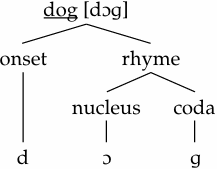
Depending on the structure of the rhyme, syllables are classified as closed (with coda(s)) and open (lacking coda(s)). Thus, in the word beacon [bi.kən] we have an open first syllable followed by a closed second syllable.
 الاكثر قراءة في Phonology
 اخر الاخبار
اخبار العتبة العباسية المقدسة









