Grammar
Tenses
Present

Present Simple
Present Continuous
Present Perfect
Present Perfect Continuous
Past
Past Simple
Past Continuous
Past Perfect
Past Perfect Continuous
Future
Future Simple
Future Continuous
Future Perfect
Future Perfect Continuous
Parts Of Speech
Nouns
Countable and uncountable nouns
Verbal nouns
Singular and Plural nouns
Proper nouns
Nouns gender
Nouns definition
Concrete nouns
Abstract nouns
Common nouns
Collective nouns
Definition Of Nouns
Animate and Inanimate nouns
Nouns
Verbs
Stative and dynamic verbs
Finite and nonfinite verbs
To be verbs
Transitive and intransitive verbs
Auxiliary verbs
Modal verbs
Regular and irregular verbs
Action verbs
Verbs
Adverbs
Relative adverbs
Interrogative adverbs
Adverbs of time
Adverbs of place
Adverbs of reason
Adverbs of quantity
Adverbs of manner
Adverbs of frequency
Adverbs of affirmation
Adverbs
Adjectives
Quantitative adjective
Proper adjective
Possessive adjective
Numeral adjective
Interrogative adjective
Distributive adjective
Descriptive adjective
Demonstrative adjective
Pronouns
Subject pronoun
Relative pronoun
Reflexive pronoun
Reciprocal pronoun
Possessive pronoun
Personal pronoun
Interrogative pronoun
Indefinite pronoun
Emphatic pronoun
Distributive pronoun
Demonstrative pronoun
Pronouns
Pre Position
Preposition by function
Time preposition
Reason preposition
Possession preposition
Place preposition
Phrases preposition
Origin preposition
Measure preposition
Direction preposition
Contrast preposition
Agent preposition
Preposition by construction
Simple preposition
Phrase preposition
Double preposition
Compound preposition
prepositions
Conjunctions
Subordinating conjunction
Correlative conjunction
Coordinating conjunction
Conjunctive adverbs
conjunctions
Interjections
Express calling interjection
Phrases
Sentences
Grammar Rules
Passive and Active
Preference
Requests and offers
wishes
Be used to
Some and any
Could have done
Describing people
Giving advices
Possession
Comparative and superlative
Giving Reason
Making Suggestions
Apologizing
Forming questions
Since and for
Directions
Obligation
Adverbials
invitation
Articles
Imaginary condition
Zero conditional
First conditional
Second conditional
Third conditional
Reported speech
Demonstratives
Determiners
Linguistics
Phonetics
Phonology
Linguistics fields
Syntax
Morphology
Semantics
pragmatics
History
Writing
Grammar
Phonetics and Phonology
Semiotics
Reading Comprehension
Elementary
Intermediate
Advanced
Teaching Methods
Teaching Strategies
Assessment

Vowels
 المؤلف:
Ben Elugbe
المؤلف:
Ben Elugbe
 المصدر:
A Handbook Of Varieties Of English Phonology
المصدر:
A Handbook Of Varieties Of English Phonology
 الجزء والصفحة:
834-46
الجزء والصفحة:
834-46
 2024-05-08
 1277
1277




+
-
20
Vowels
Across Nigeria, the majority of the dialects of NigP have a simple seven-quality vowel system. However, there are also diphthongs, which are double quality vowels that nonetheless function as single syllable nuclei. A complete inventory of NigP vowels would therefore be as in table3;
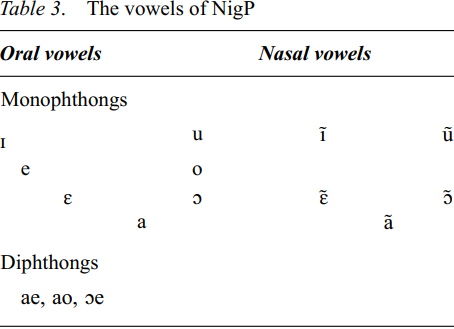
The three diphthongs listed here correspond to what are normally [aɪ] , [aʊ] and [ɔɪ] respectively in Standard British English (StdBrE). In the established numbering of English vowels, these are numbers 15, 16, and 17 respectively, the rising diphthongs. This analysis differs from that of Mafeni (1971), for whom words such as /praod/ proud and /smael/ smile end in consonant clusters – /prawd/ and /smayl/ respectively. Moreover, in Mafeni’s system, the word /bɔe/ boy would be /bɔy/, ending in a consonant. Thus Mafeni recognized no vowel sequences and no diphthongs in NigP. By contrast, Elugbe and Omamor (1991) recognized these three diphthongs as /ai/, /au/, and /ɔi/ respectively. In fact, the terminal point never goes as high as /i/ or /u/ – hence /ae/, /ao/, /ɔe/ here.
In NigP as well as in NigE, another pair of rising diphthongs, English vowel number 13, /eɪ/ , and number 14, /oʊ/ or /əʊ/ are [e] or [ee] and [o] or [oo] respectively. The double vowel form is found in word-final open syllables while the single vowel pronunciation occurs in closed syllables. At a recent workshop on translating the Bible into NigP, the above rule was found to separate words such as NigP wet ‘wait’ from wee ‘way’. Thus, ‘The way in which it was written by John’ is rendered as di wee we John (tek) raet am. The relative marker ‘which’ is we’ with a short vowel in NigP, whereas the noun ‘way’, with an open syllable is wee.
The centring diphthongs of StdBrE are numbers 18, /ɪə/ , 19, /εə/ , and 20, /ʊə/ . In NigP, these may be analyzed as sequences of vowels, (Elugbe and Omamor 1991). Thus we find the following correspondences between StdBrE and NigP: StdBrE centring diphthongs in NigP:
–  ear is NigP /ia/ with a distinct, albeit weak /j/ between the twin qualities of the diphthong: [ija].
–  air is NigP /εa/ or /εε/ – in each case they are two distinct vowels.
– /ʊə/ poor is /puɔ/ with a weak /w/ between the two vowel qualities of the diphthong: /puwɔ/
It should be noted here that the alternative to [ʊə], which in StdBrE is [ɔ:], (for example /pʊə/ or /pɔ:/ ‘poor’) does not feature in NigP. The vowels of NigP were clearly based on a variety of English which did not alternate /ʊə/ with /ɔ:/. However it did recognize the vowel /ɔ:/ which, like /ɔ/ or /ɒ/, corresponds to NigP /ɔ/. For example, the utterances in (1) and (2) are both said without a distinction between pot and Port (Port Harcourt):

Without the prepositions, the two utterances sound exactly the same.
It can be seen therefore that the simplification of the English vowel system in NigP followed very clear lines as shown in table 4.
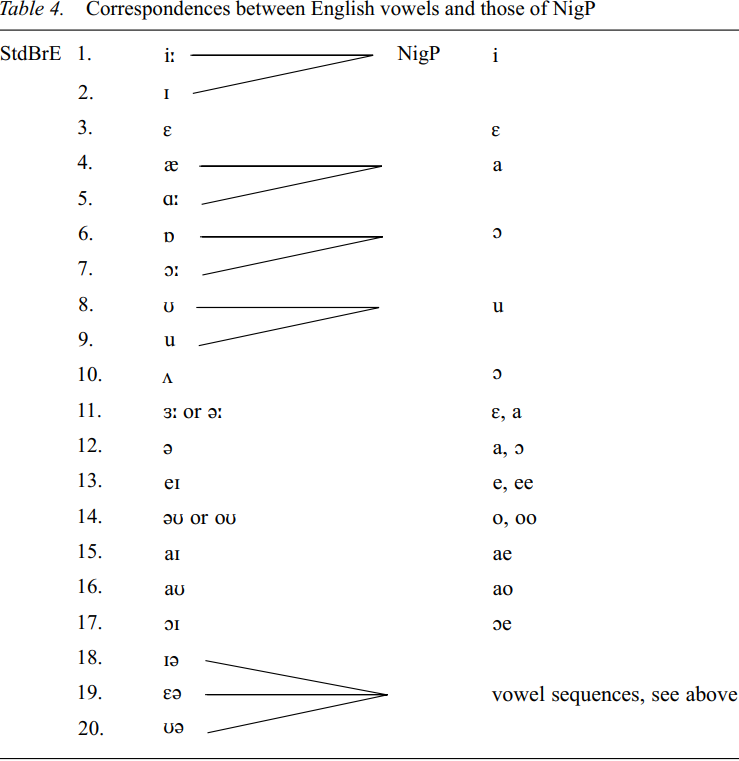
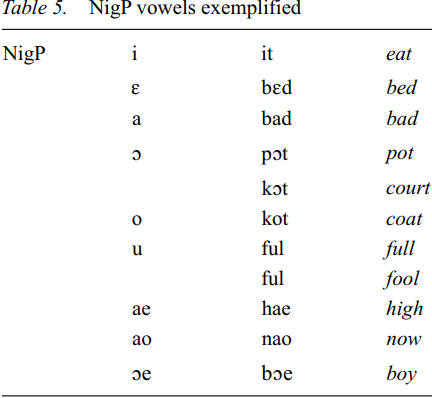
Table 5 below exemplifies the vowels of NigP:
 الاكثر قراءة في Phonology
 اخر الاخبار
اخبار العتبة العباسية المقدسة

الآخبار الصحية


مواضيع ذات صلة
 قسم الشؤون الفكرية يصدر كتاباً يوثق تاريخ السدانة في العتبة العباسية المقدسة
 "المهمة".. إصدار قصصي يوثّق القصص الفائزة في مسابقة فتوى الدفاع المقدسة للقصة القصيرة
 (نوافذ).. إصدار أدبي يوثق القصص الفائزة في مسابقة الإمام العسكري (عليه السلام)