Grammar
Tenses
Present

Present Simple
Present Continuous
Present Perfect
Present Perfect Continuous
Past
Past Simple
Past Continuous
Past Perfect
Past Perfect Continuous
Future
Future Simple
Future Continuous
Future Perfect
Future Perfect Continuous
Parts Of Speech
Nouns
Countable and uncountable nouns
Verbal nouns
Singular and Plural nouns
Proper nouns
Nouns gender
Nouns definition
Concrete nouns
Abstract nouns
Common nouns
Collective nouns
Definition Of Nouns
Animate and Inanimate nouns
Nouns
Verbs
Stative and dynamic verbs
Finite and nonfinite verbs
To be verbs
Transitive and intransitive verbs
Auxiliary verbs
Modal verbs
Regular and irregular verbs
Action verbs
Verbs
Adverbs
Relative adverbs
Interrogative adverbs
Adverbs of time
Adverbs of place
Adverbs of reason
Adverbs of quantity
Adverbs of manner
Adverbs of frequency
Adverbs of affirmation
Adverbs
Adjectives
Quantitative adjective
Proper adjective
Possessive adjective
Numeral adjective
Interrogative adjective
Distributive adjective
Descriptive adjective
Demonstrative adjective
Pronouns
Subject pronoun
Relative pronoun
Reflexive pronoun
Reciprocal pronoun
Possessive pronoun
Personal pronoun
Interrogative pronoun
Indefinite pronoun
Emphatic pronoun
Distributive pronoun
Demonstrative pronoun
Pronouns
Pre Position
Preposition by function
Time preposition
Reason preposition
Possession preposition
Place preposition
Phrases preposition
Origin preposition
Measure preposition
Direction preposition
Contrast preposition
Agent preposition
Preposition by construction
Simple preposition
Phrase preposition
Double preposition
Compound preposition
prepositions
Conjunctions
Subordinating conjunction
Correlative conjunction
Coordinating conjunction
Conjunctive adverbs
conjunctions
Interjections
Express calling interjection
Phrases
Sentences
Grammar Rules
Passive and Active
Preference
Requests and offers
wishes
Be used to
Some and any
Could have done
Describing people
Giving advices
Possession
Comparative and superlative
Giving Reason
Making Suggestions
Apologizing
Forming questions
Since and for
Directions
Obligation
Adverbials
invitation
Articles
Imaginary condition
Zero conditional
First conditional
Second conditional
Third conditional
Reported speech
Demonstratives
Determiners
Linguistics
Phonetics
Phonology
Linguistics fields
Syntax
Morphology
Semantics
pragmatics
History
Writing
Grammar
Phonetics and Phonology
Semiotics
Reading Comprehension
Elementary
Intermediate
Advanced
Teaching Methods
Teaching Strategies
Assessment

Prosody Stress and accent
 المؤلف:
Ulrike B. Gut
المؤلف:
Ulrike B. Gut
 المصدر:
A Handbook Of Varieties Of English Phonology
المصدر:
A Handbook Of Varieties Of English Phonology
 الجزء والصفحة:
824-45
الجزء والصفحة:
824-45
 2024-05-08
 1467
1467




+
-
20
Prosody
Stress and accent
The terms “stress” and “accent” are used in contradictory ways among researchers. Here, I will define “stress” as an abstract category that is stored as a feature of a syllable in the speaker’s mental lexicon and “accent” as its phonetic realization in speech. Word stress in NigE is in many cases different from that in British or American English (e.g. Simo Bobda 1997; Jowitt 1991). No systematic studies being available, a summary of various observations will be presented here.
Simo Bobda (1997) describes a general tendency for stress shifted to the right. This can be seen in realizations of the words sa'lad, ma'ttress and pe'trol. Especially with words whose final syllable contains an [n] or an [i], stress is shifted to the right. Examples are:
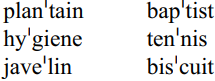
Verbs tend to have stress on the last syllable if
– they have final obstruents (e.g. inter'pret, embar'rass, com'ment, soli'cit)
– or contain the affixes -ate, -ise, -ize, -fy or -ish
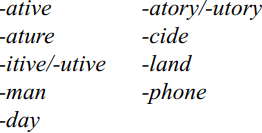
Other affixes that tend to attract stress include
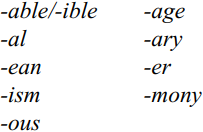
Affixes that tend to bring stress to the preceding syllable are:
Equally, strong consonant clusters pull stress to the preceding syllable as in an'cestor. In compounds, the second element is stressed as for example in fire'wood and proof'read. In general, however, it must be noted that word stress patterns are not realized uniformly and that even among educated speakers (and even between productions of one and the same speaker) there is considerable variation in individual words.
Jowitt (1991) suggests that Nigerian speakers of English equate the primary stress in English with a high tone and the tertiary stress with a low tone. In order to avoid three consecutive low tones in e.g. interestingly, word stress is shifted to arrive at the pronunciation interes'tingly.
In continuous speech, the stressed syllables of words become potential places for sentence stress, i.e. accents realized by the speaker, with the number of accents determined by the speech tempo. In each utterance or sentence the most prominent accent is called the nucleus and tends to fall on the rightmost stressed syllable of an utterance, although pragmatic reasons such as emphasis may cause stress shifts. Sentence stress in NigE is rarely used for emphasis or contrast (Jibril 1986; Jowitt 1991; Gut 2003). Instead of producing “Mary did it” Nigerians tend to say “It was Mary who did it”.
Given information is rarely deaccented. For example, consider the sequence: A tiger and a mouse [..] saw a big lump of cheese lying on the ground. The mouse said: “[…] You don’t even like cheese”.
Nigerians produce an accent on the given information cheese in the last sentence whereas British speakers accentuate like.
An overall preference for “end-stress”, i.e. the placement of the nucleus, the most prominent accent, on the last word can been observed in NigE (Eka 1985; Gut 2003). In the dialogue (1) for example

British English speakers put a nucleus on I in (1b), whereas NigE speakers stress will most.
In general, in NigE many lexical items can receive stress that do not usually do so in British English. More stressed syllables are realized as accents in NigE speech than is the case in British English speech. In reading passage style, nearly all verbs, adjectives and nouns are accented in NigE (Udofot 2003; Gut 2003). In spontaneous speech, differences between British English and NigE are most pronounced with a large number of extra accented syllables in NigE (Udofot 2003).
The phonetic realization of accents in NigE seems to be very different from that of other, especially native speaker varieties of English. In the languages of the world, the phonetic realization of accents can have different formats: In languages with “tonal accent” such as Swedish and Norwegian, different types of tones or pitch patterns are used on accented syllables. In languages with “dynamic accent” such as English or German, the phonetic parameters pitch, length and loudness are combined with different relative importance for the phonetic realization of accents. There seems to be an intricate relationship between accents and tone, not only because accents are very often produced with a phonetically high pitch. It has been suggested that in NigE accents are produced primarily by tone. Jowitt (1991) claims that stressed syllables receive a high tone whereas unstressed syllables receive a low tone. Gut (2003) found that tone in NigE is grammatically determined with lexical words receiving high tone on the stressed syllable and non-lexical words receiving low tone. The tonal patterns of some multisyllabic words are illustrated in Table 6 with L symbolizing a low tone and H symbolizing a high tone.

The stressed syllable of lexical words is produced with a high tone, which then spreads to the end of the word. Any unstressed syllables preceding the stressed syllable are produced with a low tone.
 الاكثر قراءة في Phonology
 اخر الاخبار
اخبار العتبة العباسية المقدسة

الآخبار الصحية


مواضيع ذات صلة
 قسم الشؤون الفكرية يصدر كتاباً يوثق تاريخ السدانة في العتبة العباسية المقدسة
 "المهمة".. إصدار قصصي يوثّق القصص الفائزة في مسابقة فتوى الدفاع المقدسة للقصة القصيرة
 (نوافذ).. إصدار أدبي يوثق القصص الفائزة في مسابقة الإمام العسكري (عليه السلام)