Grammar
Tenses
Present

Present Simple
Present Continuous
Present Perfect
Present Perfect Continuous
Past
Past Simple
Past Continuous
Past Perfect
Past Perfect Continuous
Future
Future Simple
Future Continuous
Future Perfect
Future Perfect Continuous
Parts Of Speech
Nouns
Countable and uncountable nouns
Verbal nouns
Singular and Plural nouns
Proper nouns
Nouns gender
Nouns definition
Concrete nouns
Abstract nouns
Common nouns
Collective nouns
Definition Of Nouns
Animate and Inanimate nouns
Nouns
Verbs
Stative and dynamic verbs
Finite and nonfinite verbs
To be verbs
Transitive and intransitive verbs
Auxiliary verbs
Modal verbs
Regular and irregular verbs
Action verbs
Verbs
Adverbs
Relative adverbs
Interrogative adverbs
Adverbs of time
Adverbs of place
Adverbs of reason
Adverbs of quantity
Adverbs of manner
Adverbs of frequency
Adverbs of affirmation
Adverbs
Adjectives
Quantitative adjective
Proper adjective
Possessive adjective
Numeral adjective
Interrogative adjective
Distributive adjective
Descriptive adjective
Demonstrative adjective
Pronouns
Subject pronoun
Relative pronoun
Reflexive pronoun
Reciprocal pronoun
Possessive pronoun
Personal pronoun
Interrogative pronoun
Indefinite pronoun
Emphatic pronoun
Distributive pronoun
Demonstrative pronoun
Pronouns
Pre Position
Preposition by function
Time preposition
Reason preposition
Possession preposition
Place preposition
Phrases preposition
Origin preposition
Measure preposition
Direction preposition
Contrast preposition
Agent preposition
Preposition by construction
Simple preposition
Phrase preposition
Double preposition
Compound preposition
prepositions
Conjunctions
Subordinating conjunction
Correlative conjunction
Coordinating conjunction
Conjunctive adverbs
conjunctions
Interjections
Express calling interjection
Phrases
Sentences
Grammar Rules
Passive and Active
Preference
Requests and offers
wishes
Be used to
Some and any
Could have done
Describing people
Giving advices
Possession
Comparative and superlative
Giving Reason
Making Suggestions
Apologizing
Forming questions
Since and for
Directions
Obligation
Adverbials
invitation
Articles
Imaginary condition
Zero conditional
First conditional
Second conditional
Third conditional
Reported speech
Demonstratives
Determiners
Linguistics
Phonetics
Phonology
Linguistics fields
Syntax
Morphology
Semantics
pragmatics
History
Writing
Grammar
Phonetics and Phonology
Semiotics
Reading Comprehension
Elementary
Intermediate
Advanced
Teaching Methods
Teaching Strategies
Assessment

Absence of {-ed}
 المؤلف:
Jan Tent and France Mugler
المؤلف:
Jan Tent and France Mugler
 المصدر:
A Handbook Of Varieties Of English Phonology
المصدر:
A Handbook Of Varieties Of English Phonology
 الجزء والصفحة:
774-42
الجزء والصفحة:
774-42
 2024-05-04
 1403
1403




+
-
20
Absence of {-ed}
The absence of the written and spoken {-ed} suffix, whether articulated as [t], [d] or [əd], in past tense forms and participial adjectives is very common in all varieties of Pure Fiji English. Some examples from Tent’s (2000) corpus of spoken Fiji English include:
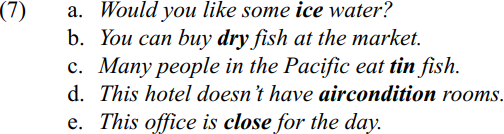
Some examples of pronunciation spellings are given in (8). Interestingly, many involve the {-ed} suffix following a voiceless consonant which normally results in assimilation, with a realization as [t]. The adjoining of two voiceless consonants may further make the perception of the suffix more difficult.
(8) a. “He is bleeding internally. Its [sic] most probably a case of an aggravated ulcer in its advance stage,” he [a doctor] said. (The Daily Post, 10/4/1996).
b. A few clap down [i.e. ‘clapped out’] diggers barely able to move have been hired and can be seen digging away at penal rate [sic] working full swing during the weekends. (Sunday Post, 30/11/1997).
c. Experience Signwriters to start immediately at Vanua Signs Limited. Phone 381553 for interview. (Positions Vacant column, The Fiji Times, 19/7/1994).
d. River sand, crush metal and garden soil we deliver Phone 362663 Jalil (For Sale column, The Fiji Times, 19/5/1994, 1/6/1994, 6/7/1994, 7/7/1994, 10/9/1994).
e. The case was heard behind close doors (Daily Post, 15/10/1999)
It is worth mentioning that the addition of the {-ed} suffix to adjectives is also quite common, e.g. I am the mother of three teenaged daughters. It seems only to be a feature of written English, frequently seen with the adjective mature, often seen in positions vacant advertisements in the local tabloids:
(9) a. Housegirl required urgently, be matured, to baby sit and do housework. Have to be good with children. Phone Ferin 386348. (Positions Vacant column, Fiji Times, 10/9/1994).
b. The police are matured people and we do not expect such an order against them. (From a Fijian university student’s written answer in a test, 9/8/1994).
The following example shows both the absence and addition of the {-ed} suffix in adjoining words:
(10) An Experience matured live in housegirl required. [...] (Positions Vacant column, The Fiji Times, 2/12/1994).
Cases of {-ed} addition are either malapropisms or instances of hypercorrection (especially since this addition seems to manifest itself predominantly in writing or print), a common phenomenon in L2 English. Once again, more research needs to be conducted to unravel exactly what is going on here.
 الاكثر قراءة في Phonology
 اخر الاخبار
اخبار العتبة العباسية المقدسة

الآخبار الصحية


مواضيع ذات صلة
 قسم الشؤون الفكرية يصدر كتاباً يوثق تاريخ السدانة في العتبة العباسية المقدسة
 "المهمة".. إصدار قصصي يوثّق القصص الفائزة في مسابقة فتوى الدفاع المقدسة للقصة القصيرة
 (نوافذ).. إصدار أدبي يوثق القصص الفائزة في مسابقة الإمام العسكري (عليه السلام)