Grammar
Tenses
Present

Present Simple
Present Continuous
Present Perfect
Present Perfect Continuous
Past
Past Simple
Past Continuous
Past Perfect
Past Perfect Continuous
Future
Future Simple
Future Continuous
Future Perfect
Future Perfect Continuous
Parts Of Speech
Nouns
Countable and uncountable nouns
Verbal nouns
Singular and Plural nouns
Proper nouns
Nouns gender
Nouns definition
Concrete nouns
Abstract nouns
Common nouns
Collective nouns
Definition Of Nouns
Animate and Inanimate nouns
Nouns
Verbs
Stative and dynamic verbs
Finite and nonfinite verbs
To be verbs
Transitive and intransitive verbs
Auxiliary verbs
Modal verbs
Regular and irregular verbs
Action verbs
Verbs
Adverbs
Relative adverbs
Interrogative adverbs
Adverbs of time
Adverbs of place
Adverbs of reason
Adverbs of quantity
Adverbs of manner
Adverbs of frequency
Adverbs of affirmation
Adverbs
Adjectives
Quantitative adjective
Proper adjective
Possessive adjective
Numeral adjective
Interrogative adjective
Distributive adjective
Descriptive adjective
Demonstrative adjective
Pronouns
Subject pronoun
Relative pronoun
Reflexive pronoun
Reciprocal pronoun
Possessive pronoun
Personal pronoun
Interrogative pronoun
Indefinite pronoun
Emphatic pronoun
Distributive pronoun
Demonstrative pronoun
Pronouns
Pre Position
Preposition by function
Time preposition
Reason preposition
Possession preposition
Place preposition
Phrases preposition
Origin preposition
Measure preposition
Direction preposition
Contrast preposition
Agent preposition
Preposition by construction
Simple preposition
Phrase preposition
Double preposition
Compound preposition
prepositions
Conjunctions
Subordinating conjunction
Correlative conjunction
Coordinating conjunction
Conjunctive adverbs
conjunctions
Interjections
Express calling interjection
Phrases
Sentences
Grammar Rules
Passive and Active
Preference
Requests and offers
wishes
Be used to
Some and any
Could have done
Describing people
Giving advices
Possession
Comparative and superlative
Giving Reason
Making Suggestions
Apologizing
Forming questions
Since and for
Directions
Obligation
Adverbials
invitation
Articles
Imaginary condition
Zero conditional
First conditional
Second conditional
Third conditional
Reported speech
Demonstratives
Determiners
Linguistics
Phonetics
Phonology
Linguistics fields
Syntax
Morphology
Semantics
pragmatics
History
Writing
Grammar
Phonetics and Phonology
Semiotics
Reading Comprehension
Elementary
Intermediate
Advanced
Teaching Methods
Teaching Strategies
Assessment

Monophthongs and diphthongs
 المؤلف:
Jan Tent and France Mugler
المؤلف:
Jan Tent and France Mugler
 المصدر:
A Handbook Of Varieties Of English Phonology
المصدر:
A Handbook Of Varieties Of English Phonology
 الجزء والصفحة:
756-42
الجزء والصفحة:
756-42
 2024-05-02
 1311
1311




+
-
20
Monophthongs and diphthongs
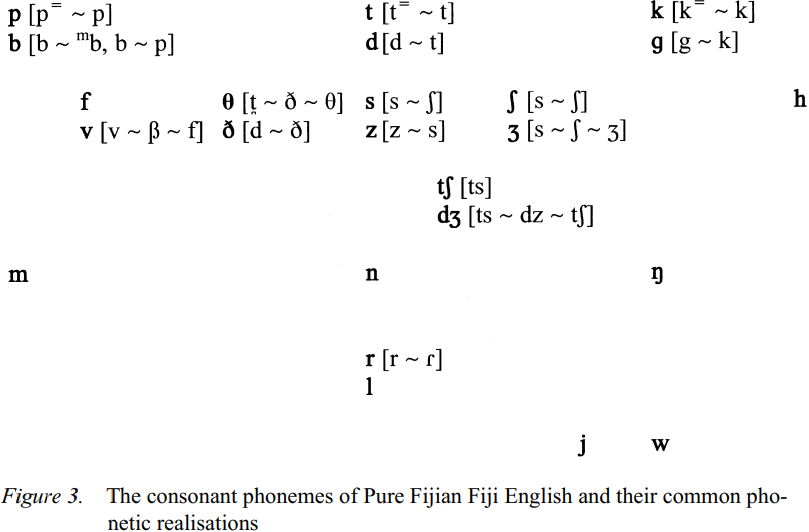
At the phonemic level, Pure Fijian English has a five vowel system, based on Fijian. In addition, the length and quality distinctions of standard varieties of English are neutralized. Most of the monophthongs of Pure Fiji English are tense but short, as opposed to Standard English tense/long versus lax/short. Examples include such items as: reach and rich > [rits]; beach and bitch > [bits]; march and much > [mats]; port and pot > [pɒt] , sport and spot > [spɒt] , caught/court and cot > [kɒt] (e.g. basketball court > [baskεtbɒl kɒt] ); fool and full > [ful]; and cloak and clock > [klɒk].
Evidence for this neutralization of length and quality is reflected in frequent pronunciation spellings in the local tabloids:
(1) a. Situations wanted: Baby seater available [...]. (Fiji Times, 23/2/1995)
b. A wife driving from a back-sit is comparable to a husband cooking from the dining room table. (Daily Post, 1/6/1999)
c. Naitasiri North’s sensational victory over giant Nadi upset the apple-cut. (Daily Post, 4/9/1995)
d. His face was a bit swollen and he also spotted a black eye. (Daily Post, 8/5/1995)
e. The roads of Labasa ... portholes are everywhere. (Fiji Times, 19/5/1999)
f. She told the Sun that most of her clients were top-class businessmen and police officers. “It is surprising that most of my customers are big shorts of our country.” (Fiji Sun, 4/12/1999)
g. Mr T. told prison offices to provide V. with 10 fullscap pages and a pen [...] (Fiji Times, 9/6/1999)
Fijian has eight diphthongs (/ai/, /ei/, /oi/, /ao/, /iu/, /eu/, /au/, /ou/), five of which (/ai/, /ei/, /oi/, /au/ and /ou/) are similar to the diphthongs of standard metropolitan English, and are often realized in Pure Fiji English as such. Nevertheless, they are sometimes instead realized as monophthongs by many speakers, especially the FACE, CHOICE and GOAT vowels. Fijian does not have any centring diphthongs like those in Standard English NEAR, SQUARE and CURE. These are realized in Pure Fiji English as monophthongs or falling diphthongs.
The following are descriptions of the most common variants of the Pure Fiji English vowels as articulated by Fijians. As stated above, there is considerable variation within this lect due to the speaker’s place of residence (largely rural vs. urban), competence as a speaker of Standard English, educational background and general exposure to standard metropolitan English. (Note that the lexical items in parentheses indicate those used in the accompanying recording of the lexical set. It was found that these words were more appropriate for the Fiji context.)
 الاكثر قراءة في Phonology
 اخر الاخبار
اخبار العتبة العباسية المقدسة

الآخبار الصحية


مواضيع ذات صلة
 قسم الشؤون الفكرية يصدر كتاباً يوثق تاريخ السدانة في العتبة العباسية المقدسة
 "المهمة".. إصدار قصصي يوثّق القصص الفائزة في مسابقة فتوى الدفاع المقدسة للقصة القصيرة
 (نوافذ).. إصدار أدبي يوثق القصص الفائزة في مسابقة الإمام العسكري (عليه السلام)