Grammar
Tenses
Present

Present Simple
Present Continuous
Present Perfect
Present Perfect Continuous
Past
Past Simple
Past Continuous
Past Perfect
Past Perfect Continuous
Future
Future Simple
Future Continuous
Future Perfect
Future Perfect Continuous
Parts Of Speech
Nouns
Countable and uncountable nouns
Verbal nouns
Singular and Plural nouns
Proper nouns
Nouns gender
Nouns definition
Concrete nouns
Abstract nouns
Common nouns
Collective nouns
Definition Of Nouns
Animate and Inanimate nouns
Nouns
Verbs
Stative and dynamic verbs
Finite and nonfinite verbs
To be verbs
Transitive and intransitive verbs
Auxiliary verbs
Modal verbs
Regular and irregular verbs
Action verbs
Verbs
Adverbs
Relative adverbs
Interrogative adverbs
Adverbs of time
Adverbs of place
Adverbs of reason
Adverbs of quantity
Adverbs of manner
Adverbs of frequency
Adverbs of affirmation
Adverbs
Adjectives
Quantitative adjective
Proper adjective
Possessive adjective
Numeral adjective
Interrogative adjective
Distributive adjective
Descriptive adjective
Demonstrative adjective
Pronouns
Subject pronoun
Relative pronoun
Reflexive pronoun
Reciprocal pronoun
Possessive pronoun
Personal pronoun
Interrogative pronoun
Indefinite pronoun
Emphatic pronoun
Distributive pronoun
Demonstrative pronoun
Pronouns
Pre Position
Preposition by function
Time preposition
Reason preposition
Possession preposition
Place preposition
Phrases preposition
Origin preposition
Measure preposition
Direction preposition
Contrast preposition
Agent preposition
Preposition by construction
Simple preposition
Phrase preposition
Double preposition
Compound preposition
prepositions
Conjunctions
Subordinating conjunction
Correlative conjunction
Coordinating conjunction
Conjunctive adverbs
conjunctions
Interjections
Express calling interjection
Phrases
Sentences
Grammar Rules
Passive and Active
Preference
Requests and offers
wishes
Be used to
Some and any
Could have done
Describing people
Giving advices
Possession
Comparative and superlative
Giving Reason
Making Suggestions
Apologizing
Forming questions
Since and for
Directions
Obligation
Adverbials
invitation
Articles
Imaginary condition
Zero conditional
First conditional
Second conditional
Third conditional
Reported speech
Demonstratives
Determiners
Linguistics
Phonetics
Phonology
Linguistics fields
Syntax
Morphology
Semantics
pragmatics
History
Writing
Grammar
Phonetics and Phonology
Semiotics
Reading Comprehension
Elementary
Intermediate
Advanced
Teaching Methods
Teaching Strategies
Assessment

Consonants
 المؤلف:
Terry Crowley
المؤلف:
Terry Crowley
 المصدر:
A Handbook Of Varieties Of English Phonology
المصدر:
A Handbook Of Varieties Of English Phonology
 الجزء والصفحة:
680-38
الجزء والصفحة:
680-38
 2024-04-26
 1412
1412




+
-
20
Consonants
Table 3 sets out the consonants which can be shown to contrast in Bislama.
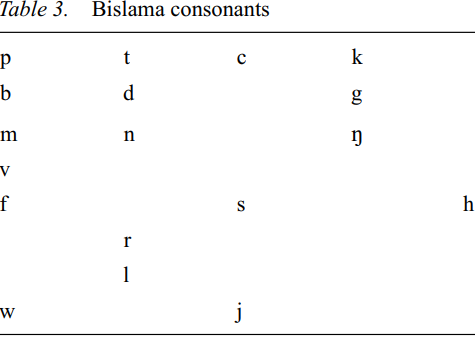
This inventory represents something of a mesolectal variety which is quite widely distributed among speakers of Bislama throughout Vanuatu. As will be demonstrated, there are some variations to this phoneme inventory.
These segments once again have phonetic realizations by and large that are suggested by the IPA values. The liquid represented as /r/ is phonetically normally an alveolar flap, though an occasional trilled articulation can be heard as a free variant. Some speakers produce instead a retroflex flap for this sound, though this is a strongly stigmatized pronunciation associated with speakers of particular local languages. The symbol /j/ represents a palatal semi-vowel. Particular note should be made of the fact that /c/ is generally realized as a voiceless post-alveolar grooved affricate, i.e. [ʧ] , though there is often a slightly fronted realization, i.e. [ts].
Words of vernacular origin tend to be adopted into Bislama with minimal change in shape, as the Bislama consonant inventory very closely resembles that of widely distributed vernacular patterns. With a consonant inventory that is substantially reduced vis-à-vis those of English and French, however, we find that a number of contrasts are systematically merged in Bislama. In particular, the English contrasts between /s/, /z/, /ʃ/ and /Ʒ/ are merged as /ð/, e.g. /sain/ ‘sign’, ‘shine’, /resa/ ‘razor’. The contrasts between /t/ and /θ/ on the one hand and /d/ and /D/ on the other are merged as /t/ and /d/ respectively, e.g. /tin/ ‘tin’ and /tiŋtiŋ/ ‘think’, /dis/ ‘dish’ and /disfala/ ‘this (< this + fellow)’. The contrast between voiced and voiceless segments is lost word-finally in Bislama, with only voiceless segments being found. Thus, the contrast between English dog and dock results in the homophonous form /dok/ meaning ‘dog’ and ‘warehouse (< dock)’ in Bislama.
The main patterns of correspondence between consonantal contrasts in standard English and French on the one hand and Bislama on the other are set in Table 4, along with illustrations of each pattern (with an English etymon presented first and a French etymon presented second).
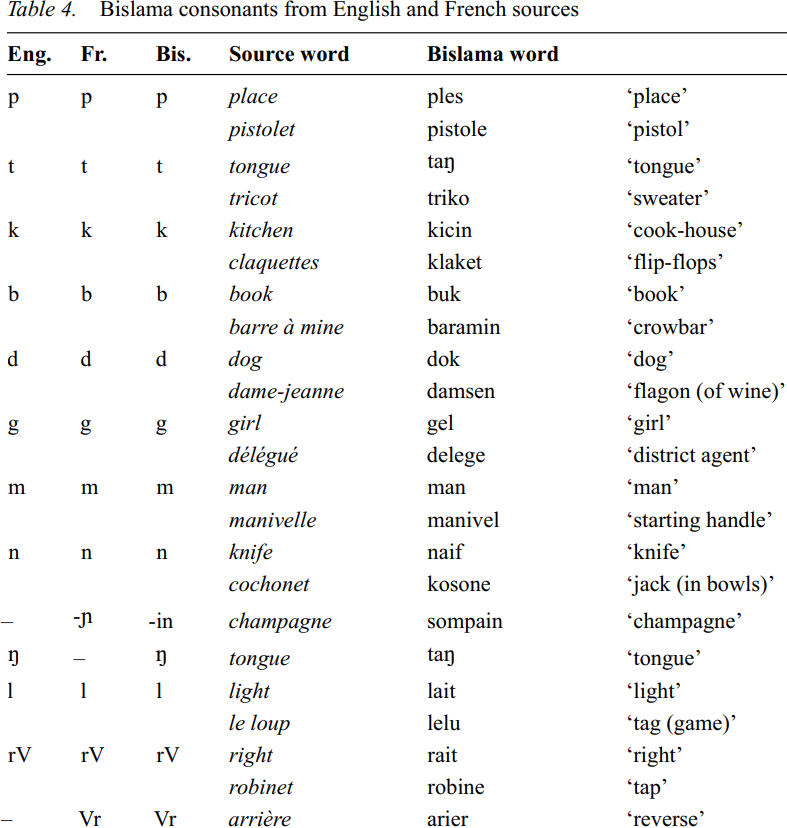
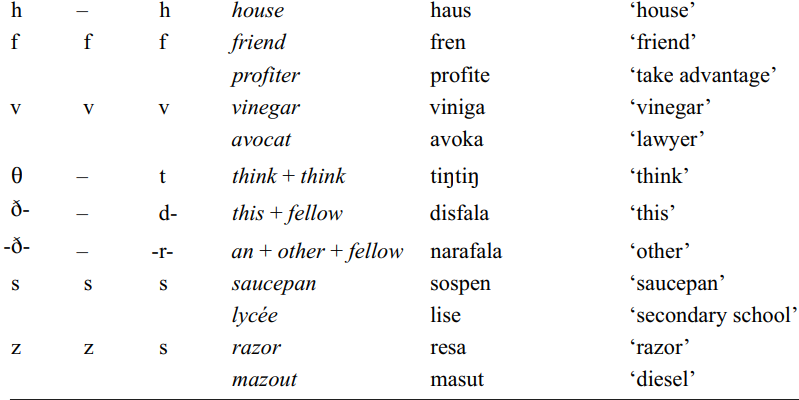
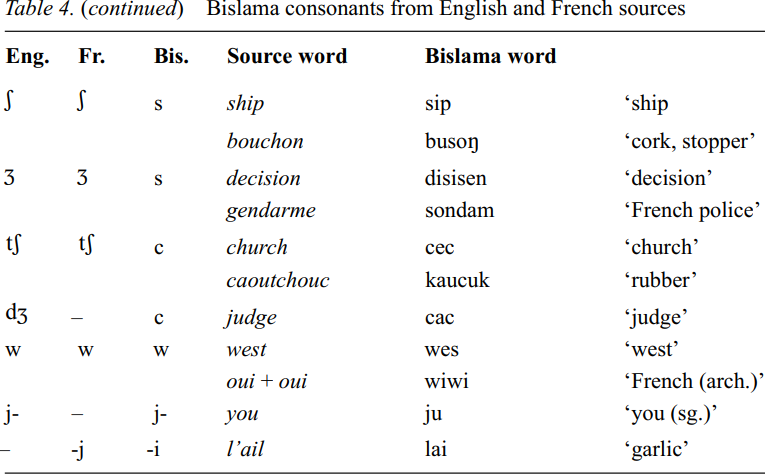
Note that with respect to French words containing /ɲ/, forms have only been attested as being incorporated into Bislama in which this segment appears word-finally, e.g. champagne. Note also that the correspondences presented above for /r/ hold up despite the substantial phonetic difference between this liquid in the three languages. Finally, words beginning with /j-/ are extremely rare in French and none of these have been incorporated into Bislama, hence the lack of examples above.
While it is often possible to predict by these fairly regular correspondence statements what form a word of English origin will take in Bislama, there is by no means a completely regular set of correspondences. Thus, while English /ʧ/ generally corresponds to Bislama /c/ as in /cec/ ‘church’, the form /sakem/ ‘throw (< chuck)’ is idiosyncratically reflected as /s/. Also, while English /r/ is the primary source of /r/ in Bislama, there are some forms in which Bislama intervocalic /r/ unexpectedly derives from a number of other sounds, as in /griri/ ‘greedy’ (where /-d-/ is reflected as /-r-/ rather than /-d-/) and /wora/ ‘water’ (where /-t-/ is reflected as /-r-/ rather than /-t-/). However, it is certainly not the case that all instances of intervocalic /-d-/ and /-t-/ in English can be reflected with /-r-/ in Bislama, as evidenced by invariant forms such as /hotel/ ‘hotel’ and /lada/ ‘ladder’.
 الاكثر قراءة في Phonology
 اخر الاخبار
اخبار العتبة العباسية المقدسة

الآخبار الصحية


مواضيع ذات صلة
 قسم الشؤون الفكرية يصدر كتاباً يوثق تاريخ السدانة في العتبة العباسية المقدسة
 "المهمة".. إصدار قصصي يوثّق القصص الفائزة في مسابقة فتوى الدفاع المقدسة للقصة القصيرة
 (نوافذ).. إصدار أدبي يوثق القصص الفائزة في مسابقة الإمام العسكري (عليه السلام)