Grammar
Tenses
Present

Present Simple
Present Continuous
Present Perfect
Present Perfect Continuous
Past
Past Simple
Past Continuous
Past Perfect
Past Perfect Continuous
Future
Future Simple
Future Continuous
Future Perfect
Future Perfect Continuous
Parts Of Speech
Nouns
Countable and uncountable nouns
Verbal nouns
Singular and Plural nouns
Proper nouns
Nouns gender
Nouns definition
Concrete nouns
Abstract nouns
Common nouns
Collective nouns
Definition Of Nouns
Animate and Inanimate nouns
Nouns
Verbs
Stative and dynamic verbs
Finite and nonfinite verbs
To be verbs
Transitive and intransitive verbs
Auxiliary verbs
Modal verbs
Regular and irregular verbs
Action verbs
Verbs
Adverbs
Relative adverbs
Interrogative adverbs
Adverbs of time
Adverbs of place
Adverbs of reason
Adverbs of quantity
Adverbs of manner
Adverbs of frequency
Adverbs of affirmation
Adverbs
Adjectives
Quantitative adjective
Proper adjective
Possessive adjective
Numeral adjective
Interrogative adjective
Distributive adjective
Descriptive adjective
Demonstrative adjective
Pronouns
Subject pronoun
Relative pronoun
Reflexive pronoun
Reciprocal pronoun
Possessive pronoun
Personal pronoun
Interrogative pronoun
Indefinite pronoun
Emphatic pronoun
Distributive pronoun
Demonstrative pronoun
Pronouns
Pre Position
Preposition by function
Time preposition
Reason preposition
Possession preposition
Place preposition
Phrases preposition
Origin preposition
Measure preposition
Direction preposition
Contrast preposition
Agent preposition
Preposition by construction
Simple preposition
Phrase preposition
Double preposition
Compound preposition
prepositions
Conjunctions
Subordinating conjunction
Correlative conjunction
Coordinating conjunction
Conjunctive adverbs
conjunctions
Interjections
Express calling interjection
Phrases
Sentences
Grammar Rules
Passive and Active
Preference
Requests and offers
wishes
Be used to
Some and any
Could have done
Describing people
Giving advices
Possession
Comparative and superlative
Giving Reason
Making Suggestions
Apologizing
Forming questions
Since and for
Directions
Obligation
Adverbials
invitation
Articles
Imaginary condition
Zero conditional
First conditional
Second conditional
Third conditional
Reported speech
Demonstratives
Determiners
Linguistics
Phonetics
Phonology
Linguistics fields
Syntax
Morphology
Semantics
pragmatics
History
Writing
Grammar
Phonetics and Phonology
Semiotics
Reading Comprehension
Elementary
Intermediate
Advanced
Teaching Methods
Teaching Strategies
Assessment

Phonemic contrasts and phonetic realizations Vowels
 المؤلف:
Terry Crowley
المؤلف:
Terry Crowley
 المصدر:
A Handbook Of Varieties Of English Phonology
المصدر:
A Handbook Of Varieties Of English Phonology
 الجزء والصفحة:
676-38
الجزء والصفحة:
676-38
 2024-04-26
 1393
1393




+
-
20
Phonemic contrasts and phonetic realizations
Vowels
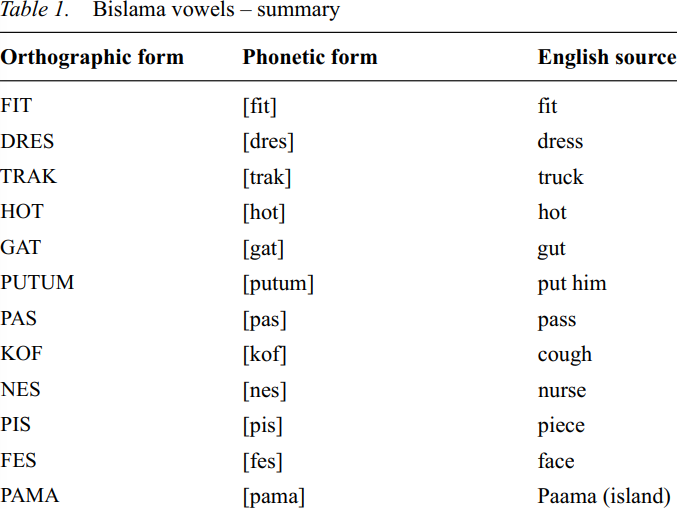
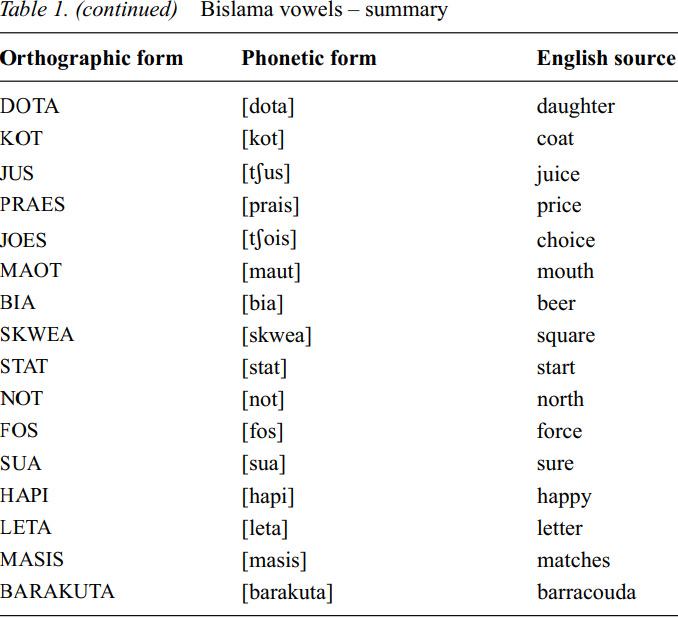
Bislama is usually described as having the following five-way vowel contrast (with no phonemically contrastive length):
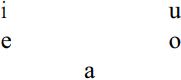
These segments have phonetic values that correspond closely to the cardinal IPA values, with little observable allophonic variation. There is a tendency for rural or lesser educated speakers from the island of Tanna to phonetically lengthen a stressed vowel in a disyllabic word, and to reduce an unstressed vowel in a closed final syllable to a high central vowel, resulting in alternations for a form such as /apol/ ‘apple’ as [ápol] and [á:pɨl]. Such pronunciations, however, are strongly stigmatized, and their appearance seems to be exaggerated as a result of stereotyping.
As with the consonants, there are some fairly regular correspondences between the shapes of Bislama words and their corresponding English or French etyma, with substantial reduction in the number of contrasts between English and Bislama. English /a:/, /æ/ and /Λ/ , for example, regularly correspond to Bislama /a/, e.g. /mak/ ‘mark’, /man/ ‘man’, /taŋ/ ‘tongue’. New words are constantly being incorporated into the language from English and French by generalizing on these correspondences. This is not to say, however, that the forms of Bislama words can be unfailingly predicted from the shape of an English word. There are substantial numbers of unpredictable shifts such as /talem/ ‘tell’ (rather than /telem/), /rusum/ ‘roast’ (rather than /rosem/) and /flaik/ ‘flag’ (rather than /flak/). The most regular patterns of correspondence between English and French vowels on the one hand and Bislama vowels on the other are set out in Table 2.
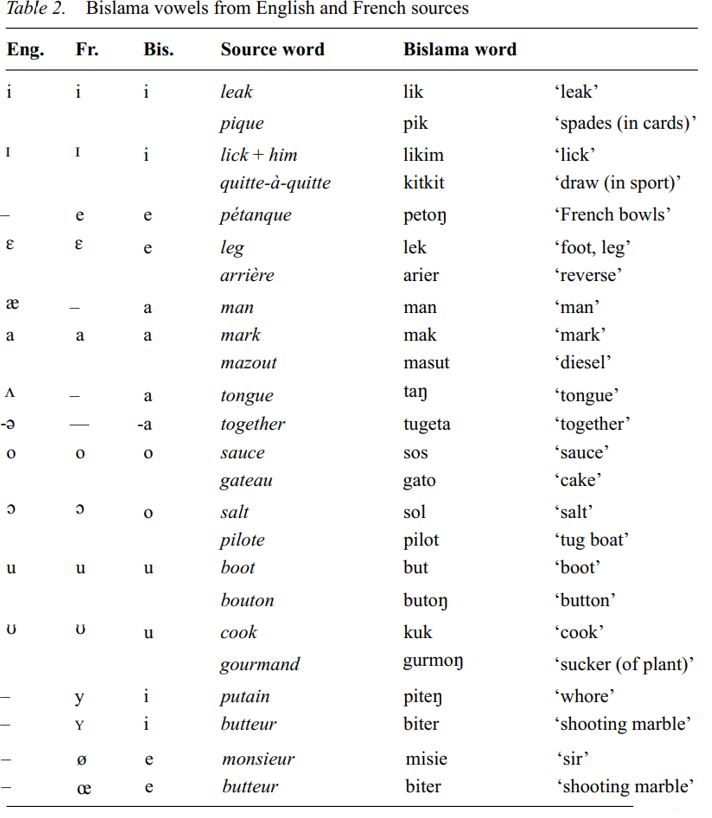
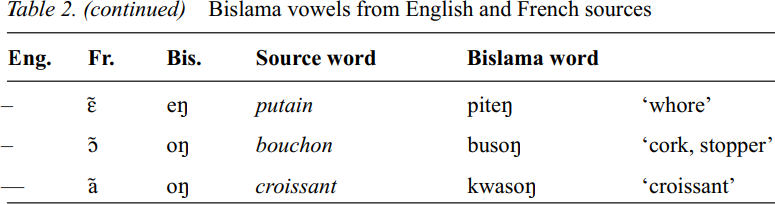
It should be noted that non-final central vowels tend to be fairly unpredictably reflected in Bislama as /o/, /e/, /i/ or /a/. We therefore find English etyma such as the following where /з:/ is reflected invariably as /o/: /bon/ ‘burnt’, /wok/ ‘work’. In /tanem/ ‘turn’ it is reflected invariably as /a/, in /gel/ ‘girl’ it is reflected as /e/, while in the word for ‘shirt’ it is reflected variably as /set ~ sot/. Non-final schwa also often varies between /o/, /e/ or /a/, as in /ofisol ~ ofisel ~ ofisal/ ‘official’.
Words in English containing diphthongs beginning with mid vowels and ending in a high vowel of the same value for frontness and roundedness tend to be somewhat variable in their Bislama reflexes. Word-medially, such diphthongs are generally reflected simply as mid vowels with no off-glide, e.g.

Word-finally, there is rather more variation between monophthongal and diphthongal reflexes in Bislama, e.g.

Word-final diphthongs beginning with a mid vowel and having a schwa offglide – corresponding to post-vocalic /r/ in rhotic dialects of English – also vary in their Bislama reflexes between a simply mid vowel and sequences of /ea/ and /oa/, e.g.

 الاكثر قراءة في Phonology
 اخر الاخبار
اخبار العتبة العباسية المقدسة

الآخبار الصحية


مواضيع ذات صلة
 قسم الشؤون الفكرية يصدر كتاباً يوثق تاريخ السدانة في العتبة العباسية المقدسة
 "المهمة".. إصدار قصصي يوثّق القصص الفائزة في مسابقة فتوى الدفاع المقدسة للقصة القصيرة
 (نوافذ).. إصدار أدبي يوثق القصص الفائزة في مسابقة الإمام العسكري (عليه السلام)