

Grammar


Tenses


Present

Present Simple

Present Continuous

Present Perfect

Present Perfect Continuous


Past

Past Simple

Past Continuous

Past Perfect

Past Perfect Continuous


Future

Future Simple

Future Continuous

Future Perfect

Future Perfect Continuous


Parts Of Speech


Nouns

Countable and uncountable nouns

Verbal nouns

Singular and Plural nouns

Proper nouns

Nouns gender

Nouns definition

Concrete nouns

Abstract nouns

Common nouns

Collective nouns

Definition Of Nouns

Animate and Inanimate nouns

Nouns


Verbs

Stative and dynamic verbs

Finite and nonfinite verbs

To be verbs

Transitive and intransitive verbs

Auxiliary verbs

Modal verbs

Regular and irregular verbs

Action verbs

Verbs


Adverbs

Relative adverbs

Interrogative adverbs

Adverbs of time

Adverbs of place

Adverbs of reason

Adverbs of quantity

Adverbs of manner

Adverbs of frequency

Adverbs of affirmation

Adverbs


Adjectives

Quantitative adjective

Proper adjective

Possessive adjective

Numeral adjective

Interrogative adjective

Distributive adjective

Descriptive adjective

Demonstrative adjective


Pronouns

Subject pronoun

Relative pronoun

Reflexive pronoun

Reciprocal pronoun

Possessive pronoun

Personal pronoun

Interrogative pronoun

Indefinite pronoun

Emphatic pronoun

Distributive pronoun

Demonstrative pronoun

Pronouns


Pre Position


Preposition by function

Time preposition

Reason preposition

Possession preposition

Place preposition

Phrases preposition

Origin preposition

Measure preposition

Direction preposition

Contrast preposition

Agent preposition


Preposition by construction

Simple preposition

Phrase preposition

Double preposition

Compound preposition

prepositions


Conjunctions

Subordinating conjunction

Correlative conjunction

Coordinating conjunction

Conjunctive adverbs

conjunctions


Interjections

Express calling interjection

Phrases

Sentences


Grammar Rules

Passive and Active

Preference

Requests and offers

wishes

Be used to

Some and any

Could have done

Describing people

Giving advices

Possession

Comparative and superlative

Giving Reason

Making Suggestions

Apologizing

Forming questions

Since and for

Directions

Obligation

Adverbials

invitation

Articles

Imaginary condition

Zero conditional

First conditional

Second conditional

Third conditional

Reported speech

Demonstratives

Determiners


Linguistics

Phonetics

Phonology

Linguistics fields

Syntax

Morphology

Semantics

pragmatics

History

Writing

Grammar

Phonetics and Phonology

Semiotics


Reading Comprehension

Elementary

Intermediate

Advanced


Teaching Methods

Teaching Strategies

Assessment
Vowels before postvocalic /l/
المؤلف:
David Bradley
المصدر:
A Handbook Of Varieties Of English Phonology
الجزء والصفحة:
649-36
2024-04-24
1463
Vowels before postvocalic /l/
In many varieties of English, there are interesting vowel changes in progress in prelateral environment; with some remarks on other related phenomena in North America. In addition, the /l/ itself is often vocalized. Both are also happening in Australian English.
In Australian English, there are various regionally-differentiated vowel mergers underway before postvocalic /l/. These include a nearly-completed merger of DRESS into TRAP in Melbourne, which is shared with New Zealand (Buchanan 2001) and Brisbane, but not with Sydney, Hobart, Adelaide or Perth. Thus Ellen and Allen, pellet and pallet, telly and tally and so on become homophonous. Melbourne speakers learning phonetics have no hesitation in transcribing words which are unambiguously DRESS + lateral elsewhere, such as Melbourne, with [æ]; but there is also limited variation and hypercorrection in the other direction, with prelateral DRESS and even some TRAP words occasionally pronounced with the DRESS vowel.
There is also regionally and socially distributed variation between [æ] ~ [ɔ] before a lateral in mall, Albany, Malvern etc. In Melbourne there is variation in Bourke Street Mall, which is usually [æ] but occasionally [ɔ]; in Perth there is Hay Street Mall, which is usually [ɔ] but sometimes [æ]. All other cities in Australia have [ɔ] in their pedestrian malls: Adelaide’s Rundle Mall, Sydney’s Pitt Street Mall, Brisbane’s Queen Street Mall, Hobart’s Elizabeth Street Mall and Launceston’s Brisbane Street Mall. The [æ] pronunciation in Melbourne and Perth is perhaps influenced by spelling, or may reflect a more archaic form; the brand name of the former Malvern Star bicycle was usually pronounced with [æ], but the suburb of Melbourne where its factory was located is now mainly pronounced with [ɔ] , which is also the more prestige form, and more like modern RP. In another small word class there is variation between [ɔ] ~ [ɒ] as in off or Launceston, but this reflects mainly age and social differences rather than region.
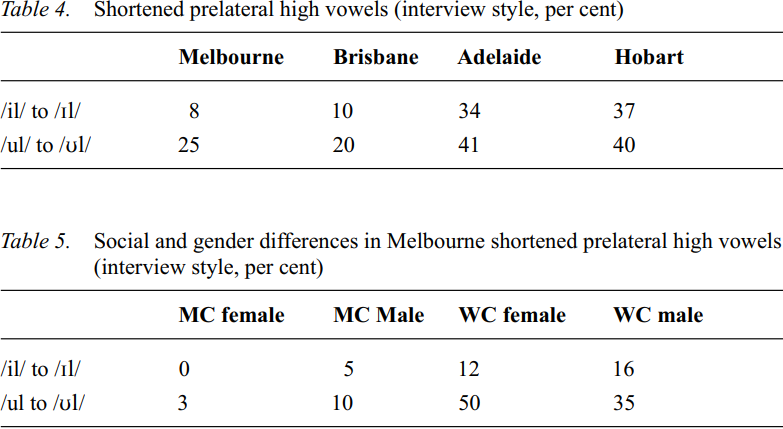
There are two mergers in progress which tend to collapse prelateral high tense vowels into the corresponding high lax vowel: FLEECE becomes KIT, and GOOSE and CURE become FOOT; for example, deal merges on dill, fool merges on full, and fuel also merges on the FOOT vowel, but keeps its medial [j] glide. This merger is furthest advanced in Adelaide and Hobart, somewhat less so in Sydney and Brisbane, and least so in Melbourne; note also the differences between front and back vowel patterns. Table 4 shows the regional distribution for four cities; comparable Sydney data is not available. Table 5 shows the social and stylistic stratification of these variables in Melbourne.
A parallel phenomenon also variably merges GOAT into GOT before /l/, especially in words of more than one syllable, so that poll usually has the GOAT vowel, but polling very often has the GOT vowel.
الاكثر قراءة في Phonology
اخر الاخبار
اخبار العتبة العباسية المقدسة
الآخبار الصحية

قسم الشؤون الفكرية يصدر كتاباً يوثق تاريخ السدانة في العتبة العباسية المقدسة
"المهمة".. إصدار قصصي يوثّق القصص الفائزة في مسابقة فتوى الدفاع المقدسة للقصة القصيرة
(نوافذ).. إصدار أدبي يوثق القصص الفائزة في مسابقة الإمام العسكري (عليه السلام)


