Grammar
Tenses
Present

Present Simple
Present Continuous
Present Perfect
Present Perfect Continuous
Past
Past Simple
Past Continuous
Past Perfect
Past Perfect Continuous
Future
Future Simple
Future Continuous
Future Perfect
Future Perfect Continuous
Parts Of Speech
Nouns
Countable and uncountable nouns
Verbal nouns
Singular and Plural nouns
Proper nouns
Nouns gender
Nouns definition
Concrete nouns
Abstract nouns
Common nouns
Collective nouns
Definition Of Nouns
Animate and Inanimate nouns
Nouns
Verbs
Stative and dynamic verbs
Finite and nonfinite verbs
To be verbs
Transitive and intransitive verbs
Auxiliary verbs
Modal verbs
Regular and irregular verbs
Action verbs
Verbs
Adverbs
Relative adverbs
Interrogative adverbs
Adverbs of time
Adverbs of place
Adverbs of reason
Adverbs of quantity
Adverbs of manner
Adverbs of frequency
Adverbs of affirmation
Adverbs
Adjectives
Quantitative adjective
Proper adjective
Possessive adjective
Numeral adjective
Interrogative adjective
Distributive adjective
Descriptive adjective
Demonstrative adjective
Pronouns
Subject pronoun
Relative pronoun
Reflexive pronoun
Reciprocal pronoun
Possessive pronoun
Personal pronoun
Interrogative pronoun
Indefinite pronoun
Emphatic pronoun
Distributive pronoun
Demonstrative pronoun
Pronouns
Pre Position
Preposition by function
Time preposition
Reason preposition
Possession preposition
Place preposition
Phrases preposition
Origin preposition
Measure preposition
Direction preposition
Contrast preposition
Agent preposition
Preposition by construction
Simple preposition
Phrase preposition
Double preposition
Compound preposition
prepositions
Conjunctions
Subordinating conjunction
Correlative conjunction
Coordinating conjunction
Conjunctive adverbs
conjunctions
Interjections
Express calling interjection
Phrases
Sentences
Grammar Rules
Passive and Active
Preference
Requests and offers
wishes
Be used to
Some and any
Could have done
Describing people
Giving advices
Possession
Comparative and superlative
Giving Reason
Making Suggestions
Apologizing
Forming questions
Since and for
Directions
Obligation
Adverbials
invitation
Articles
Imaginary condition
Zero conditional
First conditional
Second conditional
Third conditional
Reported speech
Demonstratives
Determiners
Linguistics
Phonetics
Phonology
Linguistics fields
Syntax
Morphology
Semantics
pragmatics
History
Writing
Grammar
Phonetics and Phonology
Semiotics
Reading Comprehension
Elementary
Intermediate
Advanced
Teaching Methods
Teaching Strategies
Assessment

Cultivated, General and Broad NZE
 المؤلف:
Elizabeth Gordon and Margaret Maclagan
المؤلف:
Elizabeth Gordon and Margaret Maclagan
 المصدر:
A Handbook Of Varieties Of English Phonology
المصدر:
A Handbook Of Varieties Of English Phonology
 الجزء والصفحة:
608-34
الجزء والصفحة:
608-34
 2024-04-20
 1123
1123




+
-
20
Cultivated, General and Broad NZE
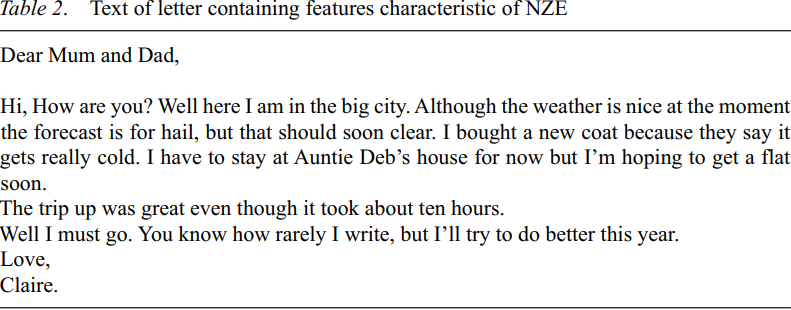
Differences because of social class are clearly identifiable in present-day NZE. The three young women in the accompanying audio clip were selected in terms of social class. Karen is from a middle social class, Christine from a lower social class and Wendy from a higher social class. However, the recordings can be clearly differentiated linguistically as can be heard in the accompanying audio clip. Wendy speaks Cultivated NZE, Karen General NZE and Christine Broad NZE. The letter they are reading is widely used in investigations of NZE. It contains most of the key vowels in stressed position. The text is given in Table 2.
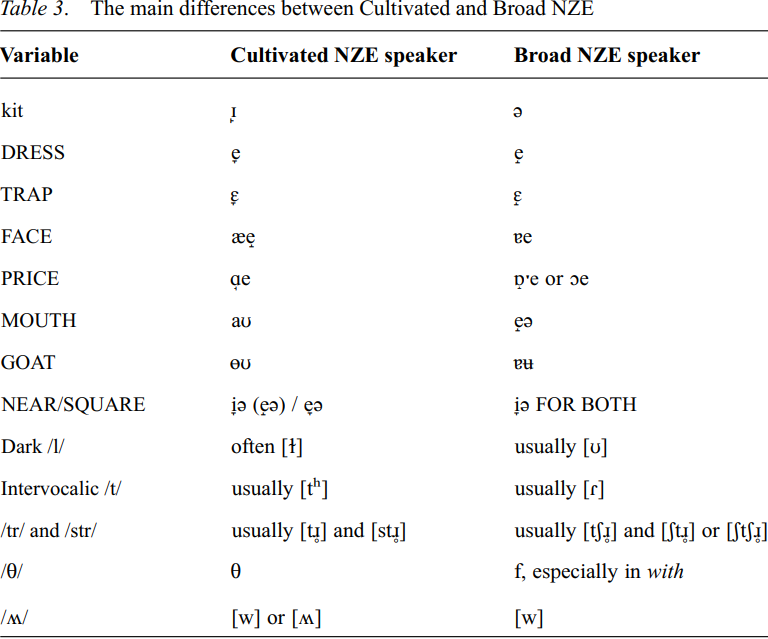
Social class is marked most clearly by the pronunciation of the closing diphthongs, FACE, PRICE, GOAT and MOUTH, with women from higher social classes in particular avoiding pronunciations associated with lower social classes. The front vowels, KIT, DRESS and TRAP and the centring diphthongs NEAR and SQUARE also receive different pronunciations from different social groups. The consonant that shows social class differentiation most clearly is /θ/, which is fronted, so that think is pronounced /fɪŋk/ by many speakers from lower social classes. TH-fronting is overtly stigmatized by those who speak Cultivated NZE, and speakers from the higher social classes avoid it. Another consonant which shows social class differentiation is /l/, which is vocalised less by speakers of Cultivated NZE. Cultivated NZE speakers are also less likely to use flaps in words like city or to affricate /tr/ and /str/ so that they sound like  . We noted that the /M/ ~ /w/ contrast is still maintained by some speakers in Southland. Some older women from the higher social classes from other parts of the country also maintain this distinction, but more often in reading than in speech. Table 3 compares the pronunciation of Cultivated and Broad speakers of NZE. Most of these features are illustrated in the recordings.
The consequences of using a Broad NZE accent can be particularly marked for women. In 1993 Elizabeth Gordon carried out a study (Gordon 1997) where subjects listened to recordings of the three young women chosen to represent Cultivated, General and Broad NZE in the audio clip described above. They were then asked to match the individual recordings to three different photos of the same model wearing clothes chosen to represent three social classes − higher to lower. Subjects were then given subjective tests in which they answered questions about each person represented by the voice/photo pairings. The results showed very clearly that the clothes and speech variety associated with a young lower class New Zealand woman produced a depressing stereotype, in which she was said to have the lowest intelligence, lowest family income, and be most likely to smoke and to be promiscuous. When asked for a possible occupation, the most frequent responses given by the subjects were “unemployed,” “single parent” or “prostitute”.
 الاكثر قراءة في Phonology
 اخر الاخبار
اخبار العتبة العباسية المقدسة

الآخبار الصحية


مواضيع ذات صلة
 قسم الشؤون الفكرية يصدر كتاباً يوثق تاريخ السدانة في العتبة العباسية المقدسة
 "المهمة".. إصدار قصصي يوثّق القصص الفائزة في مسابقة فتوى الدفاع المقدسة للقصة القصيرة
 (نوافذ).. إصدار أدبي يوثق القصص الفائزة في مسابقة الإمام العسكري (عليه السلام)