Grammar
Tenses
Present

Present Simple
Present Continuous
Present Perfect
Present Perfect Continuous
Past
Past Simple
Past Continuous
Past Perfect
Past Perfect Continuous
Future
Future Simple
Future Continuous
Future Perfect
Future Perfect Continuous
Parts Of Speech
Nouns
Countable and uncountable nouns
Verbal nouns
Singular and Plural nouns
Proper nouns
Nouns gender
Nouns definition
Concrete nouns
Abstract nouns
Common nouns
Collective nouns
Definition Of Nouns
Animate and Inanimate nouns
Nouns
Verbs
Stative and dynamic verbs
Finite and nonfinite verbs
To be verbs
Transitive and intransitive verbs
Auxiliary verbs
Modal verbs
Regular and irregular verbs
Action verbs
Verbs
Adverbs
Relative adverbs
Interrogative adverbs
Adverbs of time
Adverbs of place
Adverbs of reason
Adverbs of quantity
Adverbs of manner
Adverbs of frequency
Adverbs of affirmation
Adverbs
Adjectives
Quantitative adjective
Proper adjective
Possessive adjective
Numeral adjective
Interrogative adjective
Distributive adjective
Descriptive adjective
Demonstrative adjective
Pronouns
Subject pronoun
Relative pronoun
Reflexive pronoun
Reciprocal pronoun
Possessive pronoun
Personal pronoun
Interrogative pronoun
Indefinite pronoun
Emphatic pronoun
Distributive pronoun
Demonstrative pronoun
Pronouns
Pre Position
Preposition by function
Time preposition
Reason preposition
Possession preposition
Place preposition
Phrases preposition
Origin preposition
Measure preposition
Direction preposition
Contrast preposition
Agent preposition
Preposition by construction
Simple preposition
Phrase preposition
Double preposition
Compound preposition
prepositions
Conjunctions
Subordinating conjunction
Correlative conjunction
Coordinating conjunction
Conjunctive adverbs
conjunctions
Interjections
Express calling interjection
Phrases
Sentences
Grammar Rules
Passive and Active
Preference
Requests and offers
wishes
Be used to
Some and any
Could have done
Describing people
Giving advices
Possession
Comparative and superlative
Giving Reason
Making Suggestions
Apologizing
Forming questions
Since and for
Directions
Obligation
Adverbials
invitation
Articles
Imaginary condition
Zero conditional
First conditional
Second conditional
Third conditional
Reported speech
Demonstratives
Determiners
Linguistics
Phonetics
Phonology
Linguistics fields
Syntax
Morphology
Semantics
pragmatics
History
Writing
Grammar
Phonetics and Phonology
Semiotics
Reading Comprehension
Elementary
Intermediate
Advanced
Teaching Methods
Teaching Strategies
Assessment

Regional variation in New Zealand English
 المؤلف:
Elizabeth Gordon and Margaret Maclagan
المؤلف:
Elizabeth Gordon and Margaret Maclagan
 المصدر:
A Handbook Of Varieties Of English Phonology
المصدر:
A Handbook Of Varieties Of English Phonology
 الجزء والصفحة:
604-34
الجزء والصفحة:
604-34
 2024-04-20
 1225
1225




+
-
20
Regional variation in New Zealand English
The early immigrants to New Zealand came from all parts of the British Isles and Australia. Of those who came from England (who made up 49% of the total), by far the largest number of immigrants came from the South of England, and this was the trend at every stage of New Zealand’s development. People from the south, and in particular the southeast, made up a majority of the earliest settlers in the planned settlements (1840–1852); they made up the majority in later government-assisted immigration schemes (1871–1880). The Southern English influence could also have been reinforced by any Australian influence (seen especially at the time of the gold rush and the New Zealand Wars), as Australia was also settled predominantly from the South of England. So although over 20% of the early immigrants to New Zealand were Scottish and a similar percentage were Irish, in the end their phonological influence was overwhelmed by Southern English; the influence of other areas of the British Isles can be seen only in a few lexical and morphological examples.
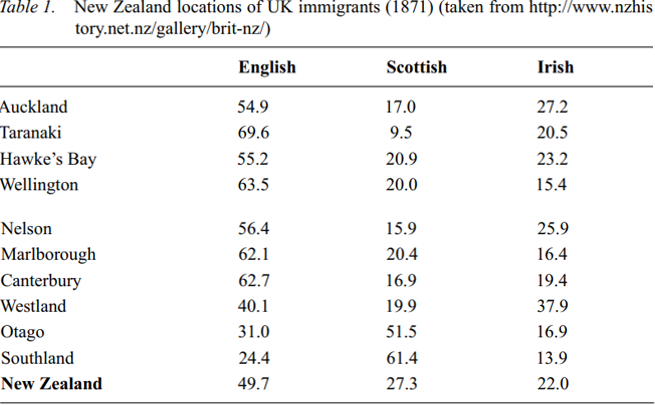
There is one exception to this general rule, and that is in the Southern part of the South Island of New Zealand – Southland and parts of Otago – where many of the early settlements were predominantly Scottish as shown in Table 1. This influence can still be heard in what is known locally as “the Southland burr”, a semi-rhotic variant of New Zealand English (NZE).
Although the Southland variety of NZE is the only regional variety attested by linguists, there are strongly held lay views that there are other dialects of NZE. A recent broadcast series on “Coastal Dialects of NZE”, for example, claimed that there were strong regional differences in New Zealand. These programmes based this assertion on recordings of single speakers from different parts of New Zealand, without any linguistic comment or discussion. Work by Pamela Gordon (1997) on attitudes towards varieties of NZE demonstrated strongly held local beliefs about the “pseudo-English” of Christchurch and Canterbury, the slowness of West Coast speech, and so on. The view of linguists is that regional phonological variation in New Zealand (apart from Southland) has so far not been demonstrated. However, new evidence is currently emerging that there are intonational differences in Taranaki in the North Island. Folk linguistic knowledge has described Taranaki intonation as “sing song”, and analysis is demonstrating that there are, indeed, more pitch shifts per intonation unit than in other areas of New Zealand. Results like this indicate that detailed analysis may reveal some differences in other regions around the country. Nevertheless such regional differences are minor when compared with those that characterize dialects in other varieties of English, or the Southland variety of NZE to which we now turn.
 الاكثر قراءة في Phonology
 اخر الاخبار
اخبار العتبة العباسية المقدسة

الآخبار الصحية


مواضيع ذات صلة
 قسم الشؤون الفكرية يصدر كتاباً يوثق تاريخ السدانة في العتبة العباسية المقدسة
 "المهمة".. إصدار قصصي يوثّق القصص الفائزة في مسابقة فتوى الدفاع المقدسة للقصة القصيرة
 (نوافذ).. إصدار أدبي يوثق القصص الفائزة في مسابقة الإمام العسكري (عليه السلام)