Grammar
Tenses
Present

Present Simple
Present Continuous
Present Perfect
Present Perfect Continuous
Past
Past Simple
Past Continuous
Past Perfect
Past Perfect Continuous
Future
Future Simple
Future Continuous
Future Perfect
Future Perfect Continuous
Parts Of Speech
Nouns
Countable and uncountable nouns
Verbal nouns
Singular and Plural nouns
Proper nouns
Nouns gender
Nouns definition
Concrete nouns
Abstract nouns
Common nouns
Collective nouns
Definition Of Nouns
Animate and Inanimate nouns
Nouns
Verbs
Stative and dynamic verbs
Finite and nonfinite verbs
To be verbs
Transitive and intransitive verbs
Auxiliary verbs
Modal verbs
Regular and irregular verbs
Action verbs
Verbs
Adverbs
Relative adverbs
Interrogative adverbs
Adverbs of time
Adverbs of place
Adverbs of reason
Adverbs of quantity
Adverbs of manner
Adverbs of frequency
Adverbs of affirmation
Adverbs
Adjectives
Quantitative adjective
Proper adjective
Possessive adjective
Numeral adjective
Interrogative adjective
Distributive adjective
Descriptive adjective
Demonstrative adjective
Pronouns
Subject pronoun
Relative pronoun
Reflexive pronoun
Reciprocal pronoun
Possessive pronoun
Personal pronoun
Interrogative pronoun
Indefinite pronoun
Emphatic pronoun
Distributive pronoun
Demonstrative pronoun
Pronouns
Pre Position
Preposition by function
Time preposition
Reason preposition
Possession preposition
Place preposition
Phrases preposition
Origin preposition
Measure preposition
Direction preposition
Contrast preposition
Agent preposition
Preposition by construction
Simple preposition
Phrase preposition
Double preposition
Compound preposition
prepositions
Conjunctions
Subordinating conjunction
Correlative conjunction
Coordinating conjunction
Conjunctive adverbs
conjunctions
Interjections
Express calling interjection
Phrases
Sentences
Grammar Rules
Passive and Active
Preference
Requests and offers
wishes
Be used to
Some and any
Could have done
Describing people
Giving advices
Possession
Comparative and superlative
Giving Reason
Making Suggestions
Apologizing
Forming questions
Since and for
Directions
Obligation
Adverbials
invitation
Articles
Imaginary condition
Zero conditional
First conditional
Second conditional
Third conditional
Reported speech
Demonstratives
Determiners
Linguistics
Phonetics
Phonology
Linguistics fields
Syntax
Morphology
Semantics
pragmatics
History
Writing
Grammar
Phonetics and Phonology
Semiotics
Reading Comprehension
Elementary
Intermediate
Advanced
Teaching Methods
Teaching Strategies
Assessment

Vowel systems CHOICE
 المؤلف:
Norval Smith and Vinije Haabo
المؤلف:
Norval Smith and Vinije Haabo
 المصدر:
A Handbook Of Varieties Of English Phonology
المصدر:
A Handbook Of Varieties Of English Phonology
 الجزء والصفحة:
544-31
الجزء والصفحة:
544-31
 2024-04-16
 1231
1231




+
-
20
Vowel systems CHOICE
The CHOICE set of words, corresponding to ME /ɔi, ʊi/ , is represented in Suriname creoles by words derived from Early Modern English boy, boil (n.), boil (v.), and spoil. According to Dobson (1957) the /ɔi/ found in modern Standard English is derived from one ME variant, alternating in many words with /ʊi/ which later became /ai/ (< /´i/) in advanced pronunciation in EModE.
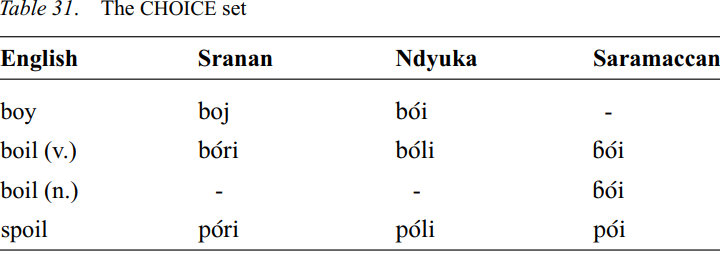
The forms for boy are not (necessarily) problematic, but those for the other three words are. The reason is the unusual combination of organic and anaptyctic vowels here. Usually, features of the organic vowel are repeated in the anaptyctic vowel:
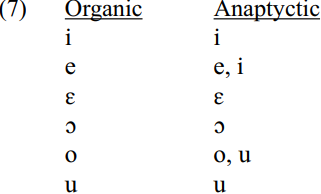
or, as in the case of low vowels, the final consonant plays a role:
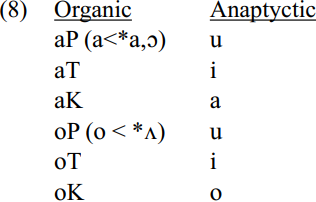
Here, however, the diphthong /ɔi/ gives us /o-i/. The other two diphthongs in English /ai/ and /au/ result in /e-i, e-e/ and /o-u, o-o/ respectively. In other words diphthongs are generally compressed to single vowels, of forecastable quality. /e/ reflects the features of both /a/ and /i – low] and [front], and /o/ the features of both /a/ and /u – low] and [round]. But, the /o/ in /bo’ri/ does not reflect both the features of /ɔ/ and the features of /i/. We must look further.
Let us start from the anaptyctic vowel /-i/. This implies in general a front organic vowel. We ignore the fact that coronal consonants following organic historic low vowels trigger anaptyctic /-i/ because we expect the three English diphthongs to be treated in a parallel fashion. As Smith (1987: 432) observes “The only case that would fit the occurring patterns would be a model involving the EModE vowel /Λ/ followed by an alveolar”. Why /ɔi/ should result in /Λ/ is not at all clear. It is of course the case that the CHOICE set has fallen together with the STRUT set.
Rounded vowels do have another source in the Suriname creoles than English back or round vowels. We find not infrequent cases of the following (unsystematic) changes:
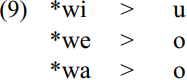
Further, in these cases the comparison drawn with Krio and Jamaican by Smith (1987) is illuminating:
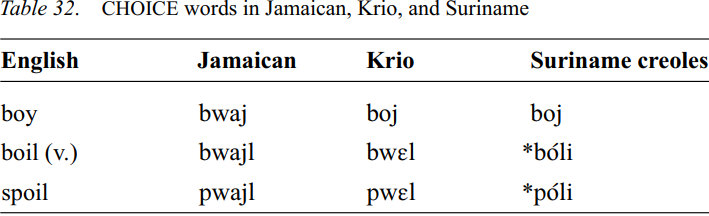
If the diphthongs in the cases with codas were preceded historically by a situation like that in Krio, then the anaptyctic front vowels can be explained. This is then due to the organic front vowel present. Note that Krio, like the Suriname creoles, systematically compresses pre-coda diphthongs /ai, au/ into single vowels. We could then imagine a derivational path as follows:

Where does this vocalic structure /wai/ come from? Presumably from EME /ʊi/. On the evidence of Wright (1905) [wai] and [wəi] only occur after labials. Dobson (1957: 825) compares the retention of /ʊi/ here to the parallel tendency to retain /ʊ/ after labials. The intermediate stages he posits are of lesser interest so we will ignore Dobson’s further discussion here.
 الاكثر قراءة في Phonology
 اخر الاخبار
اخبار العتبة العباسية المقدسة

الآخبار الصحية


مواضيع ذات صلة
 قسم الشؤون الفكرية يصدر كتاباً يوثق تاريخ السدانة في العتبة العباسية المقدسة
 "المهمة".. إصدار قصصي يوثّق القصص الفائزة في مسابقة فتوى الدفاع المقدسة للقصة القصيرة
 (نوافذ).. إصدار أدبي يوثق القصص الفائزة في مسابقة الإمام العسكري (عليه السلام)