Grammar
Tenses
Present

Present Simple
Present Continuous
Present Perfect
Present Perfect Continuous
Past
Past Simple
Past Continuous
Past Perfect
Past Perfect Continuous
Future
Future Simple
Future Continuous
Future Perfect
Future Perfect Continuous
Parts Of Speech
Nouns
Countable and uncountable nouns
Verbal nouns
Singular and Plural nouns
Proper nouns
Nouns gender
Nouns definition
Concrete nouns
Abstract nouns
Common nouns
Collective nouns
Definition Of Nouns
Animate and Inanimate nouns
Nouns
Verbs
Stative and dynamic verbs
Finite and nonfinite verbs
To be verbs
Transitive and intransitive verbs
Auxiliary verbs
Modal verbs
Regular and irregular verbs
Action verbs
Verbs
Adverbs
Relative adverbs
Interrogative adverbs
Adverbs of time
Adverbs of place
Adverbs of reason
Adverbs of quantity
Adverbs of manner
Adverbs of frequency
Adverbs of affirmation
Adverbs
Adjectives
Quantitative adjective
Proper adjective
Possessive adjective
Numeral adjective
Interrogative adjective
Distributive adjective
Descriptive adjective
Demonstrative adjective
Pronouns
Subject pronoun
Relative pronoun
Reflexive pronoun
Reciprocal pronoun
Possessive pronoun
Personal pronoun
Interrogative pronoun
Indefinite pronoun
Emphatic pronoun
Distributive pronoun
Demonstrative pronoun
Pronouns
Pre Position
Preposition by function
Time preposition
Reason preposition
Possession preposition
Place preposition
Phrases preposition
Origin preposition
Measure preposition
Direction preposition
Contrast preposition
Agent preposition
Preposition by construction
Simple preposition
Phrase preposition
Double preposition
Compound preposition
prepositions
Conjunctions
Subordinating conjunction
Correlative conjunction
Coordinating conjunction
Conjunctive adverbs
conjunctions
Interjections
Express calling interjection
Phrases
Sentences
Grammar Rules
Passive and Active
Preference
Requests and offers
wishes
Be used to
Some and any
Could have done
Describing people
Giving advices
Possession
Comparative and superlative
Giving Reason
Making Suggestions
Apologizing
Forming questions
Since and for
Directions
Obligation
Adverbials
invitation
Articles
Imaginary condition
Zero conditional
First conditional
Second conditional
Third conditional
Reported speech
Demonstratives
Determiners
Linguistics
Phonetics
Phonology
Linguistics fields
Syntax
Morphology
Semantics
pragmatics
History
Writing
Grammar
Phonetics and Phonology
Semiotics
Reading Comprehension
Elementary
Intermediate
Advanced
Teaching Methods
Teaching Strategies
Assessment

Trinidad and Tobago: Acrolect and mesolect Vowels
 المؤلف:
Valerie Youssef and Winford James
المؤلف:
Valerie Youssef and Winford James
 المصدر:
A Handbook Of Varieties Of English Phonology
المصدر:
A Handbook Of Varieties Of English Phonology
 الجزء والصفحة:
514-30
الجزء والصفحة:
514-30
 2024-04-12
 1339
1339




+
-
20
Trinidad and Tobago: Acrolect and mesolect
Vowels
There has been little careful sociolinguistic study of the distribution of vowel sounds according to features such as age, class, ethnicity and geography, but a notable exception is Winford (1972, 1978). He was able to posit a system of vowel change in progress in Trinidad, with the number of vowels in the system very reduced for older rural Indians and their descendants but gradually broadening towards the norms at the acrolectal end of the scale. He studied the variables (з:) as in work (Λ) as in hut, (ɔ) as in hot and (ə) as in the unstressed syllable in father and found considerably more variation among the rural community than the urban. Urban informants used the prestige variants, corresponding with those documented in table 1 below, more than any other, but the rural informants showed more variability with ‘significant patterns of age and ethnic differentiation’ (1978: 285). Younger rural speakers evidenced more use of the urban patterns than did older, while the older rural speakers used the more stigmatized variants. The oldest rural Indians of the lowest status group, whose first language was Bhojpuri, used highly stigmatized variants absent from the urban varieties. Most evidenced was a generalized [a] for the variables above, and here we notice an interesting correlation with the Tobagonian basilect. Winford hypothesized that they had reduced the range of vowels available in the StE system considerably at the time of first contact and that these were now in process of re-establishment. As the reader will observe in the discussion below, however, a considerable measure of vowel mergence does exist and persist across the more normative variety.
With such a measure of variation in mind we can proceed to table 1 below, which sets out Wells’ list of 28 items with most typical norms represented. Where there are significant differences from other national varieties these are bolded, and where there is a range of variation about the norm this too is specified. Overall it will be noted that there is a tendency to produce as monophthongs what in other national varieties are diphthongs. Four items are added finally from the extended Foulkes/Docherty listing and one other, BARE:
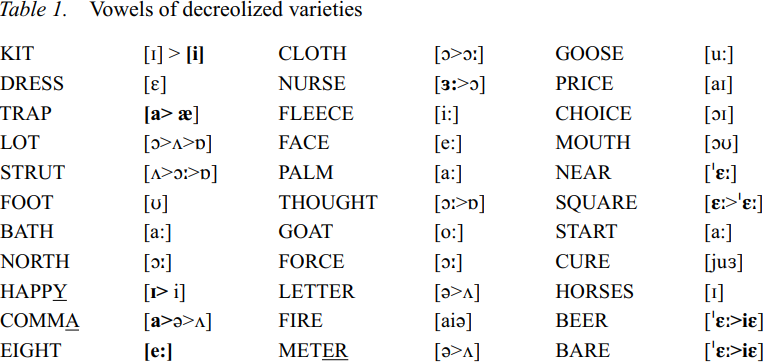
Most of these features of the vowel system of the normative national Trinidadian and Tobagonian variety are adapted from a chart compiled by Ferreira for Youssef, James and Ferreira (2001) which was verified and extended for this paper. In putting it together she drew upon her own native speaker competence as well as on that of Solomon (1993) and on the work of Allsopp (1996). Ferreira isolated 22 phonemes in comparison to 17 isolated by Winford (1978).
Vowel length is one of the most variant features in Trinidadian and Tobagonian speech. The most striking difference with other StE varieties is the low incidence of [æ]. Often it is lost in one place so that, for example, [a] and [æ] may merge rendering heart and hat the same, and then length may be reintroduced elsewhere, e.g in a word like salad, pronounced /sæ'la:d/ with stress on the final syllable. (In the Tobagonian basilect, however, heart and hat are distinguished by vowel length and salad has two short vowels.)
There is a tendency towards neutralization of complex vowel sounds particularly in combination with [ə] and occurring word finally. These produce homophones that are distinguishable by context and include beer and bear, peer and pear and similar combinations. Solomon (1993: 15-16) has observed that acrolectal speakers may have either [i] or [ε] before [ə] but not both and suggests that education may be a critical factor with women outstripping men in production of [εə] particularly on the Trinidad radio. He believes that this variant correlates with a higher level of education and is more prestigious, but admits to a general increase in the use of [iə] in the media for both sexes. In the mesolect and increasingly in the acrolect [e:] is produced.
In the Trinidadian mesolect it is generally recognized that the vowel sounds in cut, cot, caught and curt may not be distinguished with the sounds /Λ/, /ɒ/, /ɔ/ , and /з/ rendered as the single back open rounded vowel /ɒ/. Other neutralizations in the same vowel group produce the following:
– [ɒ] and [Λ] in StE as in body and buddy merge in [Λ] , rendering these items as well as others like golf and gulf homophonous.
Sometimes, however, there may be a lengthening resulting in the following merger of [ɒ] and [ɔ] ; body and bawdy become neutralized, long becomes “lorng”.
– [з] and [Λ] merge so that bird and bud are homophonous.
The major other neutralizations, which do not hold for all speakers, are as follows:
– [a] and [a] in SE as in ask and axe (where metathesis can also occur) merge in [a];
– the vowels in harm and ham, become homophonous with the use of [a].
– the vowels in bit and beat become homophonous with the use of [i:].
Warner (1967) associated these last two mergers with French Creole, Spanish or Bhojpuri influence, but today they are more generalized allophonic variants, as real contact with these disappearing languages rapidly diminishes. Other characteristic vowel sounds occur in words like down and sound which are rendered [dɒŋ] and [sɒŋ] respectively. Most usually the vowel is nasalized.
 الاكثر قراءة في Phonology
 اخر الاخبار
اخبار العتبة العباسية المقدسة

الآخبار الصحية


مواضيع ذات صلة
 قسم الشؤون الفكرية يصدر كتاباً يوثق تاريخ السدانة في العتبة العباسية المقدسة
 "المهمة".. إصدار قصصي يوثّق القصص الفائزة في مسابقة فتوى الدفاع المقدسة للقصة القصيرة
 (نوافذ).. إصدار أدبي يوثق القصص الفائزة في مسابقة الإمام العسكري (عليه السلام)