Grammar
Tenses
Present

Present Simple
Present Continuous
Present Perfect
Present Perfect Continuous
Past
Past Simple
Past Continuous
Past Perfect
Past Perfect Continuous
Future
Future Simple
Future Continuous
Future Perfect
Future Perfect Continuous
Parts Of Speech
Nouns
Countable and uncountable nouns
Verbal nouns
Singular and Plural nouns
Proper nouns
Nouns gender
Nouns definition
Concrete nouns
Abstract nouns
Common nouns
Collective nouns
Definition Of Nouns
Animate and Inanimate nouns
Nouns
Verbs
Stative and dynamic verbs
Finite and nonfinite verbs
To be verbs
Transitive and intransitive verbs
Auxiliary verbs
Modal verbs
Regular and irregular verbs
Action verbs
Verbs
Adverbs
Relative adverbs
Interrogative adverbs
Adverbs of time
Adverbs of place
Adverbs of reason
Adverbs of quantity
Adverbs of manner
Adverbs of frequency
Adverbs of affirmation
Adverbs
Adjectives
Quantitative adjective
Proper adjective
Possessive adjective
Numeral adjective
Interrogative adjective
Distributive adjective
Descriptive adjective
Demonstrative adjective
Pronouns
Subject pronoun
Relative pronoun
Reflexive pronoun
Reciprocal pronoun
Possessive pronoun
Personal pronoun
Interrogative pronoun
Indefinite pronoun
Emphatic pronoun
Distributive pronoun
Demonstrative pronoun
Pronouns
Pre Position
Preposition by function
Time preposition
Reason preposition
Possession preposition
Place preposition
Phrases preposition
Origin preposition
Measure preposition
Direction preposition
Contrast preposition
Agent preposition
Preposition by construction
Simple preposition
Phrase preposition
Double preposition
Compound preposition
prepositions
Conjunctions
Subordinating conjunction
Correlative conjunction
Coordinating conjunction
Conjunctive adverbs
conjunctions
Interjections
Express calling interjection
Phrases
Sentences
Grammar Rules
Passive and Active
Preference
Requests and offers
wishes
Be used to
Some and any
Could have done
Describing people
Giving advices
Possession
Comparative and superlative
Giving Reason
Making Suggestions
Apologizing
Forming questions
Since and for
Directions
Obligation
Adverbials
invitation
Articles
Imaginary condition
Zero conditional
First conditional
Second conditional
Third conditional
Reported speech
Demonstratives
Determiners
Linguistics
Phonetics
Phonology
Linguistics fields
Syntax
Morphology
Semantics
pragmatics
History
Writing
Grammar
Phonetics and Phonology
Semiotics
Reading Comprehension
Elementary
Intermediate
Advanced
Teaching Methods
Teaching Strategies
Assessment

The creoles of Trinidad and Tobago: phonology Sociohistorical background
 المؤلف:
Valerie Youssef and Winford James
المؤلف:
Valerie Youssef and Winford James
 المصدر:
A Handbook Of Varieties Of English Phonology
المصدر:
A Handbook Of Varieties Of English Phonology
 الجزء والصفحة:
508-30
الجزء والصفحة:
508-30
 2024-04-12
 1396
1396




+
-
20
The creoles of Trinidad and Tobago: phonology
Sociohistorical background
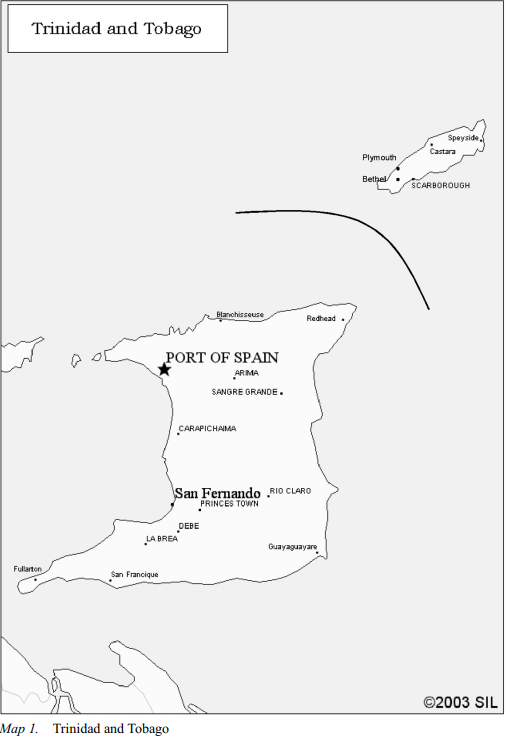
The histories of the islands of Trinidad and Tobago are divergent, and although the two have comprised a single political entity since 1889, they must be considered as separate entities for the purposes of describing both their histories and the distinct linguistic elements in their language varieties. This need has been under-stated in the literature on Trinidad and Tobago, since the two islands have hardly been treated differentially in any detail in survey texts (e.g., Holm 1989/90; Winford 1993).
Solomon (1993: 2) mentions a paucity of information available on Tobago, but there has been work (e.g. James 1974; Minderhout 1979; Southers 1977) which has simply drawn less attention to itself because of the political ascendancy of the larger island. It is hoped that a new publication on Tobagonian will redress the balance (James and Youssef 2002), since the basilectal variety peculiar to Tobago alone merits attention in its own right, and the interplay among varieties in the island is also unique. For phonology, this is undisputably the most comprehensive source. The best sources on the phonology of Trinidad are Winford (1972, 1978), Winer (1993) and Solomon (1993).
Broadly it can be said that the history of conquest, exploitation and migration was different for Trinidad and Tobago, notwithstanding their common Amerindian indigenous base and initial Spanish incursions. Both were claimed by Columbus in 1498, but Tobago was sighted and not invaded at this time. However, Trinidad remained officially Spanish until 1797, with a strong French presence up to the late-eighteenth century, while Tobago was continuously squabbled over until 1763, but with no lasting linguistic impact either from Spanish or French. The difference was one of skirmishes in Tobago versus long-lasting settlement in Trinidad, with the latter having more far-reaching linguistic results on the lexicon.
With regard to the history and development of Caribbean creole languages generally, there is likely to have been a spectrum of language varieties from the outset. A full language continuum ranging from the basilectal creole to the standard is likely to have developed in early slave societies according to the extent of exposure of different sub-groups in the society to the Standard. House slaves are likely to have developed near-acrolectal varieties, whereas the field slaves would have developed and continued to use the basilect. Field slaves were cut off from real social contact with the ruling class or from any motivation to move towards its language. Children born into the society would have heard their parents’ native African languages as well as interlanguage varieties adopted by the adults as they made more or less accommodation to the superstrate languages. In some measure, it would have been these children who would have augmented their parents’ language creation, becoming the ultimate architects of the new creole language.
 الاكثر قراءة في Phonology
 اخر الاخبار
اخبار العتبة العباسية المقدسة

الآخبار الصحية


مواضيع ذات صلة
 قسم الشؤون الفكرية يصدر كتاباً يوثق تاريخ السدانة في العتبة العباسية المقدسة
 "المهمة".. إصدار قصصي يوثّق القصص الفائزة في مسابقة فتوى الدفاع المقدسة للقصة القصيرة
 (نوافذ).. إصدار أدبي يوثق القصص الفائزة في مسابقة الإمام العسكري (عليه السلام)