Grammar
Tenses
Present

Present Simple
Present Continuous
Present Perfect
Present Perfect Continuous
Past
Past Simple
Past Continuous
Past Perfect
Past Perfect Continuous
Future
Future Simple
Future Continuous
Future Perfect
Future Perfect Continuous
Parts Of Speech
Nouns
Countable and uncountable nouns
Verbal nouns
Singular and Plural nouns
Proper nouns
Nouns gender
Nouns definition
Concrete nouns
Abstract nouns
Common nouns
Collective nouns
Definition Of Nouns
Animate and Inanimate nouns
Nouns
Verbs
Stative and dynamic verbs
Finite and nonfinite verbs
To be verbs
Transitive and intransitive verbs
Auxiliary verbs
Modal verbs
Regular and irregular verbs
Action verbs
Verbs
Adverbs
Relative adverbs
Interrogative adverbs
Adverbs of time
Adverbs of place
Adverbs of reason
Adverbs of quantity
Adverbs of manner
Adverbs of frequency
Adverbs of affirmation
Adverbs
Adjectives
Quantitative adjective
Proper adjective
Possessive adjective
Numeral adjective
Interrogative adjective
Distributive adjective
Descriptive adjective
Demonstrative adjective
Pronouns
Subject pronoun
Relative pronoun
Reflexive pronoun
Reciprocal pronoun
Possessive pronoun
Personal pronoun
Interrogative pronoun
Indefinite pronoun
Emphatic pronoun
Distributive pronoun
Demonstrative pronoun
Pronouns
Pre Position
Preposition by function
Time preposition
Reason preposition
Possession preposition
Place preposition
Phrases preposition
Origin preposition
Measure preposition
Direction preposition
Contrast preposition
Agent preposition
Preposition by construction
Simple preposition
Phrase preposition
Double preposition
Compound preposition
prepositions
Conjunctions
Subordinating conjunction
Correlative conjunction
Coordinating conjunction
Conjunctive adverbs
conjunctions
Interjections
Express calling interjection
Phrases
Sentences
Grammar Rules
Passive and Active
Preference
Requests and offers
wishes
Be used to
Some and any
Could have done
Describing people
Giving advices
Possession
Comparative and superlative
Giving Reason
Making Suggestions
Apologizing
Forming questions
Since and for
Directions
Obligation
Adverbials
invitation
Articles
Imaginary condition
Zero conditional
First conditional
Second conditional
Third conditional
Reported speech
Demonstratives
Determiners
Linguistics
Phonetics
Phonology
Linguistics fields
Syntax
Morphology
Semantics
pragmatics
History
Writing
Grammar
Phonetics and Phonology
Semiotics
Reading Comprehension
Elementary
Intermediate
Advanced
Teaching Methods
Teaching Strategies
Assessment

From Jamaican Creole to Jamaican English: The vowel system
 المؤلف:
Hubert Devonish and Otelemate G. Harry
المؤلف:
Hubert Devonish and Otelemate G. Harry
 المصدر:
A Handbook Of Varieties Of English Phonology
المصدر:
A Handbook Of Varieties Of English Phonology
 الجزء والصفحة:
464-27
الجزء والصفحة:
464-27
 2024-04-05
 1458
1458




+
-
20
From Jamaican Creole to Jamaican English: The vowel system
The only difference between the vowel inventories of the two language varieties involves the vowel /ɔ/ which exists in JamE but not in JamC. There is, therefore, for most vowels, a one-to-one relationship between JamC and JamE variants in cognate lexical items. However, there are three JamC vowels for which there are two possible JamE reflexes. These all involve the JamE vowel /ɔ/ , once as a simple vowel and twice as part of the complex vowels, /ɔɔ/ and /ɔi/ . Below are presented the vowel variants or reflexes across the two language varieties.
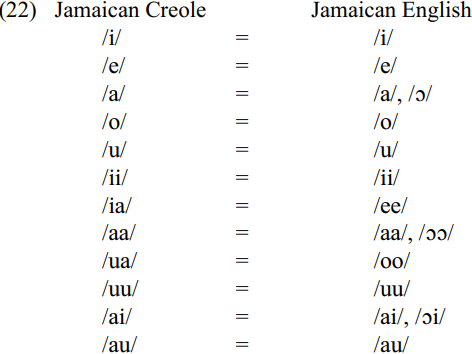
We argue that JamE phonological outputs are based on JamC lexical specifications modified by established conversion rules. These rules, we propose, are based on stereotypical notions of the difference between the phonetic outputs of lexical entries in JamC versus the phonetic outputs of their cognates in JamE. The level of success achieved by speakers operating these rules firstly depends on whether the correspondences between JamC and JamE are one-to-one or one-to-many. In the cases of JamC /ia/ > JamE /ee/ and JamC /ua/ > /oo/, we are dealing with one-to-one correspondences. The application of the conversion rule is, therefore, straightforward. The problem is less a linguistic one than a psychological one. With what consistency are speakers actually able to apply these conversion rules? Bilingual speakers will look for ways to keep the language varieties apart while minimizing the effort they put into doing so, giving rise to what we have called differential convergence between the varieties. We have already seen the evidence which suggests that speakers, in their use of JamE, employ more consistently the JamE variant, [oo], in the /ua/ ~ /oo/ variable than they do the JamE variant, [iε] in the /ia/ > /ee/ one. Here, speakers economize on their efforts to keep JamC and JamE apart, by avoiding JamC features more consistently in the former variable than in the latter. As we have already seen, also, this economy of effort may be most active in the environment immediately preceding /r/.
Where two possible JamE reflexes exist for one JamC vowel, matters are more complex. Usually, one JamE reflex is identical phonetically to that in JamC. The other one, however, represents a phonetic form which does not exist in JamC. For any item, the JamE cognate might have a phonetic output identical to its JamC equivalent. On the other hand, the JamE cognate may take the phonetic form that does not exist in JamC. It is the second possibility which is most likely to attract the attention of a speaker relatively unfamiliar with JamE. This produces naïve conversions. Thus, in the variables involving JamE /a/ and /ɔ/ respectively, a naïve conversion would change all the JamC occurrences of /a/, /aa/ and /ai/ to JamE /ɔ/ , /ɔɔ/ and /ɔi/. This approach presumes a one-to-one correspondence with JamC /a/ > JamE /ɔ/ and retains a feature characteristic of JamC:
(i) the vowels of ‘tap’ and ‘top’ not distinguished, here realized as /tɔp/,
(ii) the vowels of ‘mass’ and ‘moss’ not distinguished, both realized as /mɔɔs/, and
(iii) the vowels of ‘tile’ and ‘toil’ not distinguished, both realized as /tɔil/. This is typically discussed in the literature as hypercorrection and is one of the shibboleths of the speech community. It marks the speaker off as uneducated and unaware that the JamC > JamE conversion involves, based on lexical specification, either the form /a/, approximating phonetically to its JamC equivalent, or the form /ɔ/. For many speakers, the lexical marking is done using as a reference the way the words are spelt in English orthography.
 الاكثر قراءة في Phonology
 اخر الاخبار
اخبار العتبة العباسية المقدسة

الآخبار الصحية


مواضيع ذات صلة
 قسم الشؤون الفكرية يصدر كتاباً يوثق تاريخ السدانة في العتبة العباسية المقدسة
 "المهمة".. إصدار قصصي يوثّق القصص الفائزة في مسابقة فتوى الدفاع المقدسة للقصة القصيرة
 (نوافذ).. إصدار أدبي يوثق القصص الفائزة في مسابقة الإمام العسكري (عليه السلام)