Grammar
Tenses
Present

Present Simple
Present Continuous
Present Perfect
Present Perfect Continuous
Past
Past Simple
Past Continuous
Past Perfect
Past Perfect Continuous
Future
Future Simple
Future Continuous
Future Perfect
Future Perfect Continuous
Parts Of Speech
Nouns
Countable and uncountable nouns
Verbal nouns
Singular and Plural nouns
Proper nouns
Nouns gender
Nouns definition
Concrete nouns
Abstract nouns
Common nouns
Collective nouns
Definition Of Nouns
Animate and Inanimate nouns
Nouns
Verbs
Stative and dynamic verbs
Finite and nonfinite verbs
To be verbs
Transitive and intransitive verbs
Auxiliary verbs
Modal verbs
Regular and irregular verbs
Action verbs
Verbs
Adverbs
Relative adverbs
Interrogative adverbs
Adverbs of time
Adverbs of place
Adverbs of reason
Adverbs of quantity
Adverbs of manner
Adverbs of frequency
Adverbs of affirmation
Adverbs
Adjectives
Quantitative adjective
Proper adjective
Possessive adjective
Numeral adjective
Interrogative adjective
Distributive adjective
Descriptive adjective
Demonstrative adjective
Pronouns
Subject pronoun
Relative pronoun
Reflexive pronoun
Reciprocal pronoun
Possessive pronoun
Personal pronoun
Interrogative pronoun
Indefinite pronoun
Emphatic pronoun
Distributive pronoun
Demonstrative pronoun
Pronouns
Pre Position
Preposition by function
Time preposition
Reason preposition
Possession preposition
Place preposition
Phrases preposition
Origin preposition
Measure preposition
Direction preposition
Contrast preposition
Agent preposition
Preposition by construction
Simple preposition
Phrase preposition
Double preposition
Compound preposition
prepositions
Conjunctions
Subordinating conjunction
Correlative conjunction
Coordinating conjunction
Conjunctive adverbs
conjunctions
Interjections
Express calling interjection
Phrases
Sentences
Grammar Rules
Passive and Active
Preference
Requests and offers
wishes
Be used to
Some and any
Could have done
Describing people
Giving advices
Possession
Comparative and superlative
Giving Reason
Making Suggestions
Apologizing
Forming questions
Since and for
Directions
Obligation
Adverbials
invitation
Articles
Imaginary condition
Zero conditional
First conditional
Second conditional
Third conditional
Reported speech
Demonstratives
Determiners
Linguistics
Phonetics
Phonology
Linguistics fields
Syntax
Morphology
Semantics
pragmatics
History
Writing
Grammar
Phonetics and Phonology
Semiotics
Reading Comprehension
Elementary
Intermediate
Advanced
Teaching Methods
Teaching Strategies
Assessment

Theoretical framework
 المؤلف:
Hubert Devonish and Otelemate G. Harry
المؤلف:
Hubert Devonish and Otelemate G. Harry
 المصدر:
A Handbook Of Varieties Of English Phonology
المصدر:
A Handbook Of Varieties Of English Phonology
 الجزء والصفحة:
451-27
الجزء والصفحة:
451-27
 2024-04-04
 1343
1343




+
-
20
Theoretical framework
One of the characteristics of diglossia is the existence of linguistic convergence. In situations involving the functional separation of language varieties, speakers tend to modify their linguistic systems such that there is a level of one-to-one correspondence between elements of the coexisting systems (Gumperz and Wilson 1971: 154–166). Where some aspect of the linguistic system of one language variety is more complex than the other, there are consequences for trying to achieve this one-to-one correspondence.
Complexity may be defined in two ways. One system may make a greater number of distinctions than does another. Here, one consequence of convergence is that often the equivalent of a single form in a simple system may be two or more forms in a more complex system, one such form being common to both systems. Thus, in comparing the phonology of cognate lexical items of two language varieties, a form in the less complex system may be equivalent either to two or more cognate forms in a more complex one. The form in the more complex system will invariably predict its cognate in the less complex one, but not vice versa.
We make the following prediction about the relationship between phonological systems in the conditions of linguistic convergence which exist between JamC and JamE. If the simpler system, Variety A, has feature X and the more complex one, Variety B, has both the features X and Y, the initial hypothesis for speakers familiar with Variety A is that X in Variety A is equivalent to Y in Variety B. They thus convert all Xs to Ys in their effort to use Variety B. Later, with more exposure to B, speakers of A will learn that sometimes X in their native variety is equivalent to X in the target variety and only sometimes to Y. For speakers to know the difference requires lexical specification of individual items.
We make a second prediction about the relationship between the varieties in such conditions. Linguistic categories or variables often exist in pairs, e.g. the realization of segments equivalent to JamE /θ/ versus the realization of segments equivalent to JamE /ð/, or the realization of segments equivalent to JamC /ia/ versus those equivalent to JamC /ua/. Let us take the case of pairs of related linguistic variables, Variables 1 and 2, which, in Variety A have reflexes T and X respectively, and in Variety B, U and Y. We predict that in actual everyday usage of Variety A, only one of the two Variety A reflexes, e.g. T, will be consistently used. The other, X, will be used varying with Y, the variant associated with Variety B. Along similar lines, in the case of Variety B, only one of the two Variety B reflexes, this time Y, will be used consistently. The other, U, will vary with T, the form associated with Variety A. This is demonstrated in the table below.
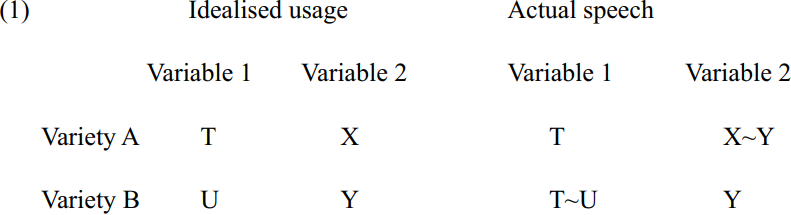
The relationship between JamC and JamE presented in (1) represents a classic example of differential convergence.
 الاكثر قراءة في Phonology
 اخر الاخبار
اخبار العتبة العباسية المقدسة

الآخبار الصحية


مواضيع ذات صلة
 قسم الشؤون الفكرية يصدر كتاباً يوثق تاريخ السدانة في العتبة العباسية المقدسة
 "المهمة".. إصدار قصصي يوثّق القصص الفائزة في مسابقة فتوى الدفاع المقدسة للقصة القصيرة
 (نوافذ).. إصدار أدبي يوثق القصص الفائزة في مسابقة الإمام العسكري (عليه السلام)