Grammar
Tenses
Present

Present Simple
Present Continuous
Present Perfect
Present Perfect Continuous
Past
Past Simple
Past Continuous
Past Perfect
Past Perfect Continuous
Future
Future Simple
Future Continuous
Future Perfect
Future Perfect Continuous
Parts Of Speech
Nouns
Countable and uncountable nouns
Verbal nouns
Singular and Plural nouns
Proper nouns
Nouns gender
Nouns definition
Concrete nouns
Abstract nouns
Common nouns
Collective nouns
Definition Of Nouns
Animate and Inanimate nouns
Nouns
Verbs
Stative and dynamic verbs
Finite and nonfinite verbs
To be verbs
Transitive and intransitive verbs
Auxiliary verbs
Modal verbs
Regular and irregular verbs
Action verbs
Verbs
Adverbs
Relative adverbs
Interrogative adverbs
Adverbs of time
Adverbs of place
Adverbs of reason
Adverbs of quantity
Adverbs of manner
Adverbs of frequency
Adverbs of affirmation
Adverbs
Adjectives
Quantitative adjective
Proper adjective
Possessive adjective
Numeral adjective
Interrogative adjective
Distributive adjective
Descriptive adjective
Demonstrative adjective
Pronouns
Subject pronoun
Relative pronoun
Reflexive pronoun
Reciprocal pronoun
Possessive pronoun
Personal pronoun
Interrogative pronoun
Indefinite pronoun
Emphatic pronoun
Distributive pronoun
Demonstrative pronoun
Pronouns
Pre Position
Preposition by function
Time preposition
Reason preposition
Possession preposition
Place preposition
Phrases preposition
Origin preposition
Measure preposition
Direction preposition
Contrast preposition
Agent preposition
Preposition by construction
Simple preposition
Phrase preposition
Double preposition
Compound preposition
prepositions
Conjunctions
Subordinating conjunction
Correlative conjunction
Coordinating conjunction
Conjunctive adverbs
conjunctions
Interjections
Express calling interjection
Phrases
Sentences
Grammar Rules
Passive and Active
Preference
Requests and offers
wishes
Be used to
Some and any
Could have done
Describing people
Giving advices
Possession
Comparative and superlative
Giving Reason
Making Suggestions
Apologizing
Forming questions
Since and for
Directions
Obligation
Adverbials
invitation
Articles
Imaginary condition
Zero conditional
First conditional
Second conditional
Third conditional
Reported speech
Demonstratives
Determiners
Linguistics
Phonetics
Phonology
Linguistics fields
Syntax
Morphology
Semantics
pragmatics
History
Writing
Grammar
Phonetics and Phonology
Semiotics
Reading Comprehension
Elementary
Intermediate
Advanced
Teaching Methods
Teaching Strategies
Assessment

Merger and the evolution of the SAmE phonological system
 المؤلف:
Jan Tillery and Guy Bailey
المؤلف:
Jan Tillery and Guy Bailey
 المصدر:
A Handbook Of Varieties Of English Phonology
المصدر:
A Handbook Of Varieties Of English Phonology
 الجزء والصفحة:
329-18
الجزء والصفحة:
329-18
 2024-03-25
 1553
1553




+
-
20
Merger and the evolution of the SAmE phonological system
The last 30 years have seen significant shifts in the phonological inventory and in the sets of phonological contrasts in urban SAmE, especially in the largest cities and in the southwest. Historically, SAmE was one of the U.S. varieties that distinguished the vowels in words like LOT (pronounced with a low back unrounded vowel [a]) from those in words like THOUGHT (pronounced with a low back rounded, often upgliding vowel  ). Since World War II, and especially since the 1970s, however, the vowels in these two classes have increasingly become merged in Southern metropolises, with both realized as [a]. The precise reason for the development of the merger after World War II is not clear, but three factors have likely played a role:
(1) extensive in-migration from the Midwest, where the THOUGHT/LOT distinction was often not maintained,
(2) the rapid growth of the Hispanic population, a group that does have the contrast, in the Southwest and in Florida, and
(3) the mild stigma that has begun to be attached to upgliding allophones of  (and more generally to anything resembling the Southern Drawl).
Once the upglide is eliminated, the vowels of the THOUGHT and LOT classes are so close in phonological space that the difference is difficult to maintain. The merger of the THOUGHT and LOT classes, of course, eliminates one of the most distinctive features of traditional SAmE—upgliding  in the THOUGHT class—and aligns the vowel system of urban SAmE more closely with that of the American West in some respects.
The inventory of vowels before r and l is also changing rapidly in urban SAmE. Older rural Southern varieties often had a three-way distinction among the vowels in words like MARY, MERRY, and MARRY and typically maintained the distinction between vowels in the NORTH and FORCE classes (as  and [o] respectively). Beginning after 1880 and accelerating rapidly after World War II, however, the distinction between the MARY and MERRY class began to disappear; currently both are typically pronounced with [ε] as the stressed vowel. Over the last quarter century, this merged MARY/MERRY class has begun to merge with the MARRY class as well. When all three are merged, either [ε] or [æ] can be the stressed vowel.
The time frame for the merger of the FORCE and NORTH classes parallels that of the MARY/MERRY merger; in the urban South, both FORCE and NORTH are now typically pronounced with close [o], though  can also appear in both classes. The ultimate consequence of these mergers, of course, is a reduction in the set of vowel contrasts in SAmE. In stressed syllables, the most advanced varieties of urban SAmE include only two front vowels before tautosyllabic r (
  and [ε ~ æ]), two back vowels ([o] and
  ), and one low central/back vowel [a], along with a rhotic central vowel of course.
Traditional Southern dialects also maintained distinctions between tense and lax vowels before tautosyllabic l, but these distinctions have increasingly been lost over the last half-century too. As a result, vowels in the FEEL and FILL classes are often merged (usually as  ), as are vowels in the FAIL and FELL classes (usually as [ε]). Even more frequent is the merger of vowels in the POOL and PULL classes (usually as
  ). This merger, like the THOUGHT/LOT merger, eliminates one of the hallmarks of earlier SAmE—upgliding or monophthongal
  in the POOL class. Finally, among some younger Southerners in urban areas, the stressed vowels in words like hull and Tulsa ([Λ] in traditional SAmE) are merged with the vowel that results from the POOL/PULL merger, again usually as
  . As a result, in stressed syllables the most advanced urban varieties of SAmE include three front vowels before l (
  ,[ε], and [æ]), two back vowels (
  and [o]), and a low central/back vowel
  .
.
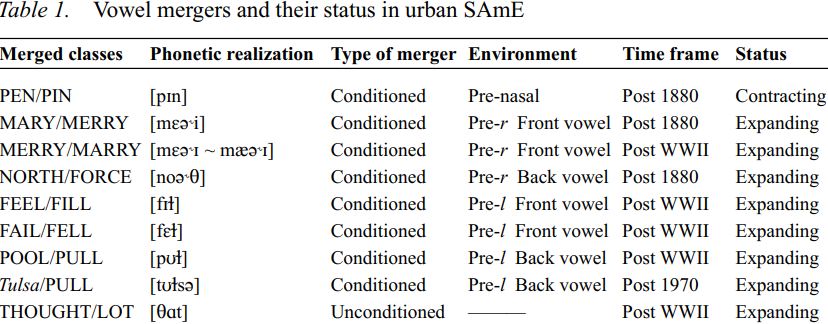
Finally, even as both the merger of the vowels in the THOUGHT and LOT classes and also the pre-r and pre-l mergers have rapidly expanded in Southern cities, one of the hallmarks of SAmE that developed during the period between 1880 and 1940, the merger of vowels before nasals in words like PEN and PIN (almost always as  ), has begun to recede. Although the PEN/PIN merger became one of the most distinctive features of SAmE after 1880, is still thriving throughout the rural South, and is even expanding in some areas contiguous to the South, in the largest Southern metropolises (areas such as Dallas and Atlanta) it is disappearing. The end result of all of these developments is widespread change in the set of vowel contrasts that affect urban SAmE and a substantial realignment of its phonological system. Table 1 summarizes the vowel mergers that currently affect urban SAmE.
 الاكثر قراءة في Phonology
 اخر الاخبار
اخبار العتبة العباسية المقدسة

الآخبار الصحية


مواضيع ذات صلة
 قسم الشؤون الفكرية يصدر كتاباً يوثق تاريخ السدانة في العتبة العباسية المقدسة
 "المهمة".. إصدار قصصي يوثّق القصص الفائزة في مسابقة فتوى الدفاع المقدسة للقصة القصيرة
 (نوافذ).. إصدار أدبي يوثق القصص الفائزة في مسابقة الإمام العسكري (عليه السلام)