Grammar
Tenses
Present

Present Simple
Present Continuous
Present Perfect
Present Perfect Continuous
Past
Past Simple
Past Continuous
Past Perfect
Past Perfect Continuous
Future
Future Simple
Future Continuous
Future Perfect
Future Perfect Continuous
Parts Of Speech
Nouns
Countable and uncountable nouns
Verbal nouns
Singular and Plural nouns
Proper nouns
Nouns gender
Nouns definition
Concrete nouns
Abstract nouns
Common nouns
Collective nouns
Definition Of Nouns
Animate and Inanimate nouns
Nouns
Verbs
Stative and dynamic verbs
Finite and nonfinite verbs
To be verbs
Transitive and intransitive verbs
Auxiliary verbs
Modal verbs
Regular and irregular verbs
Action verbs
Verbs
Adverbs
Relative adverbs
Interrogative adverbs
Adverbs of time
Adverbs of place
Adverbs of reason
Adverbs of quantity
Adverbs of manner
Adverbs of frequency
Adverbs of affirmation
Adverbs
Adjectives
Quantitative adjective
Proper adjective
Possessive adjective
Numeral adjective
Interrogative adjective
Distributive adjective
Descriptive adjective
Demonstrative adjective
Pronouns
Subject pronoun
Relative pronoun
Reflexive pronoun
Reciprocal pronoun
Possessive pronoun
Personal pronoun
Interrogative pronoun
Indefinite pronoun
Emphatic pronoun
Distributive pronoun
Demonstrative pronoun
Pronouns
Pre Position
Preposition by function
Time preposition
Reason preposition
Possession preposition
Place preposition
Phrases preposition
Origin preposition
Measure preposition
Direction preposition
Contrast preposition
Agent preposition
Preposition by construction
Simple preposition
Phrase preposition
Double preposition
Compound preposition
prepositions
Conjunctions
Subordinating conjunction
Correlative conjunction
Coordinating conjunction
Conjunctive adverbs
conjunctions
Interjections
Express calling interjection
Phrases
Sentences
Grammar Rules
Passive and Active
Preference
Requests and offers
wishes
Be used to
Some and any
Could have done
Describing people
Giving advices
Possession
Comparative and superlative
Giving Reason
Making Suggestions
Apologizing
Forming questions
Since and for
Directions
Obligation
Adverbials
invitation
Articles
Imaginary condition
Zero conditional
First conditional
Second conditional
Third conditional
Reported speech
Demonstratives
Determiners
Linguistics
Phonetics
Phonology
Linguistics fields
Syntax
Morphology
Semantics
pragmatics
History
Writing
Grammar
Phonetics and Phonology
Semiotics
Reading Comprehension
Elementary
Intermediate
Advanced
Teaching Methods
Teaching Strategies
Assessment

European settlement of New England
 المؤلف:
Naomi Nagy and Julie Roberts
المؤلف:
Naomi Nagy and Julie Roberts
 المصدر:
A Handbook Of Varieties Of English Phonology
المصدر:
A Handbook Of Varieties Of English Phonology
 الجزء والصفحة:
270-15
الجزء والصفحة:
270-15
 2024-03-16
 1484
1484




+
-
20
European settlement of New England
Our story begins with the European settlement of a region that was previously populated by a variety of indigenous peoples. There has been no systematic study of the possible influences of the indigenous languages on English, but we can see their influence in local toponyms, for example the Piscataqua River in NH, the Kennebec River in ME, Lake Memphremagog in VT, and Contacook, a town in Rhode Island, as well as the word Massachusetts.
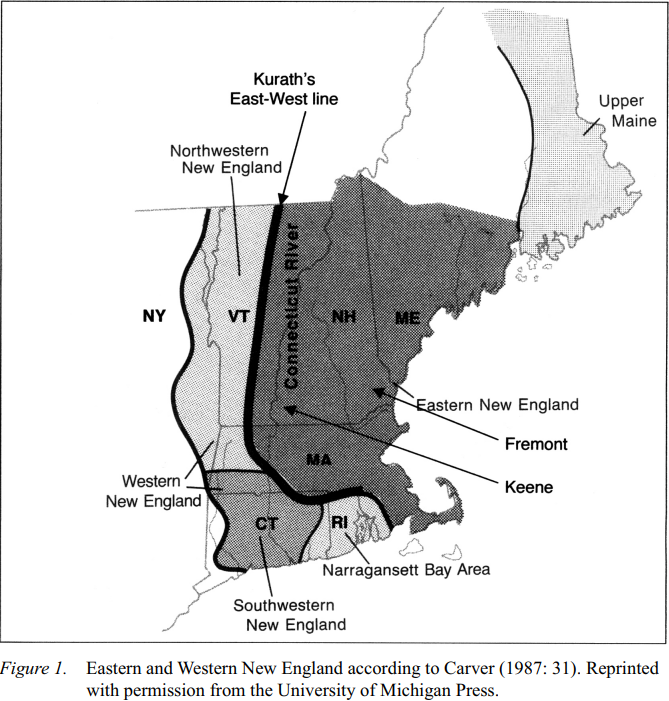
European settlers in Eastern New England came primarily from Boston, on the Massachusetts Bay, and were of English stock. This coastal area, originally home to indigenous groups, was settled by English immigrants in the early 1600’s and became one of the country’s cultural hearths. In search of better farm land, some of these original European settlers moved west from the coast and settled the Lower Connecticut River Valley in central CT. They were joined soon after by new immigrants from eastern and southern England, and later from Italy, Scotland and Ireland, among other places. Settlement spread, generally along river valleys, into NH, VT, ME, and RI (Carver 1987: 7).
WNE was settled by migration from central MA and central and western CT, including Hartford, Springfield, and New Haven, towns originally settled in the 1630s (Boberg 2001: 4). Following this movement, Eastern and Western NE remained isolated from each other until the early 18th century (Rosenberry 1962: facing 70; Kurath 1972: 42, cited in Boberg 2001: 4). Western VT was settled in the late 18th century by English-speaking migrants from western CT and MA (Kurath 1939-43: 104, cited in Boberg 2001: 5) and from NY (Rosenberry 1962: 136, cited in Boberg 2001: 5), as well as some settlers from east of the Green Mountains (NH, ME, and RI) (Kurath 1939-43: 103-4, cited in Boberg 2001: 5). WNE, in turn, was “the staging ground for the initial English-speaking settlement of the Inland North” (Boberg 2001: 9).
WNE also “received a considerable admixture of Scotch-Irish in the half century preceding the Revolution [early 18th century]” (Kurath 1928: 391, cited in Boberg 2001: 9), though they did not form a sizeable percentage of the population at any time. Also present in NE are Franco-Americans who moved south from French-speaking parts of Canada, and large Irish and Italian groups. Upper ME (north of Penobscot Bay) is quite distinct from the rest of the region, due to ties with New Brunswick, Canada (Carver 1987: 31).
Boston, the largest New England city, is still known as the hub, hearkening back to its position as the center from which settlements radiated in New England. Much of the rest of NE, however, is more rural, with many farms, forests, and undeveloped areas surrounding small towns and cities. Like many rural communities, NE is undergoing changes including increased highways, in-migration from other dialect areas, and change from small family farms to agribusiness (Frazer 1983; Labov 1994). The rural, regional dialects appear threatened with obsolescence due to the decrease in agriculture and increase in in-migration by speakers from other states. This loss evokes mixed reactions within the communities, where it may be seen as a sign of progress and increasing sophistication as well as a loss of cultural identity (Ring 1997).
 الاكثر قراءة في Phonology
 اخر الاخبار
اخبار العتبة العباسية المقدسة

الآخبار الصحية


مواضيع ذات صلة
 قسم الشؤون الفكرية يصدر كتاباً يوثق تاريخ السدانة في العتبة العباسية المقدسة
 "المهمة".. إصدار قصصي يوثّق القصص الفائزة في مسابقة فتوى الدفاع المقدسة للقصة القصيرة
 (نوافذ).. إصدار أدبي يوثق القصص الفائزة في مسابقة الإمام العسكري (عليه السلام)