Grammar
Tenses
Present

Present Simple
Present Continuous
Present Perfect
Present Perfect Continuous
Past
Past Simple
Past Continuous
Past Perfect
Past Perfect Continuous
Future
Future Simple
Future Continuous
Future Perfect
Future Perfect Continuous
Parts Of Speech
Nouns
Countable and uncountable nouns
Verbal nouns
Singular and Plural nouns
Proper nouns
Nouns gender
Nouns definition
Concrete nouns
Abstract nouns
Common nouns
Collective nouns
Definition Of Nouns
Animate and Inanimate nouns
Nouns
Verbs
Stative and dynamic verbs
Finite and nonfinite verbs
To be verbs
Transitive and intransitive verbs
Auxiliary verbs
Modal verbs
Regular and irregular verbs
Action verbs
Verbs
Adverbs
Relative adverbs
Interrogative adverbs
Adverbs of time
Adverbs of place
Adverbs of reason
Adverbs of quantity
Adverbs of manner
Adverbs of frequency
Adverbs of affirmation
Adverbs
Adjectives
Quantitative adjective
Proper adjective
Possessive adjective
Numeral adjective
Interrogative adjective
Distributive adjective
Descriptive adjective
Demonstrative adjective
Pronouns
Subject pronoun
Relative pronoun
Reflexive pronoun
Reciprocal pronoun
Possessive pronoun
Personal pronoun
Interrogative pronoun
Indefinite pronoun
Emphatic pronoun
Distributive pronoun
Demonstrative pronoun
Pronouns
Pre Position
Preposition by function
Time preposition
Reason preposition
Possession preposition
Place preposition
Phrases preposition
Origin preposition
Measure preposition
Direction preposition
Contrast preposition
Agent preposition
Preposition by construction
Simple preposition
Phrase preposition
Double preposition
Compound preposition
prepositions
Conjunctions
Subordinating conjunction
Correlative conjunction
Coordinating conjunction
Conjunctive adverbs
conjunctions
Interjections
Express calling interjection
Phrases
Sentences
Clauses
Part of Speech
Grammar Rules
Passive and Active
Preference
Requests and offers
wishes
Be used to
Some and any
Could have done
Describing people
Giving advices
Possession
Comparative and superlative
Giving Reason
Making Suggestions
Apologizing
Forming questions
Since and for
Directions
Obligation
Adverbials
invitation
Articles
Imaginary condition
Zero conditional
First conditional
Second conditional
Third conditional
Reported speech
Demonstratives
Determiners
Direct and Indirect speech
Linguistics
Phonetics
Phonology
Linguistics fields
Syntax
Morphology
Semantics
pragmatics
History
Writing
Grammar
Phonetics and Phonology
Semiotics
Reading Comprehension
Elementary
Intermediate
Advanced
Teaching Methods
Teaching Strategies
Assessment

Received pronunciation (RP)
 المؤلف:
David Hornsby
المؤلف:
David Hornsby
 المصدر:
Linguistics A complete introduction
المصدر:
Linguistics A complete introduction
 الجزء والصفحة:
73-4
الجزء والصفحة:
73-4
 2023-12-13
 1960
1960




+
-
20
Received pronunciation (RP)
RP is the socially prestigious but regionally unmarked pronunciation used predominantly by British newsreaders: while British English accents are regional, an RP speaker could come from anywhere within the UK, although RP’s features are predominantly southern English in origin. For all the reverence accorded to this pronunciation, RP is an accent like any other and is subject to change: the speech of BBC newsreaders who used RP in 1940s and 1950s newsreels sounds very different from that of today’s RP users. Where the latter would have the a vowel close to Cardinal 4 in hat [hat], for example, the former would have insisted on a vowel raised to somewhere between Cardinals 3 and 4 [æ].
The secondary cardinal vowels 9–16 simply reverse the lip-rounding value of their primary counterparts; thus Cardinal 9, [y], which corresponds to the vowel in French tu or German süss, is simply Cardinal 1, [i], with firmly rounded lips. Likewise Cardinals 10 and 11, the vowels of standard French feu  and fleuve [œ] respectively, are the rounded equivalents of 2 and 3. Cardinal 12,
  , the rounded equivalent of [a], is rare cross-linguistically, but Cardinal 13,
  , is used in RP body or cot (most US English varieties have an unrounded vowel here). Cardinal 14 [V] is the conservative RP pronunciation of the cup vowel (most southern English speakers have a more fronted variant). Cardinals 15
  and 16
  are less familiar to speakers of the major western European languages, but both occur in Scots Gaelic and Thai, and Cardinal 16 is an important vowel in Japanese.
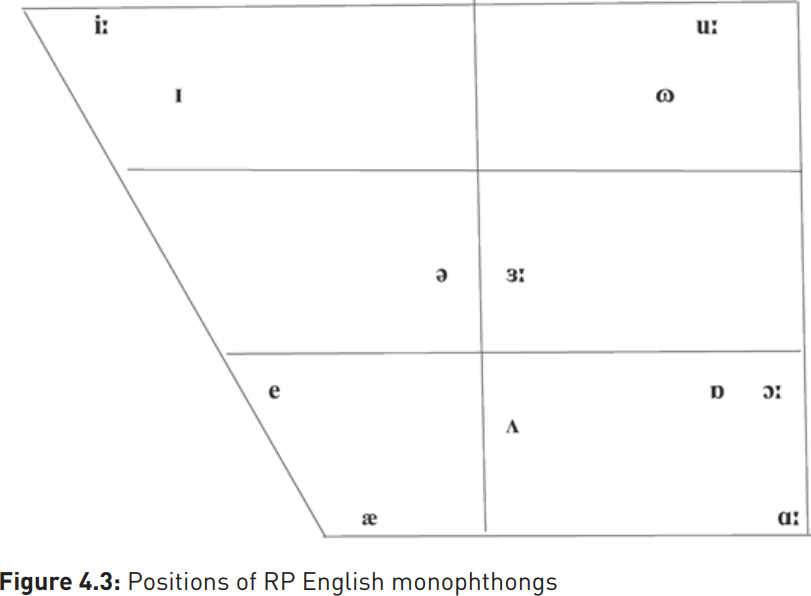
Helpful though the cardinal vowels are as reference points, they do not correspond closely with the vowel positions of English, which are shown in the diagrams below. For the RP vowels in push  (the older symbol
  is also used) and kick [I], for example, the tongue is retracted to a more central position from [u] and [i] respectively, and requires less muscular effort (for this reason these two vowels are sometimes called lax vowels). Confusingly, some of the phonemic symbols for RP vowels no longer correspond to their modern pronunciation. Textbooks still refer, for example, to /æ/ and
  in spite of the fact that, for most RP speakers, these vowels have moved to [a] and
  respectively. The modern positions of RP monophthongs can be seen in Figure 4.3.
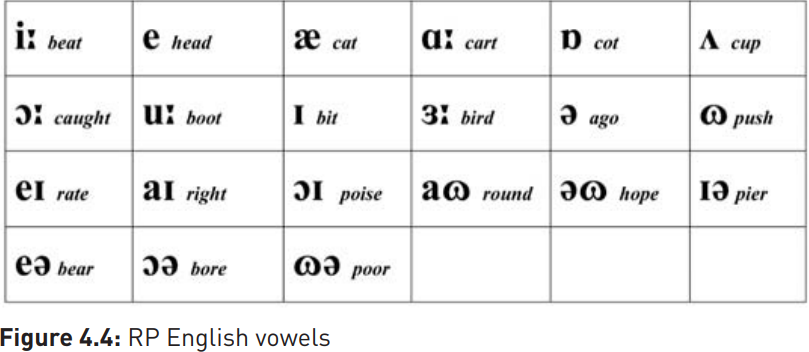
RP has one long central vowel, [3:], the vowel in bird, which may bear stress, and another, schwa,  , which cannot. Generally, vowels produced at the centre of the vocal tract require least articulatory effort. When asked a question and needing a bit of thinking time, many speakers naturally start their reply with ‘Er…’, the sound produced with the tongue in the central rest position. Although schwa has no letter of its own in English orthography (Bulgarian uses the Cyrillic character ъ, Turkish has ı), it is a very important sound in English and in many other languages. For most British English speakers it is the underlined vowel in each of the following words: potato, reader, banana, support, phonetic. In both English and French it can, in some cases, can be deleted altogether, so that in rapid speech, for example, sport and support can be homophonous.
 الاكثر قراءة في Phonetics
 اخر الاخبار
اخبار العتبة العباسية المقدسة

الآخبار الصحية


مواضيع ذات صلة
 قسم الشؤون الفكرية يصدر كتاباً يوثق تاريخ السدانة في العتبة العباسية المقدسة
 "المهمة".. إصدار قصصي يوثّق القصص الفائزة في مسابقة فتوى الدفاع المقدسة للقصة القصيرة
 (نوافذ).. إصدار أدبي يوثق القصص الفائزة في مسابقة الإمام العسكري (عليه السلام)