Laterals: primary and secondary articulations
In considering how lateral approximants are made, we have looked only at the front of the tongue. This is not, however, the whole story. Making a closure with the tip or blade of the tongue leaves the tongue body and tongue back free, as well as the lips, to be placed into a range of configurations. You can try this for yourself. Make a [l]-sound, and concentrate on your tongue tip. As you make this sound, move your tongue body backwards and forwards, and round and spread your lips as if trying to make a range of vowel sounds at the same time as making a [l] sound.
What you should hear is that the ‘tone’ of the sound changes constantly with the changes in the shape and size of the vocal tract caused by the movement of the tongue body. All of these different sounds are voiced alveolar lateral approximants.
In making [l], there are actually two (or three) different articulations. The primary articulation is the closure of the tongue tip against the alveolar ridge. The other articulations are called secondary articulations – so called because they are more open articulations than the primary one.
Secondary articulations are very similar to vocalic articulations. To make a secondary [i] articulation, spread the lips and push the tongue body forward and high in the mouth; to make a secondary [ɯ] articulation (like [u] without the rounding), raise the tongue back up towards the velum while keeping the tongue tip fixed to the alveolar ridge. These two secondary articulations are called palatalization and valorization respectively, and are transcribed as  respectively. Valorization is often accompanied by labialization (i.e. lip-rounding; symbolized with the diacritic
  ), giving labiovelarisation, which can be transcribed as
  . Phoneticians often refer to the auditory impression of these qualities: palatalized laterals are often called ‘clear’ (often also ‘light’, by American linguists) and velarized laterals are often called ‘dark’.
Palatalization and valorization are at opposite ends of a scale. Palatalization involves tongue-body fronting and raising, while valorization involves tongue-body backing and raising. In between, as you will have observed, there are many shades of difference.
Now say a few pairs of words: ‘leaf, feel; loaf, foal; lot, toll’. If you compare the laterals at the start and the end of these words, you will notice that they sound different. If you hold the articulation, you will feel a different tongue shape and posture. Syllable-final laterals are backer, more velarized, or ‘darker’ than syllable-initial ones. They are also longer in duration. Conversely, syllable-initial laterals are usually more palatalized, or ‘clearer’, than syllable-final ones. It is important to note that these are terms are relative. In some varieties of English, all laterals are dark, even when syllable initial. This is the case for e.g. many varieties of North American English (but perhaps especially New York), Manchester and Leeds (both in northern England). However, there are still relativities within these varieties, so while the initial laterals are dark, the final ones are even darker. Conversely, some varieties have clear laterals in all positions, such as many varieties of Irish English and Newcastle (England). Likewise, although these varieties have clear laterals finally, the final laterals are still darker than the initial laterals, without actually being dark.
For many varieties of English, syllable-final laterals are regularly heavily velarized, or labiovelarized.
In many cases, there is a vocalic on-glide. As the articulators move out of the vowel into the lateral, they produce what sounds like a distinct sound. Compare, for instance, the words ‘feed’ and ‘feel’; you may well notice that the [i] vowels end differently. Speakers who have a strong on-glide into the lateral will be tempted to transcribe ‘feel’ as something like  , but ‘feed’ as [fi:d]. This on-glide is very distinctive for combinations of vowel + dark lateral in many varieties, and it highlights the auditory significance of the secondary articulation. It may also explain how it comes to be that in so many varieties of English, syllable final laterals can be vocalized. Vocalization means that the consonantal articulation from
  (i.e. the tongue tip at the alveolar ridge) is lost, but the ‘secondary’ articulations are retained – we use the scare quotes because now, of course, this is not a secondary articulation but the primary articulation. Remember the earlier transcriptions of ‘hill’ as
 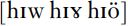 . These all capture some kind of (labio)velar approximation at the end of the word. In these varieties, it seems that the most salient feature of syllable-final ‘laterals’ is not laterality but valorization, or labiovelarisation.
Another phenomenon associated with dark syllable-final laterals is that in some British English and Australian varieties, the vowel of GOAT has a backer and more rounded beginning when before a dark lateral: in these varieties, we get something like [əυ] for ‘goat’, but something more like [ɔυ] for ‘goal’. In Melbourne (Australia), for some speakers ‘gulf ’ and ‘golf ’ are homophones, [gɔυf]: there is rounding syllable finally (resulting in [ɔυ] instead of  ) and the lateral is vocalized, resulting in [υ]. What is achieved by these kinds of articulations is that labiovelarisation is audible (and probably also visible in a face-to-face setting) quite a long time before laterality starts; in turn, this may enhance the percept of the dark lateral.








