Grammar
Tenses
Present

Present Simple
Present Continuous
Present Perfect
Present Perfect Continuous
Past
Past Simple
Past Continuous
Past Perfect
Past Perfect Continuous
Future
Future Simple
Future Continuous
Future Perfect
Future Perfect Continuous
Parts Of Speech
Nouns
Countable and uncountable nouns
Verbal nouns
Singular and Plural nouns
Proper nouns
Nouns gender
Nouns definition
Concrete nouns
Abstract nouns
Common nouns
Collective nouns
Definition Of Nouns
Animate and Inanimate nouns
Nouns
Verbs
Stative and dynamic verbs
Finite and nonfinite verbs
To be verbs
Transitive and intransitive verbs
Auxiliary verbs
Modal verbs
Regular and irregular verbs
Action verbs
Verbs
Adverbs
Relative adverbs
Interrogative adverbs
Adverbs of time
Adverbs of place
Adverbs of reason
Adverbs of quantity
Adverbs of manner
Adverbs of frequency
Adverbs of affirmation
Adverbs
Adjectives
Quantitative adjective
Proper adjective
Possessive adjective
Numeral adjective
Interrogative adjective
Distributive adjective
Descriptive adjective
Demonstrative adjective
Pronouns
Subject pronoun
Relative pronoun
Reflexive pronoun
Reciprocal pronoun
Possessive pronoun
Personal pronoun
Interrogative pronoun
Indefinite pronoun
Emphatic pronoun
Distributive pronoun
Demonstrative pronoun
Pronouns
Pre Position
Preposition by function
Time preposition
Reason preposition
Possession preposition
Place preposition
Phrases preposition
Origin preposition
Measure preposition
Direction preposition
Contrast preposition
Agent preposition
Preposition by construction
Simple preposition
Phrase preposition
Double preposition
Compound preposition
prepositions
Conjunctions
Subordinating conjunction
Correlative conjunction
Coordinating conjunction
Conjunctive adverbs
conjunctions
Interjections
Express calling interjection
Phrases
Sentences
Grammar Rules
Passive and Active
Preference
Requests and offers
wishes
Be used to
Some and any
Could have done
Describing people
Giving advices
Possession
Comparative and superlative
Giving Reason
Making Suggestions
Apologizing
Forming questions
Since and for
Directions
Obligation
Adverbials
invitation
Articles
Imaginary condition
Zero conditional
First conditional
Second conditional
Third conditional
Reported speech
Demonstratives
Determiners
Linguistics
Phonetics
Phonology
Linguistics fields
Syntax
Morphology
Semantics
pragmatics
History
Writing
Grammar
Phonetics and Phonology
Semiotics
Reading Comprehension
Elementary
Intermediate
Advanced
Teaching Methods
Teaching Strategies
Assessment

Uninterpretable features and feature-deletion
 المؤلف:
Andrew Radford
المؤلف:
Andrew Radford
 المصدر:
Minimalist Syntax
المصدر:
Minimalist Syntax
 الجزء والصفحة:
287-8
الجزء والصفحة:
287-8
 28-1-2023
 2594
2594




+
-
20
Uninterpretable features and feature-deletion
Our discussion of how case and agreement work in a sentence such as (5B) has wider implications. One of these is that items may enter the derivation with some of their features already valued and others as yet unvalued: e.g. BE enters the derivation in (6) with its tense feature valued, but its  -features unvalued; and THEY enters with its
  -features valued but its case feature unvalued. This raises the question of which features are initially valued when they first enter the derivation, which are initially unvalued – and why. Chomsky (1998) argues that the difference between valued and unvalued grammatical features correlates with a further distinction between those grammatical features which are interpretable (in the sense that they play a role in semantic interpretation), and those which are uninterpretable (and hence play no role in semantic interpretation). For example, it seems clear that the case feature of a pronoun like THEY is uninterpretable, since a subject pronoun surfaces as nominative, accusative or genitive depending on the type of [bracketed] clause it is in, without any effect on meaning – as the examples in (11) below illustrate:

By contrast, the (person/number)  -features of pronouns are interpretable, since e.g. a first-person-singular pronoun like I clearly differs in meaning from a third-person-plural pronoun like they. In the case of finite auxiliaries, it is clear that their tense features are interpretable, since a present-tense form like is differs in meaning from a past-tense form like was. By contrast, the (person/number)
  -features of auxiliaries are uninterpretable, in that they serve purely to mark agreement with a particular nominal. This suggests a correlation such as (12) below between whether or not features are interpretable and whether or not they are initially valued:

The correlation between valuedness and interpretability turns out to be an important one. (It should be noted that Chomsky 1998 offers a rather different formulation of (12ii) to the effect that uninterpretable features enter the derivation unvalued, but his claim seems problematic e.g. for languages in which nouns may enter the derivation with an uninterpretable gender  -feature with a fixed but arbitrary value: e.g. the noun M¨adchen ‘girl’ is inherently neuter in gender in German, though it denotes a feminine entity.)
As we saw in the simplified model of grammar which we have presented, each structure generated by the syntactic component of the grammar is subsequently sent to the PF component of the grammar to be spelled out (i.e. assigned a PF representation which provides a representation of its Phonetic Form). If we assume that unvalued features are illegible to (and hence cannot be processed by) the PF component, it follows that every unvalued feature in a derivation must be valued in the course of the derivation, or else the derivation will crash (i.e. fail) because the PF component is unable to spell out unvalued features. In more concrete terms, this amounts to saying that unless the syntax specifies whether we require e.g. a first-person-singular or third-person-plural present-tense form of be, the derivation will crash because the PF component cannot determine whether to spell out BE as am or are.
In addition to being sent to the PF component, each structure generated by the syntactic component of the grammar is simultaneously sent to the semantic component, where it is converted into an appropriate semantic representation. Clearly, interpretable features play an important role in the computation of semantic representations. Equally clearly, however, uninterpretable features play no role whatever in this process: indeed, since they are illegible to the semantic component, we need to devise some way of ensuring that uninterpretable features do not input into the semantic component. How can we do this?
Chomsky’s answer is to suppose that uninterpretable features are deleted in the course of the syntactic derivation, in the specific sense that they are marked as being invisible in the semantic component while remaining visible in the syntax and in the PF component. To get a clearer idea of what this means in concrete terms, consider the uninterpretable nominative case feature on they in (5B) They were arrested. Since this case feature is uninterpretable, it has to be deleted in the course of the syntactic derivation, so that the semantic component cannot ‘see’ it. However, the PF component must still be able to ‘see’ this case feature, since it needs to know what case has been assigned to the pronoun THEY in order to determine whether the pronoun should be spelled out as they, them or their. This suggests the following convention:

The next question to ask at this juncture is what kind of syntactic operation is involved in the deletion of uninterpretable features. Let’s suppose (following Chomsky) that feature-deletion involves the kind of operation outlined informally below (where  and ß enter into an agreement relation, and one is a probe and the other a goal):

Here,  and ß are two different constituents contained within the same structure, and one is a probe and the other a goal. In a language like English where finite verbs agree with their subjects in person and number (but not gender), ß is
  - complete if it carries both person and number features (though in a language like Arabic where finite verbs agree in person, number and gender with their subjects, ß is
  -complete if it carries person, number and gender: see Nasu 2001, 2002 for discussion). For ß to delete the person/number/case features of
  , the
, the  -features of ß must match the
  -features carried by
  . Let’s define the relation ‘match’ in the following terms:

To make a rather abstract discussion more concrete, let’s consider how feature-deletion applies in the case of our earlier structure (10) above. Here, both BE and THEY are  -complete, since both are specified for person as well as number. Moreover, the two match in respect of their
  -features, since the two have the same value for person and number (in that both are third person plural). Let’s assume that (in consequence of the Earliness Principle), feature-deletion applies as early as possible in the derivation, and hence applies at the point where the structure in (10) has been formed. In accordance with Feature-Deletion (14),
  -complete BE can delete the uninterpretable case feature carried by THEY; and conversely
  -complete THEY can delete the uninterpretable person/number features carried by BE. Feature-Deletion therefore results in the structure (16) below (where
 strikethrough indicates deletion):
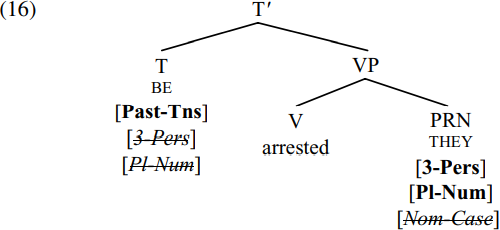
The deleted features will now be invisible in the semantic component – in accordance with (13). The rest of the derivation proceeds as before.
Chomsky sees uninterpretable features as being at the very heart of agreement, and posits (1999, p. 4) that ‘Probe and Goal must both be active for Agree to apply’ and that a constituent  (whether Probe or Goal) is active only if
  contains one or more uninterpretable features. In other words, it is the presence of uninterpretable features on a constituent that makes it active (and hence able to serve as a probe or goal, and to play a part in feature-valuation and feature-deletion).
As should be obvious, the Feature-Deletion operation posited in (14) is very different from the (Trace) Copy-Deletion operation we assumed by which a trace copy of a moved constituent is deleted. Feature-Deletion is an operation which renders the affected features invisible to the semantic component, while leaving them visible to the phonological component. By contrast, Copy-Deletion is an operation which renders traces of moved constituents invisible to the phonological component (in the sense that they are not given any phonetic spellout), while leaving them visible in the semantic component. The reason why traces must remain visible in the semantic component is that they play an important role in semantic interpretation, as we can see in relation to a sentence such as (17a) below, which has the simplified structure (17b) (assuming that a famous politician originates as the object of the passive participle seen and raises to become the subject of has):

(17a) exhibits a scope ambiguity in respect of whether a famous politician has scope over not (so that the sentence is paraphraseable as ‘There is a specific famous politician, Gerry Attrick, who has not been seen in the Hotel Casanova for weeks’) or conversely whether not has scope over a famous politician (so that the sentence is paraphraseable as ‘Not a single famous politician has been seen in the Hotel Casanova for weeks’). If the semantic component is able to ‘see’ traces, it will ‘see’ the structure represented in skeletal form in (17b) above. One way of handling the scope ambiguity of sentences like (17a) is to posit that scope is defined in terms of c-command and that the scope ambiguity correlates with the fact that in the structure (17b), not is c-commanded by (so falls within the scope of) the moved constituent a famous politician, but conversely not c-commands (and hence has scope over) its trace a famous politician. A plausible conclusion to draw is that trace-deletion takes place in the phonological component, so that traces remain in the syntax and hence are visible in the semantic component, and can play a role in determining scope in relevant types of structure. The assumption that trace-deletion is a phonological operation is implicit in Chomsky’s remark (1999, p. 11) that ‘Phonological rules... eliminate trace.’
 الاكثر قراءة في Syntax
 اخر الاخبار
اخبار العتبة العباسية المقدسة

الآخبار الصحية


مواضيع ذات صلة
 قسم الشؤون الفكرية يصدر كتاباً يوثق تاريخ السدانة في العتبة العباسية المقدسة
 "المهمة".. إصدار قصصي يوثّق القصص الفائزة في مسابقة فتوى الدفاع المقدسة للقصة القصيرة
 (نوافذ).. إصدار أدبي يوثق القصص الفائزة في مسابقة الإمام العسكري (عليه السلام)