Grammar
Tenses
Present

Present Simple
Present Continuous
Present Perfect
Present Perfect Continuous
Past
Past Simple
Past Continuous
Past Perfect
Past Perfect Continuous
Future
Future Simple
Future Continuous
Future Perfect
Future Perfect Continuous
Parts Of Speech
Nouns
Countable and uncountable nouns
Verbal nouns
Singular and Plural nouns
Proper nouns
Nouns gender
Nouns definition
Concrete nouns
Abstract nouns
Common nouns
Collective nouns
Definition Of Nouns
Animate and Inanimate nouns
Nouns
Verbs
Stative and dynamic verbs
Finite and nonfinite verbs
To be verbs
Transitive and intransitive verbs
Auxiliary verbs
Modal verbs
Regular and irregular verbs
Action verbs
Verbs
Adverbs
Relative adverbs
Interrogative adverbs
Adverbs of time
Adverbs of place
Adverbs of reason
Adverbs of quantity
Adverbs of manner
Adverbs of frequency
Adverbs of affirmation
Adverbs
Adjectives
Quantitative adjective
Proper adjective
Possessive adjective
Numeral adjective
Interrogative adjective
Distributive adjective
Descriptive adjective
Demonstrative adjective
Pronouns
Subject pronoun
Relative pronoun
Reflexive pronoun
Reciprocal pronoun
Possessive pronoun
Personal pronoun
Interrogative pronoun
Indefinite pronoun
Emphatic pronoun
Distributive pronoun
Demonstrative pronoun
Pronouns
Pre Position
Preposition by function
Time preposition
Reason preposition
Possession preposition
Place preposition
Phrases preposition
Origin preposition
Measure preposition
Direction preposition
Contrast preposition
Agent preposition
Preposition by construction
Simple preposition
Phrase preposition
Double preposition
Compound preposition
prepositions
Conjunctions
Subordinating conjunction
Correlative conjunction
Coordinating conjunction
Conjunctive adverbs
conjunctions
Interjections
Express calling interjection
Phrases
Sentences
Grammar Rules
Passive and Active
Preference
Requests and offers
wishes
Be used to
Some and any
Could have done
Describing people
Giving advices
Possession
Comparative and superlative
Giving Reason
Making Suggestions
Apologizing
Forming questions
Since and for
Directions
Obligation
Adverbials
invitation
Articles
Imaginary condition
Zero conditional
First conditional
Second conditional
Third conditional
Reported speech
Demonstratives
Determiners
Linguistics
Phonetics
Phonology
Linguistics fields
Syntax
Morphology
Semantics
pragmatics
History
Writing
Grammar
Phonetics and Phonology
Semiotics
Reading Comprehension
Elementary
Intermediate
Advanced
Teaching Methods
Teaching Strategies
Assessment

Explaining what moves where
 المؤلف:
Andrew Radford
المؤلف:
Andrew Radford
 المصدر:
Minimalist Syntax
المصدر:
Minimalist Syntax
 الجزء والصفحة:
202-6
الجزء والصفحة:
202-6
 9-1-2023
 2066
2066




+
-
20
Explaining what moves where
Our discussion looked at wh-movement in interrogative complement clauses which involve movement of a wh-word (rather than a wh-phrase), and which don’t involve auxiliary inversion. But now consider how we handle the syntax of main-clause wh-questions like (34) below which involve both movement of a wh-phrase and movement of an auxiliary:

Let’s suppose that the derivation of (34) proceeds as follows. The quantifier which merges with the noun assignment to form the QP which assignment. This in turn is merged with the verb done to form the VP done which assignment. The resulting VP is subsequently merged with the present-tense auxiliary have to form the T-bar have done which assignment, which is itself merged with the pronoun you to form the TP you have done which assignment. TP is then merged with a null interrogative C. Since (34) is a wh-question, C will carry a [WH] feature and an [EPP] feature. Since (34) is a main-clause question, we can assume that C also carries a [TNS] feature which triggers movement of a tensed auxiliary from T to C. Given these assumptions, merging C with the TP you have done which assignment will derive the following structure:
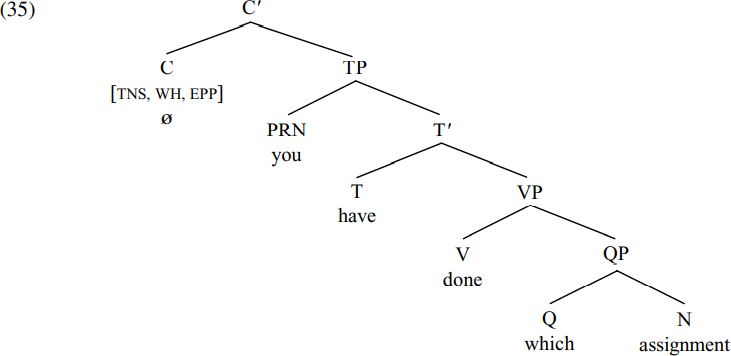
At first sight, the derivation might seem straightforward from this point on: the [TNS] feature of C attracts the present-tense auxiliary have to attach to a null question affix in C; the [WH, EPP] features of C trigger movement of the wh-expression which assignment to the specifier position within CP. Assuming that all the features of C are deleted (and thereby inactivated) once their requirements are satisfied, the relevant movement operations will derive the structure shown in simplified form below:
Since the resulting sentence (34) Which assignment have you done? is grammatical, things appear to work out exactly as required.
But if we probe a little deeper, we’ll see that there are a number of questions raised by the derivation outlined above. The core assumptions underlying it are the following
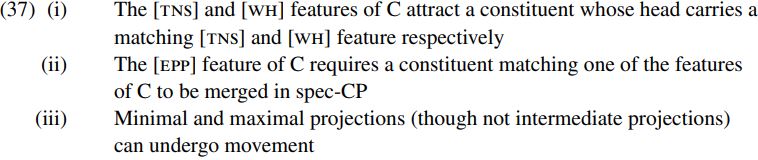
But while the assumptions made in (37) are perfectly compatible with the derivation assumed in (36), they raise important questions about what kind of constituent moves to what kind of position and why.
One such question is why the [TNS] feature of C in (35) attracts [T have] rather than [TP you have done which assignment]. We can offer a principled answer to this question by supposing that a head which carries a feature [F] can freely attract either a minimal or a maximal projection carrying [F], but that UG principles rule out certain possibilities. From this perspective, we would expect that the [TNS] feature of C can in principle attract either T or TP (and indeed both are equally close to C in terms of the definition of closeness in (32) above), and if in practice C cannot attract TP, this is because some UG principle rules out this possibility. One reason why C cannot attract its TP complement may be that movement is an operation by which a head attracts (and is thereby merged with) a constituent which it is not already merged with. Since TP is already merged with C by virtue of being the complement of C, it follows that C cannot attract TP. The tacit assumption underlying our reasoning here is that UG incorporates a principle such as the following:

As we saw earlier, [TP you have done which assignment] is initially merged with C at the stage of derivation when the structure shown in (35) above is formed. To subsequently move TP into spec-CP would involve merging TP as the specifier of C – and this would violate the Remerger Constraint (38), since it would mean that TP was initially merged with C as its complement, and subsequently remerged with C as its specifier. By contrast, the Remerger Constraint would not prevent C from attracting [T have], since have is not merged with C prior to T-to-C movement: on the contrary, have was initially merged with its VP complement done which assignment and its pronoun specifier you, so that merging (a copy of) have with C does not violate the constraint against remerger. In short, we can account for why C attracts T rather than TP in terms of a UG principle like (38) barring remerger operations.
A follow-up question is why a tensed auxiliary attracted by C moves into C rather than into spec-CP. A plausible answer to this question is that UG principles determine the landing site of moved constituents (i.e. determine where they end up being positioned). For concreteness, let’s assume that UG incorporates a principle along the lines of (39) below:

(39i) would mean that the head T constituent of TP (by virtue of being a minimal projection) can only move to the head C position of CP, not to the specifier position within CP. (Chomsky 1995, p. 253 offers an alternative account based on chain uniformity, and Carnie 2000 discusses attendant problems.)
Now consider the question of why the [WH] feature of C attracts the QP which assignment rather than the Q which. Given our earlier assumptions, we’d expect that the [WH] feature carried by C can in principle attract either a wh-word or a wh-phrase. However, the [EPP] feature carried by C requires C to project a specifier, and (39ii) tells us that a specifier position can only be filled by a maximal projection. Since we have already seen that the Remerger Constraint (38) prevents C from attracting TP to move to spec-CP, the only way of satisfying the [EPP] requirement is for a wh-constituent to be moved into spec-CP; and since (39ii) tells us that only a maximal projection can occupy a specifier position, it follows that the [WH] feature of C attracts a wh-marked maximal projection like which assignment to move into spec-CP, not a wh-marked minimal projection like which. (Note, however, that the story told here for English needs to be modified for languages which allow certain types of wh-word to move to C, as would seem to be the case for Polish data in Borsley 2002, German data in Kathol 2001, and North Norwegian data in Radford 1994: it may be that C in such languages has an [EDGE] feature requiring a wh-expression to move to the edge of C rather than an [EPP] feature requiring a wh-expression to move to spec-CP.)
The story told above assumes that UG principles like the Remerger Constraint (38) and the Constituent Structure Constraint (39) determine that the [TNS] feature of C attracts movement of a tensed auxiliary to C, and that the [WH, EPP] features of C attract movement of a whmax (i.e. a wh-marked maximal projection) to spec-CP. However, an entirely different approach to the problem of accounting for why the [TNS] and [WH] features of C attract different types of constituent to move to different positions in English is to posit that they are different types of feature which trigger different types of movement operation in different components of the grammar. For example, if the [TNS] feature on C is essentially affixal in nature, we could conclude that head movement operations like T-to-C movement are intrinsically morphological in nature (in that they are designed to provide an affix with a host), and hence take place in the PF component rather than the syntactic component – a possibility explored by Chomsky (1999, pp. 30–1). Chomsky notes that some evidence in support of such a hypothesis comes from the fact that head movement has rather different properties from typical syntactic movement operations like wh-movement. For example, head movement can attract only heads whereas wh-movement can attract maximal projections; head movement is a strictly local operation (whereby a head can attract the head of its complement), whereas wh-movement can attract more distant constituents (e.g. C can attract a wh-constituent which originates within a lower clause, as in (30) and (33) above); head movement involves a form of affixation operation by which one head is affixed to another (forming a compound head), whereas wh-movement is a merger operation by which a moved constituent is merged as the specifier of C; and conversely wh-movement has an effect on semantic interpretation (in that it creates an operator-variable configuration as we noted in relation to (21) above), whereas auxiliary inversion does not. These differences (Chomsky reasons) suggest that features like the [WH] feature of C are syntactic features triggering movement of a maximal projection in the syntax, whereas features like the [TNS] feature of C are morphological features triggering movement of a minimal projection in the PF component. (See Boeckx and Stjepanovi´c 2001 for an additional argument for head movement being a PF operation, and Baltin 2002 for a rebuttal.)
Perceptive though Chomsky’s observations are, they are suggestive rather than conclusive (see Embick and Noyer 2001 for a sceptical view). For example, his claim that head movement is a PF operation because it has no effect on semantic interpretation has little force if we assume that the semantic component interprets the tense properties of clauses by looking at the tense properties of the head T constituent of TP – and cares little whether what is in T is an overt auxiliary or a null copy of a moved auxiliary. Likewise, the argument that head movement is subject to a strict locality constraint like HMC is called into question by Hagstrom’s (1998) analysis of wh-questions in wh-in-situ languages (like Japanese, Okinawan, Navajo and Sinhala) in which he claims that they involve long-distance head movement of a question particle to C. Hagstrom proposes to abandon HMC, and argues that the apparent locality of head movement is an artefact of the Attract Closest Principle/ACP (31). On this view, local (successive-cyclic) movement of the verb say from V to T to C in a Shakespearean sentence such as:

will be a consequence of ACP rather than HMC. For example, if T has a strong V-feature and C has a strong T-feature, T will attract the closest verb (i.e. the head V said of the VP said what) to move to T, and C will attract the closest tensed head (i.e. the head T constituent of TP, with T containing the moved verb said at the relevant stage of derivation) to move to C – thereby guaranteeing local head movement without the need for positing HMC. In short, the question of whether head movement is a syntactic operation (as argued by Roberts 2002) or a PF operation (as argued by Chomsky 1999) or has facets of both (as argued by Zwart 2001) is one which remains open at present.
 الاكثر قراءة في Syntax
 اخر الاخبار
اخبار العتبة العباسية المقدسة

الآخبار الصحية


مواضيع ذات صلة
 قسم الشؤون الفكرية يصدر كتاباً يوثق تاريخ السدانة في العتبة العباسية المقدسة
 "المهمة".. إصدار قصصي يوثّق القصص الفائزة في مسابقة فتوى الدفاع المقدسة للقصة القصيرة
 (نوافذ).. إصدار أدبي يوثق القصص الفائزة في مسابقة الإمام العسكري (عليه السلام)