Grammar
Tenses
Present

Present Simple
Present Continuous
Present Perfect
Present Perfect Continuous
Past
Past Simple
Past Continuous
Past Perfect
Past Perfect Continuous
Future
Future Simple
Future Continuous
Future Perfect
Future Perfect Continuous
Parts Of Speech
Nouns
Countable and uncountable nouns
Verbal nouns
Singular and Plural nouns
Proper nouns
Nouns gender
Nouns definition
Concrete nouns
Abstract nouns
Common nouns
Collective nouns
Definition Of Nouns
Animate and Inanimate nouns
Nouns
Verbs
Stative and dynamic verbs
Finite and nonfinite verbs
To be verbs
Transitive and intransitive verbs
Auxiliary verbs
Modal verbs
Regular and irregular verbs
Action verbs
Verbs
Adverbs
Relative adverbs
Interrogative adverbs
Adverbs of time
Adverbs of place
Adverbs of reason
Adverbs of quantity
Adverbs of manner
Adverbs of frequency
Adverbs of affirmation
Adverbs
Adjectives
Quantitative adjective
Proper adjective
Possessive adjective
Numeral adjective
Interrogative adjective
Distributive adjective
Descriptive adjective
Demonstrative adjective
Pronouns
Subject pronoun
Relative pronoun
Reflexive pronoun
Reciprocal pronoun
Possessive pronoun
Personal pronoun
Interrogative pronoun
Indefinite pronoun
Emphatic pronoun
Distributive pronoun
Demonstrative pronoun
Pronouns
Pre Position
Preposition by function
Time preposition
Reason preposition
Possession preposition
Place preposition
Phrases preposition
Origin preposition
Measure preposition
Direction preposition
Contrast preposition
Agent preposition
Preposition by construction
Simple preposition
Phrase preposition
Double preposition
Compound preposition
prepositions
Conjunctions
Subordinating conjunction
Correlative conjunction
Coordinating conjunction
Conjunctive adverbs
conjunctions
Interjections
Express calling interjection
Phrases
Sentences
Grammar Rules
Passive and Active
Preference
Requests and offers
wishes
Be used to
Some and any
Could have done
Describing people
Giving advices
Possession
Comparative and superlative
Giving Reason
Making Suggestions
Apologizing
Forming questions
Since and for
Directions
Obligation
Adverbials
invitation
Articles
Imaginary condition
Zero conditional
First conditional
Second conditional
Third conditional
Reported speech
Demonstratives
Determiners
Linguistics
Phonetics
Phonology
Linguistics fields
Syntax
Morphology
Semantics
pragmatics
History
Writing
Grammar
Phonetics and Phonology
Semiotics
Reading Comprehension
Elementary
Intermediate
Advanced
Teaching Methods
Teaching Strategies
Assessment

Ejectives in English
 المؤلف:
Richard Ogden
المؤلف:
Richard Ogden
 المصدر:
An Introduction to English Phonetics
المصدر:
An Introduction to English Phonetics
 الجزء والصفحة:
163-10
الجزء والصفحة:
163-10
 26-7-2022
 1661
1661




+
-
20
Ejectives in English
Ejectives occur in a good number of British English varieties, though remarkably little is known about which ones. Nor is anything much known about the distribution of ejectives. The material on which the observations here are based is collected from a range of sources in Britain, and the following observations seem to be true, but are only indicative. Ejectives occur:
• word finally (and not e.g. before vowels)
• in stressed syllables
• after vowels, nasals and laterals (which are all voiced), but not after voiceless sounds such as [s]
• within utterances (before pauses), as well as at the end of utterances
Ejectives may be a development of glottal reinforcement. In glottal reinforcement, a glottal constriction is made before an oral one; once the oral constriction is made, the glottis is opened, and air is forced from the lungs across the open glottis. In the case of ejectives, a glottal constriction is also made simultaneously with an oral constriction; but is released after the release of the oral constriction. So ejectives involve a rearrangement in time of the constrictions needed to produce glottally reinforced voiceless plosives.
Another explanation for ejectives in English lies in the fact that the plosive release of ejectives is typically loud (or at least louder than the release of the corresponding pulmonic sound): this enhances the audibility of the burst, and makes it easier to perceive the place of articulation of the plosive.
Here are some examples of ejectives taken from a narrative by a woman from Aberdeen in her early twenties. She is telling about applying for a job. (Timings between brackets within transcriptions mark pauses in the speaker’s talk; e.g. (0.5 s) means the speaker is not talking for 0.5 seconds.)
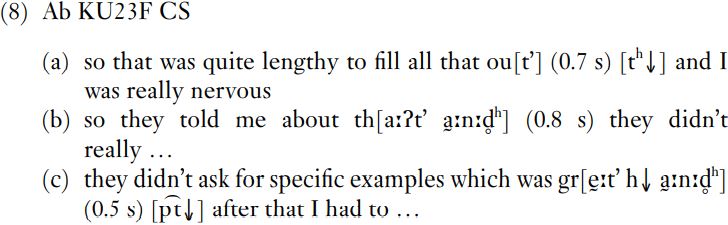
The ejectives here all come in the context of a pause in her talk, either immediately or shortly after the ejective. In (a), the ejective comes before a pause, which is exited with an audible percussive alveolar release, followed immediately by an in-breath (marked here with  ). In (c) too, there is an in-breath just after the ejective. In (b) and (c), the ejective is followed by a long production of ‘and’ which starts with creaky voice: we might expect creak after a glottal closure, as the vocal folds start to vibrate modally again. In all these cases, the speaker continues speaking after the stretch which contains the ejective.
In the extract in (9) below, a conversation between two students from the north of England, there are two ejectives: one turn-finally, the other in the middle of a turn.
The turn-final ejective is in line 2, a reformulation of a question (line 1) which makes it more specific what kind of answer is required (a reference to which week in term, rather than, e.g. a calendar date like ‘15 June’). This one is at a place in the conversation where the other person can be expected to talk next.
The turn-medial one comes in line 15 between the words ‘week’ and ‘three’, which is part of a list (week one, week two, week three). Although the word ‘three’ is highly predictable from the context, there is a hitch in the speaker’s production, and the ejective occurs before a 0.2-s pause.
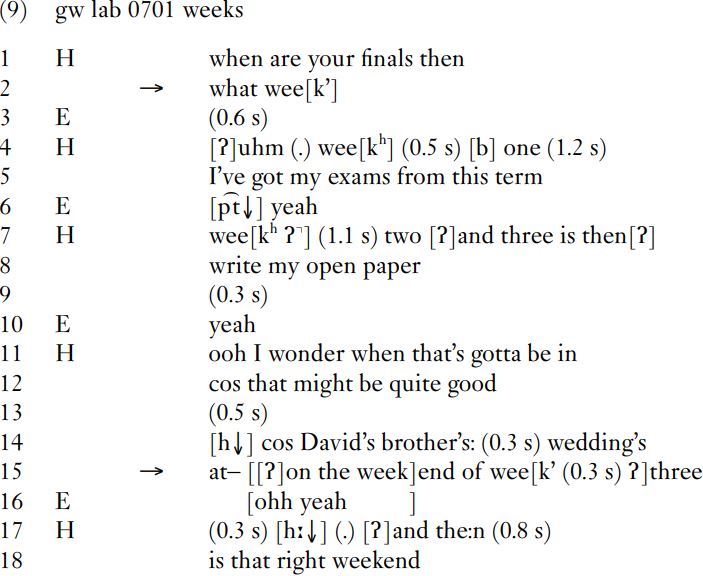
In line 15, in between the release of the plosive of ‘week’ and the start of the friction of ‘three’ is a pause of about 0.3 s. The fricative [f ] at the start of ‘three’ starts with a glottal stop. So the glottal closure made earlier at the same time as the velar closure in ‘week’ is held until the speaker starts to speak again with ‘three’. Articulations which are held across gaps in speaking within a speaker’s turn like this have been shown for English to mark: ‘I may not be speaking now but I have more to say and I am keeping the turn’. So perhaps the ejective in this environment is a side-effect of some other work that is being done by a glottal stop.
We can compare Helen’s production of ‘week’ here with her other productions of ‘week’ in lines 4 and 7. In line 4, the plosive is produced with aspiration, followed by a long pause. There is evidently labial closure too: the word ‘one’ is preceded by a bilabial plosive with approximately 0.07 s of voicing during the closure. In line 7, the plosive at the end of ‘week’ is produced with lengthy aspiration (0.45 s), which is abruptly cut off by a glottal stop before a pause of 1.1 s. The pause is released into an alveolar plosive.
For comparison, spectrograms of the tokens of ‘week’ from lines 4 ([k]) and 15 ([k’]) are shown in Figure 10.2.
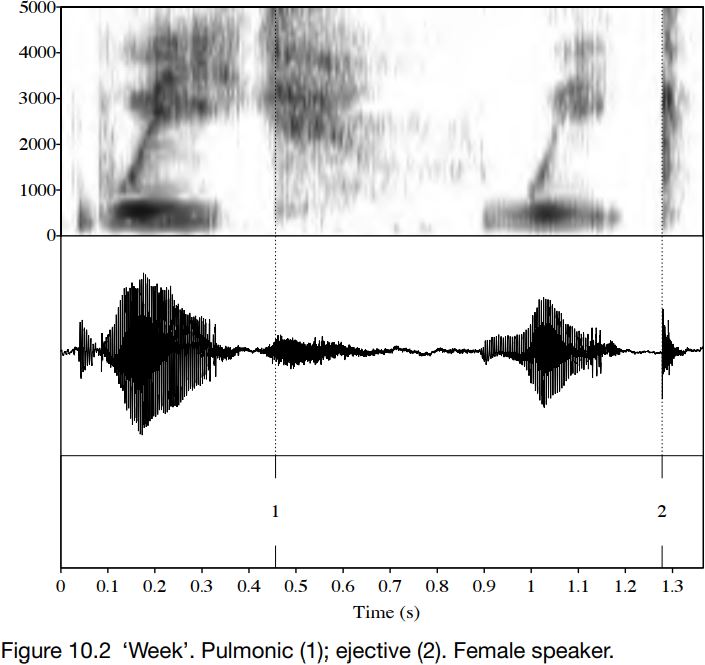
The first production (on the left) shows voicelessness and closure cooccurring: notice the high-frequency friction around 3000–4000 Hz between 0.3 and 0.4 s on the spectrogram. The plosive is released with a considerable amount of aspiration: the release is marked at 1 on the spectrogram. The second production is an ejective production, marked at 2 on the spectrogram. Notice the glottal closure at around 1.15 s, and the very abrupt way that the energy for the vowel dies away. The plosive release marked at 2 is sharp and loud (darker than at 1), and although there is some friction noise, it is much shorter in duration than in the pulmonic production. This is because the amount of air available between the glottal and velar closures is rather small, which makes it difficult for friction to be sustained for very long; whereas for pulmonically initiated productions, there is far more air in the lungs which can be forced out to produce aspiration noise.
So while not all the tokens of ‘week’ contain ejectives in this fragment, they do all have some kind of closure which is held in the pause after the word ‘week’, and two of these, in lines 7 and 15, involve also glottal closure. In making sense of the distribution of ejectives, then, we probably need to look at the wider context. This way, we can see the ejectives as part of a longer stretch of phonetic events, which includes a plosive, a pause, and an exit from the pause.
 الاكثر قراءة في Phonetics
 اخر الاخبار
اخبار العتبة العباسية المقدسة

الآخبار الصحية


مواضيع ذات صلة
 قسم الشؤون الفكرية يصدر كتاباً يوثق تاريخ السدانة في العتبة العباسية المقدسة
 "المهمة".. إصدار قصصي يوثّق القصص الفائزة في مسابقة فتوى الدفاع المقدسة للقصة القصيرة
 (نوافذ).. إصدار أدبي يوثق القصص الفائزة في مسابقة الإمام العسكري (عليه السلام)