Grammar
Tenses
Present

Present Simple
Present Continuous
Present Perfect
Present Perfect Continuous
Past
Past Simple
Past Continuous
Past Perfect
Past Perfect Continuous
Future
Future Simple
Future Continuous
Future Perfect
Future Perfect Continuous
Parts Of Speech
Nouns
Countable and uncountable nouns
Verbal nouns
Singular and Plural nouns
Proper nouns
Nouns gender
Nouns definition
Concrete nouns
Abstract nouns
Common nouns
Collective nouns
Definition Of Nouns
Animate and Inanimate nouns
Nouns
Verbs
Stative and dynamic verbs
Finite and nonfinite verbs
To be verbs
Transitive and intransitive verbs
Auxiliary verbs
Modal verbs
Regular and irregular verbs
Action verbs
Verbs
Adverbs
Relative adverbs
Interrogative adverbs
Adverbs of time
Adverbs of place
Adverbs of reason
Adverbs of quantity
Adverbs of manner
Adverbs of frequency
Adverbs of affirmation
Adverbs
Adjectives
Quantitative adjective
Proper adjective
Possessive adjective
Numeral adjective
Interrogative adjective
Distributive adjective
Descriptive adjective
Demonstrative adjective
Pronouns
Subject pronoun
Relative pronoun
Reflexive pronoun
Reciprocal pronoun
Possessive pronoun
Personal pronoun
Interrogative pronoun
Indefinite pronoun
Emphatic pronoun
Distributive pronoun
Demonstrative pronoun
Pronouns
Pre Position
Preposition by function
Time preposition
Reason preposition
Possession preposition
Place preposition
Phrases preposition
Origin preposition
Measure preposition
Direction preposition
Contrast preposition
Agent preposition
Preposition by construction
Simple preposition
Phrase preposition
Double preposition
Compound preposition
prepositions
Conjunctions
Subordinating conjunction
Correlative conjunction
Coordinating conjunction
Conjunctive adverbs
conjunctions
Interjections
Express calling interjection
Phrases
Sentences
Grammar Rules
Passive and Active
Preference
Requests and offers
wishes
Be used to
Some and any
Could have done
Describing people
Giving advices
Possession
Comparative and superlative
Giving Reason
Making Suggestions
Apologizing
Forming questions
Since and for
Directions
Obligation
Adverbials
invitation
Articles
Imaginary condition
Zero conditional
First conditional
Second conditional
Third conditional
Reported speech
Demonstratives
Determiners
Linguistics
Phonetics
Phonology
Linguistics fields
Syntax
Morphology
Semantics
pragmatics
History
Writing
Grammar
Phonetics and Phonology
Semiotics
Reading Comprehension
Elementary
Intermediate
Advanced
Teaching Methods
Teaching Strategies
Assessment

Clicks in English
 المؤلف:
Richard Ogden
المؤلف:
Richard Ogden
 المصدر:
An Introduction to English Phonetics
المصدر:
An Introduction to English Phonetics
 الجزء والصفحة:
157-10
الجزء والصفحة:
157-10
 25-7-2022
 1616
1616




+
-
20
Clicks in English
Clicks can be produced at a range of places of articulation. In English, the commonest ones are probably bilabial, alveolar lateral and dental.
Bilabial clicks, when produced with pursed lips, resemble a peck on the cheek. These clicks are used to mimic kissing (or even done instead of kissing, as in the stereotyped ‘mwah!’ of insincerely warm greetings). Lateral clicks are sometimes used to ‘gee up’ horses (and usually come in pairs).
The dental click is so ubiquitous in English that we even have a verb to describe making it: ‘tutting’. Stereotypically, we associate this with an expression of disapproval (accompanied in our mind’s eye by rolling one’s eyes heavenwards). In the next few paragraphs, we look at some instances of [J] taken from naturally occurring English conversation.
We start with an example of a click used as part of a response to a story. Lesley has been telling Joyce about a visit to a church fair. At this fair, an acquaintance of theirs said something Lesley finds offensive, and which she has taken delight in telling Joyce about. At lines 2–3, Lesley directly quotes this acquaintance and brings his objectionable behavior to the fore in the punchline of the story.
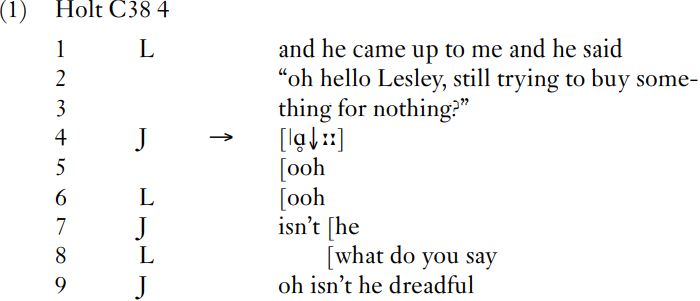
Joyce’s immediate reaction to the punchline at line 4 is a dental click followed by an open vocalic gesture accompanied by ingressive airflow. This is a display of understanding of Lesley’s story: a complaint about the behavior of their acquaintance. The click is only the beginning of the sequence of talk in which Joyce and Lesley complain about him, and Joyce’s turn continues with an assessment of this acquaintance as ‘dreadful’.
Perhaps it is significant that both the click and the vowel sound that come after it are ingressive: having air in the lungs is a prerequisite for talking, and in-breaths are often used to mark: ‘I have more to say’. Sharp in-breaths are also a reflex reaction to unexpected physical events: perhaps the in-breath here is an iconic device to express ‘shock’ – although it is unlikely to be a spontaneous shock, since the story has been constructed to achieve precisely this response.
Clicks can also be used to initiate turns at talk in less emotionally charged contexts, as in the following cases:
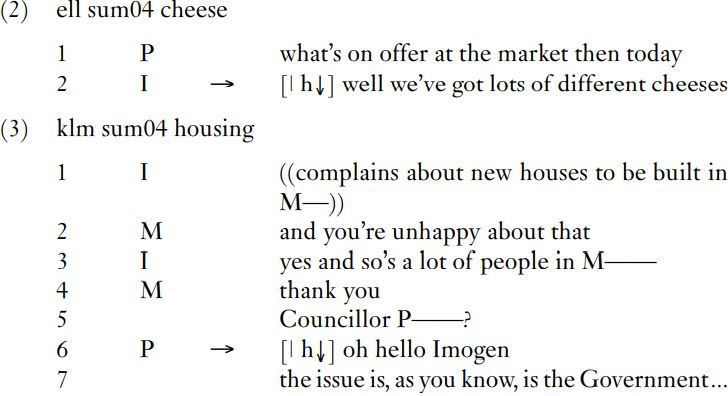
In (2), the click in line 2 prefaces the answer to a question; in (3), the click in line 6 starts Councillor P’s response to I’s point, having been selected as the next speaker in line 5 by M.
Again the clicks are followed by ingressive airflow, this time an in-breath (marked in the transcripts as [h↓]). In these cases, the clicks do not seem to ‘express disapproval’. Rather, they seem to be used to project more talk by the speaker, i.e. to mark ‘I have more to say’.
Clicks can be used as part of turns that display other kinds of stance. For example, they can occur at the start of turns that mark some display of sympathy. In the example below, Agnes complains about the weekend she has had. In response to this telling, Billie produces a click followed by a long and creaky  . The click is produced on beat with a rhythm established by Agnes: the stars above lines 2 and 3 mark the beats, which are evenly spaced in time.
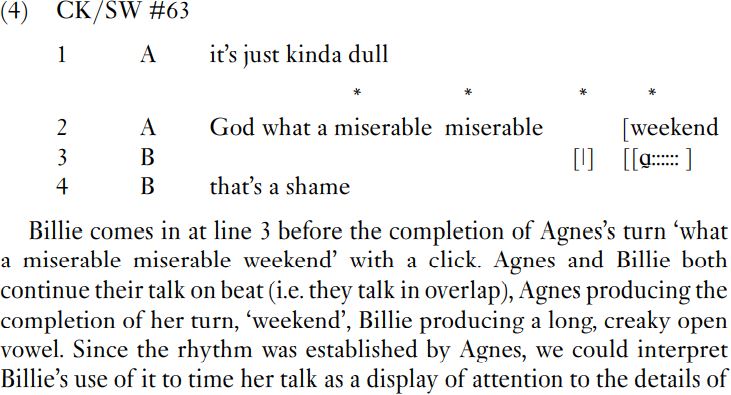
Billie comes in at line 3 before the completion of Agnes’s turn ‘what a miserable miserable weekend’ with a click. Agnes and Billie both continue their talk on beat (i.e. they talk in overlap), Agnes producing the completion of her turn, ‘weekend’, Billie producing a long, creaky open vowel. Since the rhythm was established by Agnes, we could interpret Billie’s use of it to time her talk as a display of attention to the details of Agnes’s talk, and in doing that, going along with the complaint made by Agnes. This is consistent with her display of sympathy in her next turn: ‘that’s a shame’. So here we have a click which seems to be produced as the first part of a display of sympathy with another’s situation, and which seems to be temporally placed to display attentiveness to that other person’s telling of the situation.
Clicks can also be used to mark receipt of positive news. In the next fragment, Jade tells Kate how two people they know became a couple. Once she has completed her story, Kate offers an appreciation of the story (line 6), which starts with a click followed by a long, breathy open vowel with falling pitch. If clicks marked ‘disapproval’, then Kate would be treating this story as bad news; but in fact she makes a positive assessment of the story: ‘that’s lovely’. Indeed, we might even say that the stretch  marks a positive receipt of the news.
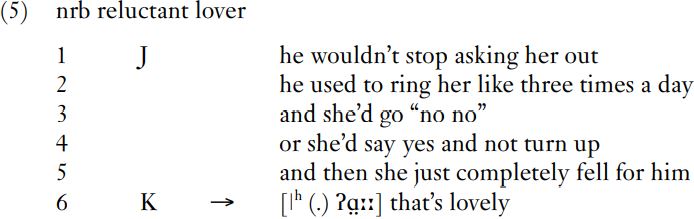
So, here we have a few instances where clicks initiate turns that provide assessments or appreciations of a telling; in these turns, the recipient of a story demonstrates their understanding of the kind of story it was, which can include ‘disapproval’, but also ‘a story deserving of sympathy’ and ‘good news’.
Another common use for clicks is to signal the transition from one activity to another (Wright 2007). A good place to observe this is at the end of phone calls, where there is a sequence that English speakers commonly use to manage how they will both get to the point of putting the phone down. (This may seem trivial, but putting the phone down before it is due is a big faux pas in English-speaking societies.) The fragment in (6) below displays this well. The current topic is closed down in lines 8–9 (‘oh splendid’/‘yahp’); then there follows a click in line 9; then there is a short sequence in lines 9–10 where a proposal is made to close the call (‘Okay then’), which is accepted (‘right’), and then greetings are exchanged, and the speakers hang up the phone. Clicks are common in this sequence in between the closing down of the topic and the ‘OK’:
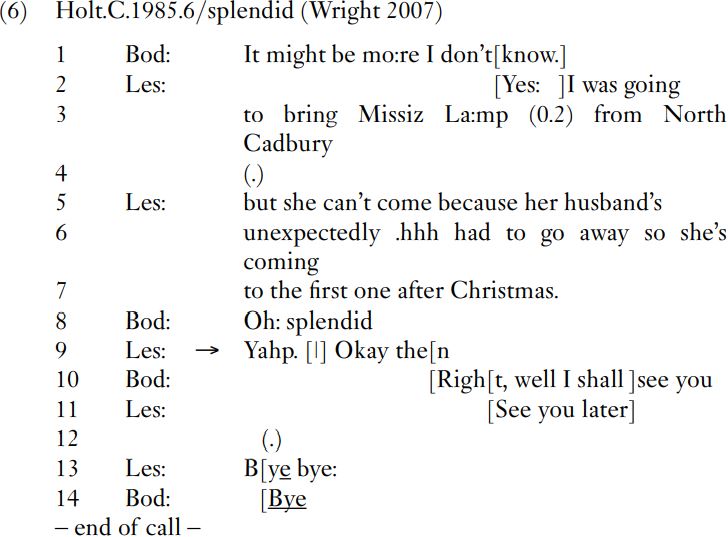
The click occurs in a single turn which has two parts. The first part, ‘yahp’, closes down the earlier sequence about Mrs Lamp’s attendance at a meeting. The second part of the sequence, ‘Okay then’, marks the beginning of the closing of the call (‘Okay then/right’, after which the speakers start to exchange greetings). The click marks the transition between two activities.
While we commonly find velarically initiated clicks in turns like this, we also find other kinds of ingressive sounds and percussives: the most usual are audible lip smacks or releases of other closures, where the articulators are separated from one another, which may produce a sound loud enough to be heard. If the speaker breathes in loudly enough to be heard, this can sound like e.g. an ingressive voiceless bilabial plosive, [p↓]. It is perhaps an important feature of clicks in these particular sequences that they stand in free variation with other (related) sounds; whereas the clicks that express some kind of stance are not, and cannot be, produced in this way, but must be velarically initiated.
The clicks we have looked at so far are all accompanied by [k] and then sometimes followed by a vocalic articulation which is either ingressive or egressive. The next, and final, example of a click is accompanied by voicing and nasality,  . In this example, the click occurs at the start of the receipt of a compliment.
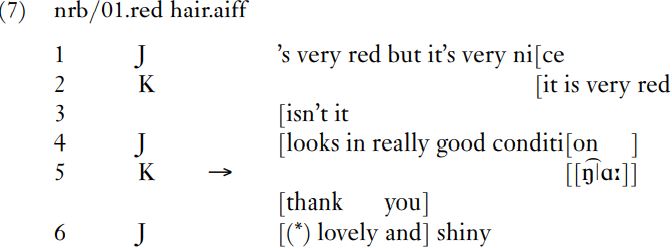
(In line 6, (*) marks an indistinct syllable.) Kate has dyed her hair red, and Jade has been complimenting her on it. In line 5, Kate produces a nasalized click with a breathy-voiced and long open vowel, with a pitch contour that falls from high to low in her range. It is immediately followed by ‘thank you’. The commonest lay interpretation of clicks, ‘disapproval’, is once again unlikely to be what Kate does in line 5.
In summary then, we can find a range of clicks in naturally occurring spoken English. Their distribution and functions are not well researched; but they seem to occur at the start of turns, or to mark the transition from one kind of activity to another within a turn. They commonly seem to be involved in assessing stories or situations, but (contrary to English speakers’ general intuitions) they do not necessarily imply ‘disapproval’, or even anything negative at all.
 الاكثر قراءة في Phonetics
 اخر الاخبار
اخبار العتبة العباسية المقدسة

الآخبار الصحية


مواضيع ذات صلة
 قسم الشؤون الفكرية يصدر كتاباً يوثق تاريخ السدانة في العتبة العباسية المقدسة
 "المهمة".. إصدار قصصي يوثّق القصص الفائزة في مسابقة فتوى الدفاع المقدسة للقصة القصيرة
 (نوافذ).. إصدار أدبي يوثق القصص الفائزة في مسابقة الإمام العسكري (عليه السلام)