Grammar
Tenses
Present

Present Simple
Present Continuous
Present Perfect
Present Perfect Continuous
Past
Past Simple
Past Continuous
Past Perfect
Past Perfect Continuous
Future
Future Simple
Future Continuous
Future Perfect
Future Perfect Continuous
Parts Of Speech
Nouns
Countable and uncountable nouns
Verbal nouns
Singular and Plural nouns
Proper nouns
Nouns gender
Nouns definition
Concrete nouns
Abstract nouns
Common nouns
Collective nouns
Definition Of Nouns
Animate and Inanimate nouns
Nouns
Verbs
Stative and dynamic verbs
Finite and nonfinite verbs
To be verbs
Transitive and intransitive verbs
Auxiliary verbs
Modal verbs
Regular and irregular verbs
Action verbs
Verbs
Adverbs
Relative adverbs
Interrogative adverbs
Adverbs of time
Adverbs of place
Adverbs of reason
Adverbs of quantity
Adverbs of manner
Adverbs of frequency
Adverbs of affirmation
Adverbs
Adjectives
Quantitative adjective
Proper adjective
Possessive adjective
Numeral adjective
Interrogative adjective
Distributive adjective
Descriptive adjective
Demonstrative adjective
Pronouns
Subject pronoun
Relative pronoun
Reflexive pronoun
Reciprocal pronoun
Possessive pronoun
Personal pronoun
Interrogative pronoun
Indefinite pronoun
Emphatic pronoun
Distributive pronoun
Demonstrative pronoun
Pronouns
Pre Position
Preposition by function
Time preposition
Reason preposition
Possession preposition
Place preposition
Phrases preposition
Origin preposition
Measure preposition
Direction preposition
Contrast preposition
Agent preposition
Preposition by construction
Simple preposition
Phrase preposition
Double preposition
Compound preposition
prepositions
Conjunctions
Subordinating conjunction
Correlative conjunction
Coordinating conjunction
Conjunctive adverbs
conjunctions
Interjections
Express calling interjection
Phrases
Sentences
Grammar Rules
Passive and Active
Preference
Requests and offers
wishes
Be used to
Some and any
Could have done
Describing people
Giving advices
Possession
Comparative and superlative
Giving Reason
Making Suggestions
Apologizing
Forming questions
Since and for
Directions
Obligation
Adverbials
invitation
Articles
Imaginary condition
Zero conditional
First conditional
Second conditional
Third conditional
Reported speech
Demonstratives
Determiners
Linguistics
Phonetics
Phonology
Linguistics fields
Syntax
Morphology
Semantics
pragmatics
History
Writing
Grammar
Phonetics and Phonology
Semiotics
Reading Comprehension
Elementary
Intermediate
Advanced
Teaching Methods
Teaching Strategies
Assessment

Taps
 المؤلف:
Richard Ogden
المؤلف:
Richard Ogden
 المصدر:
An Introduction to English Phonetics
المصدر:
An Introduction to English Phonetics
 الجزء والصفحة:
114-7
الجزء والصفحة:
114-7
 15-7-2022
 1093
1093




+
-
20
Taps
Taps are stop articulations, but unlike plosives, the closure for a tap is non-maintainable. For taps, the closure is made by two articulators when one articulator – usually the front of the tongue – strikes another in passing. The closure lasts for about 30–40 ms. Because the active articulator is in motion, the closure cannot be maintained.
Taps occur very commonly all over the English-speaking world as forms of [t] and [d] between vowels. The cluster [nt] is sometimes produced with a nasalized tap  , so that e.g. ‘winter’ can be pronounced
  . Taps are especially common in many varieties of American English, but are by no means limited to those varieties.
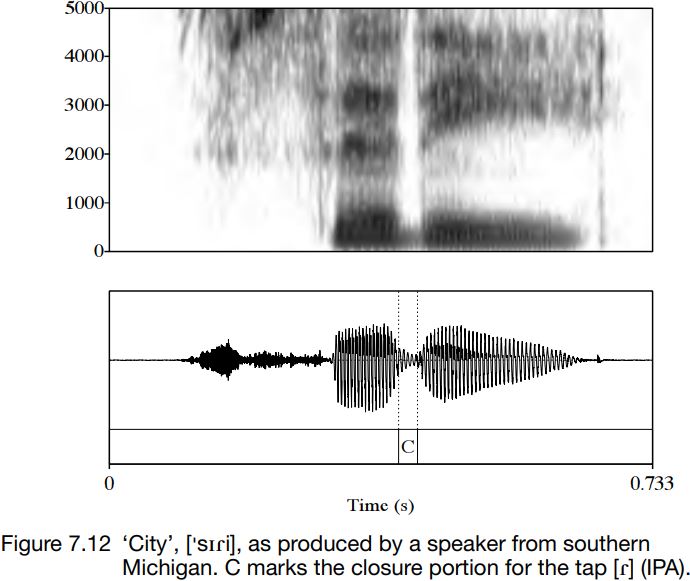
Figure 7.12 shows a production of the word ‘city’,  , by a speaker from southern Michigan. The portion labelled C corresponds to the short closure period characteristic of taps. Notice how short it is (about 25 ms). It is voiced all the way through. Immediately after the labelled portion there is a transient which corresponds to the release of the tongue.
There are many pairs of words distinguished by [t] and [d] which sound very alike or even identical when pronounced with taps: ‘writer’ and ‘rider’ ( ) are well-known cases. Sometimes, however, the distinction is still made through e.g. vowel duration (longer duration in [t/ɾ] words) and vowel quality (for example, Canadian speakers use
  in ‘rider’, but
  in ‘writer’). This loss of distinction between originally different words has given rise to some interesting ‘eggcorns’ – words which are misheard and then given peculiar spellings. (‘Eggcorn’ is an eggcorn from ‘acorn’.) Examples arising from confusion over [t/d] include: ‘Catillac’, ‘radify’, ‘color-coated’, and ‘don’t know X from atom’. (See eggcorns.lascribe.net for more.)
Here are some taps as produced by Anglo-English speakers in unscripted conversation in places where [t] might also be expected:
(4) VT 020104
a little bi[ɾ] of acid
I’ve go[ɾ]a go by my husband’s opinion
e[ɾ] it cool
I think I know wha[ɾ] i[ɾ] is
i[ɾ] is del:icious
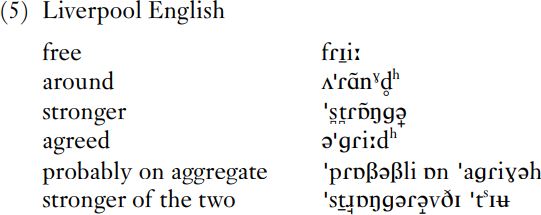
Taps occur in conservative varieties of Anglo-English as one form of rhotic. They are commonly heard in old British black-and-white films where the actors speak RP. Taps also occur dialectally in England as tokens of rhotics, e.g. in many parts of Yorkshire and Liverpool. Many speakers who do not normally produce  as a tap use a voiceless tap in the cluster
  , as in ‘three’.
Here are some narrow transcriptions of words with taps in Liverpool English (Scouse) (Watson 2007). Scouse is known for its open articulations, of which there are many here, including aspiration for [d] in ‘around’.
 الاكثر قراءة في Phonetics
 اخر الاخبار
اخبار العتبة العباسية المقدسة

الآخبار الصحية


مواضيع ذات صلة
 قسم الشؤون الفكرية يصدر كتاباً يوثق تاريخ السدانة في العتبة العباسية المقدسة
 "المهمة".. إصدار قصصي يوثّق القصص الفائزة في مسابقة فتوى الدفاع المقدسة للقصة القصيرة
 (نوافذ).. إصدار أدبي يوثق القصص الفائزة في مسابقة الإمام العسكري (عليه السلام)