Grammar
Tenses
Present

Present Simple
Present Continuous
Present Perfect
Present Perfect Continuous
Past
Past Simple
Past Continuous
Past Perfect
Past Perfect Continuous
Future
Future Simple
Future Continuous
Future Perfect
Future Perfect Continuous
Parts Of Speech
Nouns
Countable and uncountable nouns
Verbal nouns
Singular and Plural nouns
Proper nouns
Nouns gender
Nouns definition
Concrete nouns
Abstract nouns
Common nouns
Collective nouns
Definition Of Nouns
Animate and Inanimate nouns
Nouns
Verbs
Stative and dynamic verbs
Finite and nonfinite verbs
To be verbs
Transitive and intransitive verbs
Auxiliary verbs
Modal verbs
Regular and irregular verbs
Action verbs
Verbs
Adverbs
Relative adverbs
Interrogative adverbs
Adverbs of time
Adverbs of place
Adverbs of reason
Adverbs of quantity
Adverbs of manner
Adverbs of frequency
Adverbs of affirmation
Adverbs
Adjectives
Quantitative adjective
Proper adjective
Possessive adjective
Numeral adjective
Interrogative adjective
Distributive adjective
Descriptive adjective
Demonstrative adjective
Pronouns
Subject pronoun
Relative pronoun
Reflexive pronoun
Reciprocal pronoun
Possessive pronoun
Personal pronoun
Interrogative pronoun
Indefinite pronoun
Emphatic pronoun
Distributive pronoun
Demonstrative pronoun
Pronouns
Pre Position
Preposition by function
Time preposition
Reason preposition
Possession preposition
Place preposition
Phrases preposition
Origin preposition
Measure preposition
Direction preposition
Contrast preposition
Agent preposition
Preposition by construction
Simple preposition
Phrase preposition
Double preposition
Compound preposition
prepositions
Conjunctions
Subordinating conjunction
Correlative conjunction
Coordinating conjunction
Conjunctive adverbs
conjunctions
Interjections
Express calling interjection
Phrases
Sentences
Grammar Rules
Passive and Active
Preference
Requests and offers
wishes
Be used to
Some and any
Could have done
Describing people
Giving advices
Possession
Comparative and superlative
Giving Reason
Making Suggestions
Apologizing
Forming questions
Since and for
Directions
Obligation
Adverbials
invitation
Articles
Imaginary condition
Zero conditional
First conditional
Second conditional
Third conditional
Reported speech
Demonstratives
Determiners
Linguistics
Phonetics
Phonology
Linguistics fields
Syntax
Morphology
Semantics
pragmatics
History
Writing
Grammar
Phonetics and Phonology
Semiotics
Reading Comprehension
Elementary
Intermediate
Advanced
Teaching Methods
Teaching Strategies
Assessment

Fricative release
 المؤلف:
Richard Ogden
المؤلف:
Richard Ogden
 المصدر:
An Introduction to English Phonetics
المصدر:
An Introduction to English Phonetics
 الجزء والصفحة:
110-7
الجزء والصفحة:
110-7
 13-7-2022
 1433
1433




+
-
20
Fricative release
Plosives can be released into friction which is generated immediately on release. In this case, the two articulators are separated only so far as to generate a stricture of close approximation, causing friction on release. This friction is homorganic with the plosive, i.e. it is made at the same place of articulation. The friction can be long or short in duration.
Combinations of plosive + long fricative release are commonly known as ‘affricates’. English has two clear instances of affricates, [tʃ] and  . These are clear cases because they both pattern phonologically as one unit. They occur both syllable initially and syllable finally. For both, the coronal closure is postalveolar, and the tongue shape is the one required for [ʃ] and
  . (See the production of fricatives.) More narrowly, then, they can be transcribed as
  .
.
The release of the plosive portion is immediately into friction. The best way to realize the difference is to take a pair where there is a sequence of [t] + [ʃ] vs. an affricate [tʃ], such as ‘why choose/white shoes’, ‘to buy chews/to bite shoes’. In the cases with affricate [tʃ], the first word ends with an open articulation, and the second begins with an affricate; in cases with [t+ʃ], the first word ends with an alveolar closure and the second starts with a fricative. The closure is longer in the [t + ʃ] sequences than in the [-tʃ-] cases. The tongue shape on release is flatter in the [t + ʃ] sequences, whereas in the [-tʃ-] cases it has the appropriate shape for generating postalveolar friction. The closure is also a little further back for the affricate [tʃ]. These many small details reveal some of the subtle phonetic distinctions that can be made to differentiate what on paper at least look like potentially homophonous sequences.
Other common affricate sequences in English are [t ɹ‑ d ɹ]. [t ɹ‑] occurs syllable initially, e.g. in ‘tree, tram, true’. The plosive part, [t ], involves a postalveolar closure with a tongue shape appropriate for a [ɹ] sound: the tongue is somewhat curled back, the sides make a tight contact with the teeth, and the tongue back is raised. It can be classed as an affricate because the release part, [ɹ‑], involves friction caused by the curling back of the tongue. There may also be a narrow channel down the tongue, causing some degree of whistling on release.
 is the voiced equivalent of
  . As a voiced sound, it has weaker friction than
  .
.
 and
and  are distinguishable from sequences of [t+r] and [d+r] because they only occur syllable initially. If you compare pairs such as ‘a tree’,
  vs. ‘at Reeth’,
  , then you should notice several differences between them (Table 7.2).
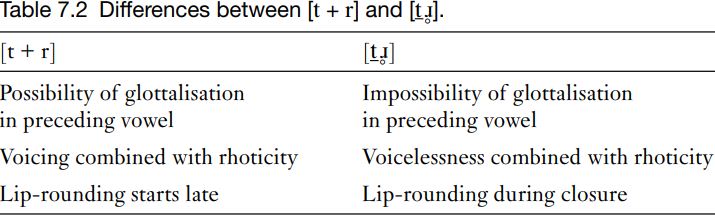
We turn now to plosives with short periods of friction on release. We will transcribe these with a small superscript symbol for the frication portion.
Initial [ð] can often be pronounced as  , especially when utterance initial. Many function words (which are commonly phrase initial), such as ‘the, this, that, those, they’, start with this sound.
Below are three examples of  . G speaks a dialect from the West Midlands of England (around Birmingham); W’s variety is from the north west of England.
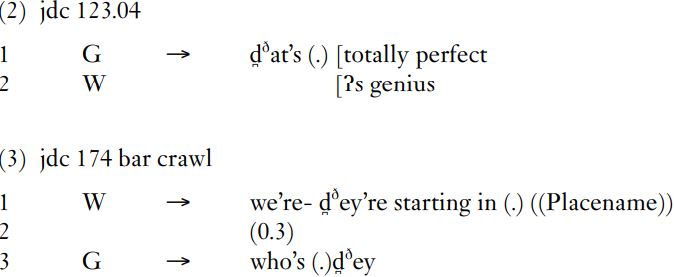
Plosives released with short periods of friction are common in English. Most speakers have some degree of frication in their release of the closure for [t], giving a sound which is sometimes transcribed as  . In Edinburgh (Chirrey, in Foulkes and Docherty 1999: 227), fricated releases for word-final plosives are reported, as in
  , ‘take, food’, respectively.
 الاكثر قراءة في Phonetics
 اخر الاخبار
اخبار العتبة العباسية المقدسة

الآخبار الصحية


مواضيع ذات صلة
 قسم الشؤون الفكرية يصدر كتاباً يوثق تاريخ السدانة في العتبة العباسية المقدسة
 "المهمة".. إصدار قصصي يوثّق القصص الفائزة في مسابقة فتوى الدفاع المقدسة للقصة القصيرة
 (نوافذ).. إصدار أدبي يوثق القصص الفائزة في مسابقة الإمام العسكري (عليه السلام)